Manor, a small town in Texas a few miles from Austin, has become an unlikely star player in the new world of “Government 2.0.” This week Manor and GovFresh, an organization that provides news and information about technology innovation in government, joined forces to host a conference on “big ideas for local America.” The conference highlighted the work Manor, nearby DeLeon, and other small governments in the U.S. are doing to incorporate social media and open data approaches to provide better information and services to citizens, and to engage them more effectively. This is part of an open government trend that’s been brewing since the 1990s, but is catching fire with pervasive Internet adoption and digital convergence.
The field of knowledge management includes a wide variety of components and disciplines. Here is a list of 25 specialties practiced by those in the field, followed by Tara Pangakis list of 50 KM components across people, processes, and technologies.
Sharing, culture, organizational design, and change management
Innovation, invention, creativity, and idea generation
Reuse, proven practices, and lessons learned
Collaboration and communities
Learning, development, and training
Goals, measurements, incentives, and rewards
Social networks, organizational networks, value networks, and network analysis
One is gradually ending. This is the cyclical recession, we have them all the time, they come and they go. Not fun, but not permanent.
The other one, I fear, is here forever. This is the recession of the industrial age, the receding wave of bounty that workers and businesses got as a result of rising productivity but imperfect market communication.
. . . . . .
The networked revolution is creating huge profits, significant opportunities and a lot of change. What it's not doing is providing millions of brain-dead, corner office, follow-the-manual middle class jobs. And it's not going to.
Fast, smart and flexible are embraced by the network. Linchpin behavior. People and companies we can't live without (because if I can live without you, I'm sure going to try if the alternative is to save money).
The sad irony is that everything we do to prop up the last economy (more obedience, more compliance, cheaper yet average) gets in the way of profiting from this one.
There are differences between “learning” and “education,” but hopefully more people can be inspired to blur the two further than we currently see happening.
Video talks Sir Ken Robinson: school kills creativity
Sir Ken Robinson makes the case for a radical shift from standardized schools to personalized learning — creating conditions where kids’ natural talents can flourish.
Jesse Schell: Visions of the Gamepocalypse (entertaining and fascinating)
Jesse Schell explores the social, cognitive, and technological trends in computer game design and use.
September 21, 2010, NEW YORK CITY — Omidyar Network today announced it will dedicate $55 million to fund technology investments that provide people around the world with information, tools and services that improve their quality of life. The philanthropic investment firm pledged $30 million to progress government transparency and $25 million in support of mobile innovation benefitting people in emerging markets. The announcement was made at the Clinton Global Initiative (CGI) annual meeting in New York City.
“We are at the cusp of understanding technology’s potential for creating positive change in the world,” said Matt Bannick, managing partner, Omidyar Network. “Through these commitments, Omidyar Network will support technologies that provide citizens with information and insight about their government, and fund mobile platforms that reach new markets with life-changing services.”
Each of Omidyar Network’s CGI commitments will be fulfilled over the next three years, and include both for-profit investments and nonprofit grants.
Technology for Transparency: Omidyar Network will invest $30 million to advance government transparency both domestically and abroad. To fulfill the commitment, Omidyar Network will identify and support organizations that use technology to provide access to information and tools necessary for citizens to participate in the governing process and shape outcomes important to them. This effort was created on the belief that open access to information and transparent systems increase the public's knowledge of government activities, leading to a more informed and engaged society that can hold its officials accountable. This new commitment expands Omidyar Network’s government transparency work, which to date has provided support to organizations such as the Sunlight Foundation, mySociety, and Global Integrity.
Opportunity through Mobile: Omidyar Network’s second CGI commitment sets aside $25 million to harness the power of mobile technology in emerging markets. Omidyar Network will back innovative entrepreneurs who use mobile platforms to connect people with vital resources in areas such as financial services and banking, health care, agriculture, commerce, and education. Across these sectors, Omidyar Network will invest in mobile technologies that break new ground in improving access to services, reaching underserved populations, and driving large-scale social impact. This new commitment builds on Omidyar Network’s experience supporting mobile initiatives at organizations such as FrontlineSMS, Ushahidi, and Opportunity International.
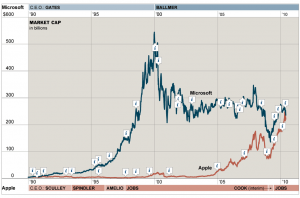
Phi Beta Iota: Industry colleagues point out that Ballmer took over at the top while Jobs came back in at the bottom. Our own view is that a convergence is occurring that will be settled between the personal device and the cloud–who comes up with the most secure reliable personal device (e.g. an eye-screen with earpiece/mike and voice or virtual keyboard or pointer) and the most global affordable mix of call centers, intelligence centers, and M4IS2 softwares, services, and sense-making within the cloud. Google and Oracle and IBM (and their Brazilian, Chinese, and Russian counterparts) are on the same court, but none of them are truly focused on the end game: a World Brain with a Global Game in which we connect all humans to all information in all languages….an open self-organizing world in which profit comes from cost avoidance, truth, reconciliation, and non-zero outcomes.
Only 500 generations ago, hunter-gatherers began cultivating crops and forming their tiny communities into social hierarchies. Around 15 to 20 generations ago, industrial capitalism erupted on a global scale.
In the last generation, the entire human species, along with virtually all other species and indeed the entire planet, have been thrown into a series of crises, which many believe threaten to converge in global catastrophe: global warming spiraling out of control; oil prices fluctuating wildly; food riots breaking out in the South; banks collapsing worldwide; the spectre of terror bombings in major cities; and the promise of ‘endless war’ to fight ‘violent extremists’ at home and abroad.
Amazon Page
We are running out of time.
Phi Beta Iota: The entire article is a distillation of the author's new book, now at Amazon UK and soon at Amazon US. The article ends with a sensible coherent list of “must do's” that should be–but are not–understood by one and all.
Dr. Ahmed is interviewed on the BBC World News here.