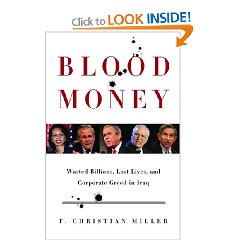
Review: Blood Money–Wasted Billions, Lost Lives, and Corporate Greed in Iraq

5 Star, Empire, Sorrows, Hubris, Blowback, Executive (Partisan Failure, Reform), Insurgency & Revolution, Intelligence (Government/Secret), Iraq, War & Face of Battle

Amazon Page
Amazon Page

Shocking, Read with “Squandered Victory”,

September 8, 2006
T. Christian Miller
This is a definite five star piece of work that approaches our failures in Iraq from a different perspective, and hence should be read with, Squandered Victory: The American Occupation and the Bungled Effort to Bring Democracy to Iraq. It goes beyond Squandered Victory, which creates outrage over incompetence, and actually turns one's stomach with disgust toward the end.

The book starts with a very useful timeline of events, and the opening premise that Paul Wolfowitz was wrong on virtually every promise and claim made to Congress.

The author's strategic view, threaded throughout the book, is that the U.S. effort in Iraq never had coherent “supreme commander” type leadership, that virtually all elements (U.S. Army and U.S. Marines excepted) lacked both intelligence and integrity, and that this was one of the most incompetent, ignorant occupations in the history of mankind. He does seem to avoid pointing out that Rumsfeld demanded complete military control of the country, relegated the diplomats to the back room, and did not even tell Bremer for a year that there was a diplomatic plan for nation-building. This is on Rumsfeld and Bremer. History will judge them harshly.

The author documents that the US Government knew in advance that there was no plan for the peace (the State Department efforts not-withstanding) and no way of creating an effective plan.

The author is powerful in showing that “shock and awe” warfare made the transition to peace virtually impossible. 17 out of 21 Ministry headquarters buildings were completely destroyed (and then the occupying force allowed for the looting of all offices, all museums, all universities, and all stockpiles of ammunition and explosives needed for the Improvised Explosive Devices (IED) that have killed so many of our troops. The oil infrastructure was not protected, was completely looted, and this lost the chance for paying anything with oil in the early years.

Immortal quote on page 40: “…a circus, a Looney Tunes version of government, hatched on the fly, delivered at random, and operating without instruction.”

Reconstruction cost estimate: $2.4 billion. Actual cost: $30 billion and rising. Results after several years: less than 10% of the needed work. Money unaccounted for: $18 billion.

The author differs from those who supported sanctions in pointing out that the sanctions virtually destroyed Iraq's health system.

Psychologically, the author suggests that the months of lip service to freedom and reconstruction raised hopes that were then dashed. One is reminded of the Davies J-Curve from the 1970's–revolutions occur not among the oppressed, but among those who have been shown the prospect of freedom and prosperity, and then had it taken out of their grasp.

On contracting, one's stomach turns with every page. Cost plus, no incentive to save; U.S. companies doing for millions what Iraqi companies would do for tens of thousands; U.S. contractors earning $60K and more, foreign laborers imported for $3000 a year. The author specifically quotes contractors as saying they knew they could steal the process blind in the first year, which would be “open season.”

I consider this book to be the eventual final nail in the coffin of the Private Military Contractors. The author documents how the military's very unwise reliance on private contractors for combat zone logistics led to a need for private contractors to provide security, to the point that 22% of the reconstruction dollars are going toward Private Military Corporations (PMC).

My global reading program suggests that the Bush-Cheney Administration will go down in history as having pulled off the most blatant program of planned lies to the public, Congress, and the United Nations, and the most blatant slight of hand in switching the burden from a properly staffed military command to a war-profiteering mélange of PMCs. There is no question in my mind but that we need to eliminate PMCs along with Transnational Organized Crime (TOC) in the future, and we need to properly fund four forces after next: big war force, small war and gendarme force, peace force, and homeland security force. The US military today is a Cadillac built for the superhighway, when we need 10 jeeps, 100 motorcycles, and 1000 bicycles.

The author condemns both the U.S. Government in all its parts, and the PMCs in all their parts, for issuing frantic and confused orders and never really getting their act together. This book is the obituary for Donald Rumsfeld, Paul Wolfowitz, and Paul Bremmer, among others.

EDIT of 10 Dec 07: Since then war crimes of contractors have become an issue, see Licensed to Kill: Hired Guns in the War on Terror and varied media stories.

Vote on Review
Vote on Review

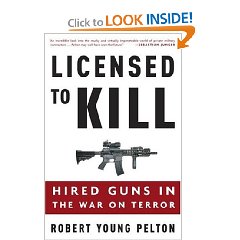
Review: Licensed to Kill–Hired Guns in the War on Terror (Hardcover)

5 Star, Empire, Sorrows, Hubris, Blowback, Iraq, War & Face of Battle

Amazon Page
Amazon Page

THE Reference on Private Military Contractors and Those Who Hire or Fear Them,

August 29, 2006
Robert Young Pelton
I was the guy that did the threat study that put private military contractors on the official targeting list for the US Government, establishing them as legitimate targets who needed to be understood by all available (secret and open) means as either belligerents or at least relevant actors in any situation.

Robert Young Pelton, whom I know personally and admire as one of the most honest, courageous, and mature investigative journalists and adventurers (see my review of his Robert Young Pelton's The World's Most Dangerous Places: 5th Edition (Robert Young Pelton the World's Most Dangerous Places), is without question the best reporter and observer in the world of the “dogs of war.” He ranks up with and above Robert Kaplan, Seymour Hersh, and John Fialka, three intrepid and intellectual reporters who help define the extraordinary talents and veracity of this author, Robert Young Pelton.

When I received his book I dropped everything and offer here a few of the highlights:

He distinguishes carefully between Mercenaries (soldiers for hire) and Private Military Contractors (PMC) who are security for hire.

Blackwater, the best of the (PMC can train 35,000 men in a year, and delivers a lighter, faster, smaller (and more effective) security force than the U.S. Army.

He recounts the history of CIA money into Special Operations Forces (SOF) black operations, which in turn created PMCs. Just as CIA funded the jihad in Afghanistan, so also has it funded–perhaps ignorantly in both cases–the emergence of the PMCs.

Telling early story: before 9/11, lawyers reduced CIA and other action elements of the US Government to wimpy toast. It took 9/11 to frost the lawyers and unleash the real men in the USG and elsewhere.

EDIT: Prior to 9/11, the lawyers were piss-ants such as those who advised the ABLE DANGER team to destroy evidence discovered pre 9-11 of two hijackers, instead of turning it over to the FBI. CIA lawyers, with a couple of exceptions, are also piss-ants. Real men include the guys that went into Afghanistan (see my reviews of Jawbreaker: The Attack on Bin Laden and Al-Qaeda: A Personal Account by the CIA's Key Field Commander and First In: An Insider's Account of How the CIA Spearheaded the War on Terror in Afghanistan), and the guys at US Special Operations Command who are on their own all over the world. I never imagined that NSA and CIA would simply turn the lawyers off and violate ALL of our civil liberties, including warrantless wiretapping and rendition (kidnapping to export for torture) and the denial of habeas corpus to US and UK and Australian citizens, among others.

His overall account makes it clear that the new breed of PMC warrior is better in all respects (stronger, faster, smarter, better shot, more tech savvy) than the past SOF heroes, but FAILS in one important respect: tactical combat decision-making. He explains that communications has robbed the field men of all initiative, and they are now nothing more than risk takers for fat-assed pasty-faced Rear Echelon Mother Fryers (REMF) with too much rank, too much air conditioning, and not enough character to make it in the field.

This book will be, for some time, the basic reference for those who wish to be PMCs, manage PMCs, or employ PMC companies. On the one hand, he documents the rates and the profits ($500 a day per man, billed at $1500 a day per man, with $500 for overhead and $500 for profit PER DAY), but he also points out that at 24/7 ops tempo, this can come out to $25 an hour, or worse. He points out that SOF and other skilled uniformed professionals earn $50K a year, while PMCs can earn $200K a year–the contrast explains why SOF is hemorrhaging personnel. He discussed the 90 days on, 30 days off, but also notes that a third of the candidates do not make the grade in training, while half of those who are sent to the field do not make the grade under combat conditions and are Ordered Home.

In passing he notes that CIA tends to stink at local level relations, throwing money at locals to get intelligence, which is consequently generally bad and useless.

He also warns those who receive USG funded PMCs that as was the case in Haiti, the withdrawal of US funding for PMC security can be capricious and sudden.

He related the rise of the PMC to the political desire in the US of limiting the uniformed head counts in combat conditions, and this in turn not only supports PMCs with guns instead of uniformed military with guns, but also turning over all logistics to PMCs, some of which are unrealizable (and thus leave our troops without water and food and shower points in the clinch).

The book adds further to the documented view of Paul Bremer as a dictator no better than Saddam Hussein (who at least provided electricity and water and stability).

This thoughtful study notes that the Rules of Engagement (ROE) have not been well developed for PMCs, and that the seam between PMCs and the US military and the US Department of State are thoroughly screwed up to non-existent.

He notes that in addition to Iraqi disdain for Paul Bremer, there is acute Iraqi consciousness for the fact that in Iraq, PMCs are the top of the food chain and have everything, including jobs, which Iraqis have not received in the so-called “peace.”

This author and this book SMASHES both the Rolling Stone article on “Heavy Metal Mercenaries” and the self-promoting and largely false book The Hunt for Bin Laden: Task Force Dagger.

Passing comments document the different “tribes” in the PMC world, the fact that many PMCs are paying their US citizens with offshore accounts that evade taxes, that laptops not guns are the focus for many individuals (their lifeline to family and reality), that London is the center of gravity for PMC activity, that over 400 PMCs have been killed in Iraq (contract this with 2,500 from US military), and that the bottom line for PMCs is that they are largely ethical, moral, professional, and committed.

I especially liked the author's closing contrast between the British PMC model “it's about minimum force, Old Boy” and the US model, “high tech max force” approach.

Immortal quote on page 227: “The post 9/11 world opened up a Pandora's box of prospects for adventurers, conmen, and opportunists….”

I will end with three points the author brings out:

1) PMC Blackwater is smart, focused on the bomb makers not the bomb deliverers.

2) Everybody is making money in Iraq (that is a US citizen) EXCEPT the US uniformed soldiers actually fighting the war.

3) PMCs are, like guns, something that can be used for good or bad.

Robert Young Pelton is extraordinary, and this book is the cutting edge of reality: PMCs. He is unique for his preparation and for walking in the PMC shoes.

Vote on Review
Vote on Review

Review: 101 Ways to Help Birds (Paperback)

5 Star, Nature, Diet, Memetics, Design

Amazon Page
Amazon Page

Useful, Easy to Read, Great Gift, Makes a Difference,

August 16, 2006
Laura Erickson
I bought this as a gift for my wife, who just qualified our backyard as a National Wildlife Habitat. It is sensibly organized in five parts:

Part I: Helping Birds at Home

Part II: Enhancing the Natural Habitat of Your Backyard

Part III: Supplementing Backyard Habitat

Part IV: Helping Birds Away from Home

Part V: Helping Birds on a Larger Scale

As experienced bird lovers and supporters, I can readily say that there is a great deal in this book that I was unaware of. Parts III and IV were most interesting to me, and Part V I had never really thought about. If birds are the “canary in the coal mine” for the Earth, then this book, as other reviewers have suggested, of larger importance, but for me, it is quite simply a wonderful selection of 101 useful easy to read ideas that can make a difference.

Vote on Review
Vote on Review

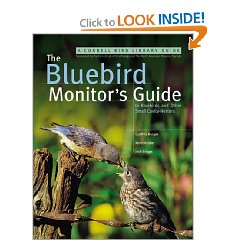
Review: The Bluebird Monitor’s Guide to Bluebirds and Other Small Cavity Nesters (Paperback)

5 Star, Nature, Diet, Memetics, Design

Amazon Page
Amazon Page

The Single Best Book on Bluebirds,

August 16, 2006
Jack Griggs
We have so many bird books my wife routinely says “don't get me another bird book,” but this one made the grade. It is absolutely riveting and held me spell-bound in the bookstore.

We were devastated when a late frost wiped out the bluebird population for miles around. It took three years for them to recover.

For all of our experience with blue birds, our favorite, this book is world-class in three ways:

1) The photographs cover the hard to see inside the next information in a brilliant manner. This is one of the finest collection of photographs in support of text I have ever seen.

2) The monitoring aspect was new to us, and very interesting to understand.

3) The hardware section is really well put together and illustrated, and taught me that there are humane ways to deal with sparrows and others. Our solution works as well: we provide five boxes around the property, and this seems to have worked well in ensuring that our bluebirds get first choice and then everyone else has options.

Good index. I have been through the book several times now, and each time I find something new.

Vote on Review
Vote on Review

Review: Complete Official Mgb Model Years 1962-1974: Comprising the Official Driver’s Handbook, Workshop Manual, Special Tuning Manual (Paperback)

5 Star

Amazon Page
Amazon Page

Not the Same As Hayes Manual, Adds to the Library,

August 14, 2006
British Leyland Motors
MGB Automotive Repair Manual: All Models of the MGB Roadster and GT Coupe With 1798 CC (110 cu in Engine) (Haynes Manuals) by John Haynes is still the world-class best.

This book is bigger, heavier, more white space, larger print, better diagrams and illustrations, and for all those reasons, it adds to the library.

The “Driver's Handbook” is 22 pages of really basic stuff, while the special tuning manual appears to be more or less a restatement of the calibration data for the car.

If I could only afford to buy one book, I would not buy this, and would go instead with the Haynes Manual. If money is not an issue, I would buy this book fourth in line, after Haynes, “The MGB Restoration Manual” by Porter which dramatically enhances Haynes on points of restoration, and “Original MGB C-V8 Compl: The Complete Guide to All Roadster and GT Models (Original Series)” by Anders Ditlev Clausager which is a dramatic color photo compilation of what perfect looks like.

Vote on Review
Vote on Review

Review: American Gospel–God, the Founding Fathers, and the Making of a Nation (Hardcover)

5 Star, Religion & Politics of Religion

Amazon Page
Amazon Page

Read with Three Other Books (Or My Reviews of All Four),

August 13, 2006
Jon Meacham
I bought and read this book as part of a series, with The End of Faith: Religion, Terror, and the Future of Reason being the first book. I recommend both highly. “The End of Faith” depicts the threat to America and the world, while this book is more of a historical treatment of how America has always favored religious tolerance and pluralism, but secular governance. Other interesting books deal with misquoting Jesus and the myths of the Bible. I hope to get to them soon.

This book over all an extraodinarily balanced and vital perspective on the good of religion in American life. It puts extremist ideologies in historical context, and concludes in the final chapter that whenever religions become extremist and exclusive, as have both the extreme right Christian evangelicals in America and the radicalized Muslims around the world; they become a tyranny, and must be fought down at all costs.

This is a history book, but it is vibrant with clear and direct quotations showing how successive Presidents used religion to make important points. The books begins with an explosive characterization of liberty and democracy in relation to freedom of religion, and this sets the stage for the entire book which ends by denouncing religious extremism of any sort.

Immortal quotes:

Page 16. “…the Founders understood the dangers of mixing religious passion with the ambitions of politics.”

Page 17. “If totalitarianism was the great problem of the twentieth century, then extremism is, so far, the great problem of the twenty-first.”

The author, while documenting the need for a separation of church and state, is also careful to note that a shared acceptance of public religion and religiosity in all its forms is very helpful to democracy and essential for civil domestic solidarity.

Two books that are unique and distinct from this one, that I recommend be read in addition to this book and “The End of Faith,” are The Left Hand of God: Taking Back Our Country from the Religious Right and Faith-Based Diplomacy: Trumping Realpolitik The four together frame the power of religion in this century, for both good and bad.

The author is quite clear in stating that religions become a problem when their practitioners demand conversion to their own faith, or denigrate all who are not of their faith as unbelievers subject to genocide, confiscation of goods or–as the more rabid Jews taught me in college, full licenses to rape and dishonor, since “chicksas” or gentile girls are “free game.”

This book is the single best authoritative documentation for the hard fact that America was founded as a secular Nation providing for religious tolerance, and it is especially strong in pointing out that Judaism and other religions, including Islam, were present in the early years and America is NOT, per se, a Christian Nation in its founding roots.

The author documents how the Constitution and the intent of the Founders specifically forbade any religious requirements or qualification for holding public office.

On page 93 the author discusses how the Founding Father explicitly favored and sought a diversity of churches and faiths to reduce the possibility of any one faith “coming to play too large a role in politics,” (something I believe we can all see has hurt America gravely as the extremist religious right has trashed civil liberties at home and the Nation of Iraq as a whole–never mind global rendition and torture and a refusal to respect the Geneva Convention.

The author concludes that the USA and radicalized Islam are indeed on a collision course, of pluralism versus monotheism, but a careful reading of the book suggests that we must first heal ourselves internally and stamp down the extremist religious right (I am a moderate Republican who segued from Catholicism to high Episcopal to Methodist via two marriages).

The book includes ten extraordinary appendices and one excellent compilation of Presidential scripture citations up through President Eisenhower (I recommend the DVD on “Why We Fight” to better understand the pernicious effects of faith-based decisions to go to war that ignore all facts and evidence).

This is a serious book. Religion is going to be, as the author documents, a key factor in whether we prosper or implode in the 21st Century. For that reason alone, I strongly recommend all four of the books I have cited above, including this one.

Vote on Review
Vote on Review

Review DVD: Why We Fight (2006)

5 Star, Military & Pentagon Power, Reviews (DVD Only)

Amazon Page
Amazon Page

Foundation Film With Fog of War, Wal-Mart, and The Corporation,

August 11, 2006
Gore Vidal
This is a foundation film, a foundation for citizens restoring power to the people and removing it from the corporations. Other films that complement this one are the Fog of War (documentary with McNamara), the Wal-Mart video, and “The Corporation” on how corporations use their “legal personality” to keep their managers immune from accountabiity.

High points of this video:

1) General and President Eisenhower's son says on camara that his dad told him he wished we had never invented the nuclear bomb, when Truman used it it made him feel “low.”

2) Growing gap between the elite and the public. Still a general assumption by the public that the govenrment knows more than they do about the reasons for going to war.

3) Too many accept the premise that democracy can be imposed at gunpoint, and do not realize (see my review of book “The End of Faith”) that religious fanatism must be repressed before secular democracy can be adopted.

4) Huge segment on how the draft was our best defense against being manipulated, how the volunteer Army makes it possible for the elite to use the military for the wrong reasons while lying to the public.

5) Good references to how the rest of the world sees us as practicing economic colonialism combined with unilateral militarism.

6) Oil, oil, oil and lies, lies, lies.

7) Elite lesson from Viet-Nam was that death cannot be seen in US living rooms. The embedded media, far from being more useful is being distracted at the tactical level, and kept from focusing on the strategic question of “is this war necessary?”

8) Senator Byrd is featured as the lone adult voice against the war. Congress is widely perceived as having failed in every possible way because it is both beholden to the military-industrial complex and its bribes, and has (see my review of book “The Broken Branch”) abdicated its role as the “first” branch of government and accepted a subordinate role as “footsoldiers of the President.”

9) Perhaps most useful, as more and more voices call for the impeachment of Bush and Cheney, is the clips of the lies told to us on television by Bush, Cheney, Rumsfeld, and Rice, interspersed with interviews of military and other intelligence analysts who now can speak of the truth as it was known then. This DVD could be “Exhibit A” in any impeachment trial.

10) Hottest quote: “A terrible thing when Americans can't trust their President….the government exploited (my emotions and trust after 9/11)”.

11) Those interviews believe that we had no exit strategy from Iraq precisely because Cheney and Rumsfeld did not plan to leave, and they cite as proof the fact that 14 permanent installations have been built in Iraq, instead of the reconstruction and stabilization of the civil sector that would normally be the priority in an exit strategy.

This is a compelling objective film. Those who demean it by associating it with the Oliver Stone JFK conspiracy documentary are doing Amazon readers and the DVD a great dis-service.

Vote on Review
Vote on Review
noble gold