Review: A Sustainable Economy for the 21st Century (Open Media Pamphlet Series, 7)

5 Star, Economics, Survival & Sustainment

Amazon Page
Amazon Page

5.0 out of 5 stars Primer on Key Issues for Next and Future Elections,

March 28, 2002
Juliet Schor
I am just blown away by the quality and utility of the Open Media Pamphlet Series, which brings very high-value thinking to the people in a very low-cost and easy to understand format.Juliet Schor, author of two books on related topics, and a lecturer at Harvard since 1984, does a lovely job, in 64 pages, of hitting on the key issues that voters must address as they move forward in taking back the power from political parties now held hostage by corporations.

Her reasoned and logical discussion of basic premises (sustainability, democractic control, egalitarianism), of key issues in the relations between workers and their corporate employers, of how to achieve environmental as well as social balance, and of the larger global issues including needed changes in federal law, provide the single best primer I have ever seen for anyone–at any level of understanding–who wishes to invest time in understanding what needs to be done to protect future generations who have no one to represent them other than the people.

Vote on Review
Vote on Review

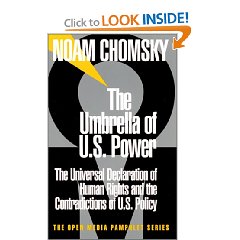
Review: The Umbrella of U.S. Power–The Universal Declaration of Human Rights and the Contradictions of U.S. Policy

5 Star, Empire, Sorrows, Hubris, Blowback

Amazon Page
Amazon Page

5.0 out of 5 stars Big Money Buys Poverty and Kills, Citizens Being Looted,

March 10, 2002
Noam Chomsky
This is one of Noam Chomsky's most interesting pamphlets (actually a quarter-size booklet of 78 pages). It has a special relevance and importance to citizens in the aftermath of 9-11 because he directly links our corporate criminality (“Justice Department estimates the cost of corporate crime as 7 to 25 times as high as street crime”) to our national policies against human rights (poverty pays, for the corporate class that strives to liquidate Third World nations in their predatory roving of the planet).He pointedly identifies the U.S. arms industry as being among the worst violators, but even more importantly, points out that U.S. policies favoring our arms dealers are opposed by 96% of the U.S. population. While that number might be high, I believe there is no question but that Washington is being instructed by corporations rather than its citizens on this vital point of policy. It is time for citizens to take the power back.

Chomsky notes that in 1996 the World Health Organization characterized extreme poverty as the world's most ruthless killer and the greatest cause of suffering on earth. This ties in with the United Nations finding that human suffering is now a legitimate basis for intervention, and with George Soro's observation in The Washington Post of 24 February 2002, that “We can't be successful in fighting terrorism, unless we fight that other axis of evil–poverty, disease and ignorance.”

This little gem of a book also includes well-footnoted observations about how nations seek to carry out trade negotiations in secrecy, in part because they are agreeing to overlook if not actively participate in the looting of poor countries as a condition for prosperous trade among the already developed nations.

The book begins and ends with thoughts from Chomsky on the intellectual discipline he founded, the relationship between linguistics, ethics, and action. He begins with pointed observations on how the most horrible crimes are allowed to go without comment because of *self* censorship, and ends by noting that our citizens do not need to be forbidden to speak of these monstrous deeds that our corporations and government are secretly agreeing to perpetuate, because we have chosen to remain ignorant and silent.

U.S. policy today is *not* founded on moral values, and it is *not* representative of the will of the people in so far as it is carried out in secret collaboration with major corporations and in opposition to the minimal mandatory needs of developing nations for water, food, disease, and economic security.

This is not about political ideology–Ralph Nader, the ultimate spoiler, has one thing right: the parties are irrelevant, this is now about the people versus the corporations. Absent a huge popular turn-out *prior* to each election, to make it clear to candidates that they will be held accountable by the people for keeping all trade and other negotiations in the public domain, and for voting on issues mindful of the will of the people rather than their corporate Enron-like paymasters, then we are the ones ultimately responsible for U.S. policy's misdirection.

Vote on Review
Vote on Review

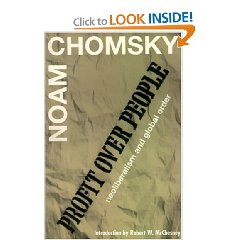
Review: Profit Over People–Neoliberalism & Global Order

5 Star, Capitalism (Good & Bad), Empire, Sorrows, Hubris, Blowback

Amazon Page
Amazon Page

5.0 out of 5 stars Pay Attention or Pay the Price,

March 10, 2002
Noam Chomsky
Edit of 20 Jun 09 to add links (feature not available back then)

This book begins with a very fine introduction by Robert McChesney, who defines neoliberalism as an economic paradigm that leaves a small number of private parties in control and able to maximize their profit (at the expense of the people). He goes on to note that a distracted or apathetic or depoliticized public essentially “goes along” with this, resulting in the loss of community and the rise of consumerism.

Chomsky himself, over the course of 167 pages, points out the damages of neo-liberalism (public abdicating power to corporations), not just to underdeveloped nations and their peoples, but to the American people themselves, who are suffering, today, from a fifteen year decline in education, health, and increased inequality between the richest and the poorest.

Over the course of several chapters, he discusses various U.S. policies, including the U.S. policy of using “security” as a pretext for subsidizing the transfer of taxpayer funds to major arms dealers. The declaration of Cuba as a threat to U.S. national security is one that Mexico could not support–as one of their diplomats explained at the time: “if we publicly declare that Cuba is a threat to our security, forty million Mexicans will die laughing.”

At the end of it all, Chomsky comes down to the simple matter of protecting both civilization and the civilians from their own governments in cahoots with corporations. His observations on the deaths by disease, starvation, and so on, at the same time that billions are being spent on arms which perpetuate the cycles of violence, are relevant. So also are his observations on the dramatic increase in both the extent and the damages caused by increasingly unregulated financial markets. He singles out the Multilateral Agreement on Investment (MAI) as an especially pernicious organization whose machinations are invisible to the public and harmful as well.

I note with interest a review of this book that seeks to call Chomsky a liar, uninformed, and a laughingstock among “serious” scholars. I wish to address that point of view kindly. I can understand, when scholarship consists largely of going through the motions, reading a limited number of works, and answering by rote with the prescribed thought, how so many of our allegedly educated people in business and government are simply socially tuned in. I have myself come to the conclusion that Washington runs on 2% of the available international information (and is largely witless about the 75% or so that is in foreign languages), and I also agree with Howard Bloom's observation in Global Brain: The Evolution of Mass Mind from the Big Bang to the 21st Century, to wit, that half one's brain cells are killed off by the time one is an adult, due to normal biological adjustments to accommodate the prescribed social, cultural, and intellectual parameters that are demanded if one is to “get along.” In that light, I view Chomsky as one of our more important vaccinations against premature stupidity among our loosely-educated adult policymakers. For myself, with considerable reading and a 25-year national security career behind me, I find that while Chomsky is repetitious, he is generally meticulous about foot-noting (something that cannot be said for the lazy authors residing in most think tanks, all of them being paid to think along very specifically prescribed directions).

The bottom line for me is clear: citizens must read and think, or perish from the earth as slaves to those who control money. There is only one thing that matters more than money in this world, and that is the vote. In a representative democracy, the vote can be bought with ease *until* the moment comes when citizens realize that they can combine the use of public sources to reach conclusions (open source intelligence) with self-organization via the Internet, with civil action (cyber-advocacy, street-advocacy, communication and voting) to *take back the power.* It is not terrorism that scares the corporate carpetbaggers, it is something much more powerful: thinking citizens willing to spend the time keeping their corporate servants in line.

Chomsky has labored for over fifty years to keep that part of our brain alive that our schools, seeking to train obedient factory workers, have worked so hard to kill. It can be disheartening, to see citizens so freely give up their rights and their powers, but I do believe, that with the The Radical Center: The Future of American Politics (Halstead and Lind), The Cultural Creatives: How 50 Million People Are Changing the World (Rya and Anderson) and other books I have reviewed, there is, without question, a tipping point. The Internet has changed everything-now we need for the people to notice, and act. Chomsky sheds light in a way that no prostituted scholar or preppy business acolyte will respect-but if the workers wish to begin reading for the future salvation of their children's rights, Chomsky is as good a place as any from which to step off into true democracy.

See also:
The Manufacture Of Evil: Ethics, Evolution, and the Industrial System
The Shock Doctrine: The Rise of Disaster Capitalism
Screwed: The Undeclared War Against the Middle Class – And What We Can Do about It (BK Currents (Paperback))
The Working Poor: Invisible in America
The Global Class War: How America's Bipartisan Elite Lost Our Future – and What It Will Take to Win It Back
The Corporation: The Pathological Pursuit of Profit and Power
The People's Business: Controlling Corporations and Restoring Democracy

Vote on Review
Vote on Review

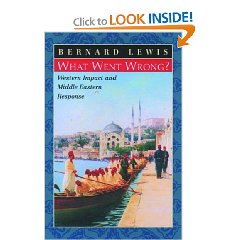
Review: What Went Wrong? Western Impact and Middle Eastern Response

5 Star, Diplomacy, Economics, Empire, Sorrows, Hubris, Blowback, Threats (Emerging & Perennial), Truth & Reconciliation

Amazon Page
Amazon Page

5.0 out of 5 stars Are We Our Brother's Keeper, or Not?,

March 10, 2002
Bernard Lewis
The essence of this book that captured my attention was not the impact of the West on the Middle East, but rather the divergent manner in which the West separated religion from business and government, while the Middle East generally did not. I would point readers toward two other books: Seyyed Vali Reza Nasr, in Islamic Leviathan: Islam and the Making of State Power, has done a fine job of looking at the differing manner in which Malaysia on the one hand, and Pakistan on the other, utilized Islam as a means of legitimizing the state. In the end, both states had to control their fanatics.The other book, by Howard Bloom, Global Brain: the Evolution of Mass Mind from the Big Bang to the 21st Century, adds value to the very educated efforts of Bernard Lewis in this volume, because it points out that culturate training kills half the brain by the time one is an adult. This is serious stuff, to wit: if religion and culture can embed in an entire region the makings for a sustained collapse of social and economic measures needed to achieve stability and a minimalist quality of life for the population, is it safe for us to stand back? Are we to leave them to their own devices? What must we do to ensure that we *share* some common brain concepts and what will it take for both their educational system and ours to “build for peace” from grade one?

These are complex issues, even more challenging that the more tangible issues of intervention in the face of epidemics, gang wars, genocide, and so on. Certainly we cannot intervene with force nor confront our Islamic brothers, but we must ask ourselves: at what point should we consider substantial investments in both Islamic studies and socio-economic, even ideo-cultural and techno-demographic assistance, to the nations of Islam?

Are they our brother, or not? If we are to respect the universal declaration of human rights, and acknowledge that human suffering is justification for intervention, ideally peaceful intervention, then at what point do we create a national capability for responding to these needs in a manner that is both appropriate to the tangible challenge and consistent with the religious challenge?

In my view, this book is most valuable for outlining the depths of the challenge of modernization in a deeply religious region, and rather than ending on a note of “on your own heads be it,” I wonder if we might not better ask, “what do we need to do differently to find a middle road toward modernization, one that can be accepted within the strictures of Islam?”

Vote on Review
Vote on Review

Review: Warfare in the Third World

5 Star, Voices Lost (Indigenous, Gender, Poor, Marginalized), War & Face of Battle

Amazon Page
Amazon Page

5.0 out of 5 stars Highly Original, Well-Documented, Provocative,

March 10, 2002
Robert E. Harkavy
I recently secured from those who study conflict in Europe several recommendations for core readings, and this book was in their top three, along with Monty Marshall's “Third World War” and the edited work, “Human Security and The New Diplomacy.” All three are excellent.This book is most helpful in that it actually studies conflicts in the Third World, and ends up with documented conclusions or in some cases speculations about:

1) why subjective factors including culture sometimes allow the defeat of forces whose numbers, lethality, and wealth would normally be expected to be invincible;

2) how “absorbtion” through training and leadership are at least as important if not more important than the actual provision of arms;

3) how seapower and airpower play out differently in the Third World than in conventional battlegrounds;

4) what lessons might be drawn from the Third World regarding the design and acquisition of weapons technology, both in the offense and in the defense;

5) the critical importance of economic, social, and cultural factors in determining the outcomes of otherwise high-tech wars;

6) the relative absence of decisive victories, making military power relatively meaningless unless it is accompanied by “peace in force” and the follow-on civil affairs, law enforcement, agricultural and other infrastructure, investments; and

7) “pain thresholds” as a critical factor.

While well foot-noted, the book lacks a bibliography and the index is average to below average–not only lacking substance but being hard to read with 8 point font size. These are shortcomings that should be corrected in the next edition. The book is recommended, and should be standard reading in all conflict courses.

Vote on Review
Vote on Review

Review: The Future of Life

5 Star, Environment (Problems), Environment (Solutions), Future

Amazon Page
Amazon Page

5.0 out of 5 stars Practical Manifesto for Preservation of *Value* in Nature,

February 27, 2002
Edward O. Wilson
Whereas the author's last really big book, “Consilience”, addressed the integral relationship between the knowledge offered by the humanities and that of the sciences (too often isolated and out of context), this book brings together political economy and nature.It is more easily readable than his more heavily foot-noted and astonishingly deep earlier work, but all the more valuable for its smooth overview of why life on the rest of the planet matters to the American heartland; why we must deal with the limits of food production and control population (both in terms of numbers and in terms of consumption per capita).

The heart of the book, for me, can be found in three profound numbers–numbers that we must all appreciate:

Value of the Ecosystem/Cost to Replace: $33 trillion per year in increased Gross National Product (GNP)–and presumably everything would be artificially recreated.

One-Time Cost of Fund for Preserving Nature: $24-72 billion one-time funding. His numbers vary from $24 billion (one -time) to preserve 800,000 square kilometers already under protection, to $28 billion to preserve a (different?) representative sample. The bottom line: for a one-time $100 billion investment, 25% of what the US spends on its military *every* year, we could, at our own expense, save the world.

Subsidies for Unsound Acts Against Nature: $2 trillion per year and rising ($2000 per American alone–this refers to energy, water, deforestation, and agricultural subsidies that encourage and perpetuate unsound acts against nature as well as unneeded exploitation–one example: $20 billion a year in subsidies for fishing–this is the difference between the actual value of $100 billion and the lower subsidized revenues of $80 billion a year).

Wilson's book, in combination with those by Brian Czech and L. O. Stromberg, is in my view a capstone endeavor that moves the environment to the forefront of any intelligent person's agenda. As he concludes, we have entered the century of the environment–we must save it or lose it.

Vote on Review
Vote on Review

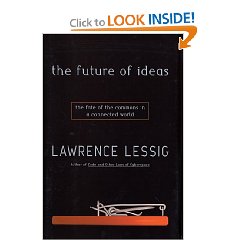
Review: The Future of Ideas–The Fate of the Commons in a Connected World

5 Star, Civil Society, Consciousness & Social IQ, Democracy, Education (General), Future, Information Society

Amazon Page
Amazon Page

5.0 out of 5 stars Public Warning of looting and Destruction of the E-Commons,

February 27, 2002
Lawrence Lessig
I struggled with this book, in part because I really dislike the manner in which the law has been complicated to the point of unreason–beyond the ken of normal people. Having concluded the book, however, I have to say this is really worth the effort. The author is laying bare the raw threats to the future of the electronic commons. He discusses in detail how very specific government policies to sell and control bandwidth, and very specific corporate legal claims being backed by “the people's” lawyers within government, are essentially “fencing” the Internet commons and severely constraining both the rights of the people and the prospects for the future of ideas and innovation.I am not a lawyer and I cannot speak to the points of law, but I am a voter and I can speak to that; what is happening to the Internet through legal machinations that are largely invisible to the people is a travesty, a crime against humanity even if permissible by law, and perhaps grounds for a public uprising demanding the recall of any official that permits and perpetuates the theft of the commons by corporations and their lawyers.

In the aftermath of 9-11, when our secret national intelligence and counterintelligence capabilities failed us, there is a need for a restoration of the people's intelligence in the aggregate as our first line of defense against enemies both foreign and domestic. I regard this book as a very serious, thoughtful, and well-intentioned “public intelligence estimate” and warning, of the harm to our security and prosperity that will ensue from a legal system that is now “out of control” and not being audited by the common sense of the people.

This book makes it clear that if the people are inert and inattentive, they will be enslaved, “virtually speaking.” If you thought Manufacturing Consent by Noam Chomsky was scarcy, or Norman Cousins' The Pathology of Power, then this book is for you.

Along with Internet standards acceptable to the people, we now appear to need a public advocacy group, funded by the people, to fight these corporate lawyers at every turn, whilst helping our less than stellar government lawyers cope….

Vote on Review
Vote on Review
noble gold