Review: The Human Factor–Inside the CIA’s Dysfunctional Intelligence Culture

5 Star, Intelligence (Government/Secret)

Human FactorA few false notes, but on balance, final nail in CIA's coffin,  August 12, 2008

Ishmael Jones

This is a clean-sheet final review. I considered dropping it to a four because of false notes. However, after adding up all the substantial “bombs” in this book, bombs I will itemize below, I believe the book not only merits five stars, but should–if Congress were honest, which it is not–warrant a full Congressional investigation, and a wholesale purging of the light-weight risk-averse clowns now managing CIA's directorates.

The author was a Non-Official Cover (NOC) Officer, something he is not allowed to say, but he no doubt has infuriated the pretentious at CIA by making it clear that virtually all of CIA's case officers are under Department of State cover.

I will list the false notes first. While I have not been active in clandestine operations since 1988, the following troubled me:

1) Ability to work on own funds with pay and expense gaps of up to $200,000 at a time.

2) Excessive travel to HQS and entry into HQS. In my day NOCs did not come inside at all.

3) Implied knowledge of inside operations and actual sighting of final cables–in my day, NOCs were handled as prize agents, and never saw any official traffic.

4) Agents (the ones committing treason) complaining to HQS to get their NOC fired? This is way over the edge.

5) Uninformed view on JAWBREAKER and First In with respect to public story–however, it is now it is coming out that Bin Laden was believed killed by multiple air bursts over Tora Bora, and the “flight” to Jalabad might have been a CIA deception ordered by the White House, and the only good explanation for why General Franks refused to drop a Ranger battalion, knowing it was merely in support of a CIA fabrication.

6) Inconsistency between one claim that Plame had four years of training followed by a short tour followed by five more years of training, and footnote 46, which is much more credible.

I hope other case officers, and NOCs, will read and review this book and contribute reviews that extend my own notes in the public interest. The time has come to shut CIA down and start over (the same is true of the rest of the secret world, but this book focuses on CIA).

Management crimes itemized in this book:

1) Waste of billions of dollars in post 9-11 money, to include paying rent for domestic assignments and creating hundreds of new CIA offices all over the USA, while failing to create new NOC capabilities overseas. [Note: open sources tell us that rather than fielding hundreds of NOCs, CIA created extremely expensive cover companies, all but one of which has since had to shut down–just as the Joint Fusion Centers across the USA are shutting down: CIA management is disconnected from reality in a big big way).

2) Risk aversion, multiple layers of inept and egotistical management, most of whom have made a career out of being in HQS rather than serving in the field (I myself did three back to back tours overseas and quit CIA when I was told to go down the hall and lie to another case officer–which was coincident with Ted Price deciding I was unfit for duty because I consider the DO a joke).

3) US academic access agents being sent to destroy NOC access and existing cases, management seeking to triple-up coverage on cases best handled by singleton NOCs. Combined with the risk aversion, with HQS officers being clueless on how easy a commercial approach can be, anywhere including in “rogue” or “threat” states, this book for all of its flaws, is a death blow to the Potemkin village called the National Clandestine Service.

4) HQS, and Agency personnel, have blown virtually every clandestine identity in history–very very few have been brought down by hostile counterintelligence. I was one of five case officers NOT blown by Phil Agee's Cuban-sponsored list as published in Mexico, this resonates with me. CIA lives “immunity from accountability,” NOT “cover.”

5) Many credible examples of CIA waste of new money on NOC “trainees” that are stationed in USA and “counted” in testimony to Congress. Riveting story on how CIA fabricated NOC overseas presence by sending NOCs on non-operational sight-seeing tours, called “Axis of Evil Tourism” by the NOCs.

6) Lends additional support to the long-known unwillingness and inability of CIA to operate in Syria or any other Middle Eastern country, in anything other than a declared liaison capability.

7) Destroys CIA claims on Europe, pointing out that more often than not CIA is “shut down” across Europe and refuses to do operational actions not being done jointly by liaison. Points out that Europe is important as a transit point, not as a target, but this nuance is evidently lost on risk-averse “managers.”

8) Recurring theme is the micro-management, the multiple layers of approval and editing (including the morphing of Reports Officers into “Collection Management Officers” who no longer add value)

9) Exposes the ease with which an ally, perhaps Germany, has dangled double-agents and consistently embarrassed CIA case officers. This probably applies to Russia and France, and more subtly, to China and Cuba, but then CIA is not admitting any of this.

10) Page 118: in the Middle East, the author's primary area of operations, 15% of the NOCs working as they should; 70% quiet failures; 15% spectacular failures. The real question is: what number. My guess is 30, of whom only 4 are real, and half are light-weight contractors.

I am coming up on my 1000 word limit, so here are some teasers: NOC laptops used to fire one out of ten NOCs for access to pornography; polygraph given for “disgruntlement”; CIA stationary accidentally sent to all NOCs overseas; contract firms taking the money and destroying clandestine service….

The appendix, specific recommendations for reform, merits serious consideration. On balance, this book is now on my short list of essential references on the deception and death of our spy service.

See also:
On Intelligence: Spies and Secrecy in an Open World
Legacy of Ashes: The History of the CIA
Lost Promise
None So Blind: A Personal Account of the Intelligence Failure in Vietnam
Decent Interval: An Insider's Account of Saigon's Indecent End Told by the Cia's Chief Strategy Analyst in Vietnam
The Crimes of Patriots: A True Tale of Dope, Dirty Money, and the CIA
Dark Alliance: The CIA, the Contras, and the Crack Cocaine Explosion
See No Evil: The True Story of a Ground Soldier in the CIA's War on Terrorism
Still Broken: A Recruit's Inside Account of Intelligence Failures, from Baghdad to the Pentagon
Blond Ghost


Review: First Do No Harm–Humanitarian Intervention and the Destruction of Yugoslavia

5 Star, Empire, Sorrows, Hubris, Blowback, Humanitarian Assistance
Amazon Page
Amazon Page

Superb Re-Discovery of Core Knowledge, Presents New Insights, July 4, 2009

David N. Gibbs

At the age of 56, having been educated in the 1970's when political science created “comparative studies” as a ruse for avoiding field world and foreign language mastery in favor of statistical comparisons from afar, I am now quite accustomed to seeing each generation rediscover core knowledge.

Even more distressing for one who loves books as artifacts of human wisdom, is to see each generation re-discover knowledge known to earlier generations, without citation. Scholarship seems to be on a wheel making little forward progress, at least in the humanities.

This is a fine book. It is exceptional for both its clear-eyed understanding of the combination of evil and banal ignorance that characterizes those in power, whether of one party or another. In the 1970's, for the US Institute of Peace, I wrote that the greatest threat to peace was the cataclysmic separation of those with power from those with knowledge. This book manifests all of that brilliantly.

Continue reading “Review: First Do No Harm–Humanitarian Intervention and the Destruction of Yugoslavia”

Review: Art, Politics and Dissent–Aspects of the Art Left in Sixties America

5 Star, Communications, Diplomacy, Politics

art politicsEarly Contribution Highly Relevant to Future of Public Diplomacy, August 13, 2008

Francis Frascina

This is a very special book, an early contribution that is sure to be built upon by others. We all urgently need more such books focusing on dissent everywhere, and the role that art, and especially street theater and “public” art as opposed to “commissioned” art, plays in representing the public consciousness and values that stand in opposition to dictatorships, abusive authority, and predatory operations (e.g. by corporations).

I am persuaded that we will finally create a prosperous world at peace when public art and public intelligence (decision support, collective intelligence, wisdom of the crowds) come together and create a public as an immovable object that no external authority can overthrow.

See also:
The Design of Dissent: Socially and Politically Driven Graphics
Cornucopia Limited: Design and Dissent on the Internet
Imagery of Dissent: Protest Art from the 1930s and 1960s (Chazen Museum of Art Catalogs)
Disturbing the Peace: A Conversation with Karel Huizdala
The Power of the Powerless: Citizens Against the State in Central-Eastern Europe
Improper behavior
From Art to Politics: How Artistic Creations Shape Political Conceptions

Review: Handbook of Data Visualization (Springer Handbooks of Computational Statistics)

5 Star, Communications, Decision-Making & Decision-Support

data visualoization935 pages, 569 Figures, 50 Tables, See Image, August 21, 2008

Chun-houh Chen

I gained access to this book free, via the sponsor of our non-profit's first year of operations, or I would not have bought it. It is a “great work” in the classic sense, and merits total respect. It must certainly be in the library of any university or college with ambitions to educate those who will lead the next wave moving us toward Web 3.0 and Web 4.0.

The publisher has been responsible about posting useful information (see inside the book, the second active link below the cover on this page) so I urge anyone thinking about this work, at this price, to print and attach the table of contents to their requisition.

The book does NOT make the leap to geospatially-referenced data or infinite end-user tagging of data, but it is certainly a foundation endeavor and I recommend it on that basis.

The other books being read by our senior “working” technologist include:
A New Ecology Perspective by Sven Jergensen et al (Elsevier, not on Amazon that I can find)
Information Visualization: Beyond the Horizon
Building Trustworthy Semantic Webs

Most of what we are reading these days are research reports that are outrageously priced and really should be affordable books and also free online, but most authors are too willing to give away their intellectual property for a pittance at tis time. Personally, I am betting on humans linked with low cost information sharing and group sense-making tools, and I am NOT holding my breath for automated fusion, machine learning, artificial intelligence, or machine sense-making.

I admire, very much, the more affordable books on visualization offered by Amazon, and urge the individual reader to spend on more of those than on this one overly expensive basic reference (I would have priced it at $90).

See the image I have loaded under book cover for a sense of the nuances Earth Intelligence Network is exploring.

Review: Building Trustworthy Semantic Webs

5 Star, Information Technology

semantic netsExtraordinary, Reasonably Priced, See Table of Contents & Image, August 21, 2008

Bhavani Thuraisingham

I gained access to this book free, via the sponsor of our non-profit's first year of operations, or I would not have bought it. It must certainly be in the library of any university or college with ambitions to educate those who will lead the next wave moving us toward Web 3.0 and Web 4.0. It is however reasonably priced and I recommend it for both library acquisition and deep reader purchase.

The publisher has been responsible about posting useful information (see inside the book, the second active link below the cover on this page) so I urge anyone asking that this work be acquired, at this price, print and attach the table of contents to their requisition.

The book is very well-organized with ample white space and excellent illustrative graphics and figures. I particularly liked the positioning of the references at the end of each chapter rather than grouped at the end.

The other books being read by our senior “working” technologist include:
A New Ecology Perspective by Sven Jergensen et al (Elsevier, not on Amazon that I can find)
Information Visualization: Beyond the Horizon
Handbook of Data Visualization (Springer Handbooks of Computational Statistics) (Springer Handbooks of Computational Statistics)

Most of what we are reading these days are research reports that are outrageously priced and really should be affordable books and also free online, but most authors are too willing to give away their intellectual property for a pittance at tis time. Personally, I am betting on humans linked with low cost information sharing and group sense-making tools, and I am NOT holding my breath for automated fusion, machine learning, artificial intelligence, or machine sense-making.

See the image I have loaded under book cover for a sense of the nuances Earth Intelligence Network is exploring.

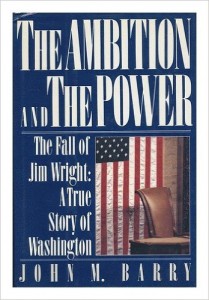
Review: The Ambition and the Power–The Fall of Jim Wright : A True Story of Washington

5 Star, Congress (Failure, Reform), Corruption, Politics, Power (Pathologies & Utilization)
Amazon Page
Amazon Page

John M. Barry

5 Stars Classic Detailed Study of Both Corruption and Abusive Power, September 18, 2008

This is the book whose account of what it takes to be a “Member” that so turned my stomach (i.e. the book is phenomenal) I concluded that no sane and honorable person should seek election.

On the one hand, it recounts in excruciating detail the degree to which then Speaker of the House Jim Wright had to be constantly on the go to collect (“raise”) funds for his future campaigns (every two years), while also illuminating the pathologies of House leadership processes.

On the other hand, it recounts in equal detail the deliberate and malicious manner in which future Speaker of the House Newt Gingrich set about to destroy Jim Wright–his reputation, his position, his office, his personna.

I am not sure which turned my stomach more–the two together are quite depressing.

I have since learned that the Democrats are much more practiced at electoral fraud and other connivances, and that the Republicans are now learning to match the Democrats and “level the playing field.” We need to take back the power, get the money out of politics, eradicate the rule by secrecy and information asymmetries between elites and the voters, and get our Republic back.

From a Constitutional point of view, this book also charts how Newt Gingrich destroyed Article 1 of the Constitution, and turned all Members into “foot soldiers” for the party — they vote the party line as bought by billionaires, or they get no nice offices, staff numbers, etcetera. He destroyed what was left of the bi-partisan balance of power aspect of the US Constitution.

This is a SUPERB reading for any university or college class studying the real world of politics as it is still practiced today on the Hill.

More recent books, also recommended:
Breach of Trust: How Washington Turns Outsiders Into Insiders
The Broken Branch: How Congress Is Failing America and How to Get It Back on Track (Institutions of American Democracy)
Tribes on the Hill: The United States Congress–Rituals and Realities, Revised Edition

Vote and/or Comment on Review

Review: A Consumer’s Dictionary of Household, Yard and Office Chemicals: Complete Information About Harmful and Desirable Chemicals Found in Everyday Home Products, Yard Poisons, and Office Polluters

5 Star, Environment (Problems), True Cost & Toxicity
COnsumer Dictionary
Amazon Page

One of several great books, only dictionary I could see, September 21, 2008

Ruth G Winter

This needs to be accessible via bar code scanback and cloud look up.

See also my more detailed reviews, and the books themselves:
High Tech Trash: Digital Devices, Hidden Toxics, and Human Health
How Everyday Products Make People Sick: Toxins at Home and in the Workplace
The Blue Death: Disease, Disaster, and the Water We Drink
Pandora's Poison: Chlorine, Health, and a New Environmental Strategy

Vote on Review
noble gold