Review: Running The World–the Inside Story of the National Security Council and the Architects of American Power (Hardcover)

4 Star, Decision-Making & Decision-Support, Empire, Sorrows, Hubris, Blowback, Executive (Partisan Failure, Reform), Military & Pentagon Power, Misinformation & Propaganda, Power (Pathologies & Utilization)

Amazon Page
Amazon Page

4.0 out of 5 stars Documents Arrogance and Naivete of Top Executive Officials,

September 11, 2005
David Rothkopf
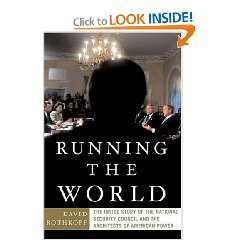
The arrogance and naiveté of the National Security Council and its principal protagonists is ably reflected in the title. The pretentiousness and unreality of “Running the World” is fittingly complemented by a cover photo of a Cabinet meeting, not an NSC meeting-the latter take place in crummy little rooms with poor ventilation, not at all the kind of image one wants as an Emperor, naked or not.

There are three consistent and very useful themes throughout the book that make it extraordinarily valuable to any student of the pathologies of the national security “decision” process (I use that term *very* loosely).

First, that each Administration allows personal ambitions and an almost pathological desire for “differentiation” from the previous Administration to first destroy and then slowly rebuilt the NSC. Hence, it is dysfunctional much of the time, regardless of the ideology prevailing at the time.

The second prevailing theme, one that Amy Zegart captured so well in her seminal scholarly work, “Flawed by Design,” is the perpetual dysfunctionality, a constant dysfunctionality, between the Departments of State and Defense, and between Defense and the loosely managed U.S. Intelligence Community. The bottom line is that personalities and politics, not intelligence nor wisdom, are the prevailing drivers of U.S. national security.

Lastly, the irrelevance of secret intelligence to the White House decision process, regardless of what Administration is in power, is documented. Page 361 is an especially good indictment of the Central Intelligence Agency (CIA) in particular, and with specific reference to its complete incompetence at economic intelligence needed by the Department of the Treasury. In general, intelligence in this book is portrayed, accurately, as either irrelevant or a pawn to the politically-driven preferences of the White House.

This is not a scholarly work, but merits great credit for the many interviews. Over-all the author has leveraged close access to a large variety of U.S.players over time, while not engaging the other players, including foreign players, private sector players, and non-governmental players. The book, even with its focus only on US players would have benefited from an annex charting and comparing the approaches of various NSC iterations to various issues and topics, to include number of action officers, number of meetings, and number of decision papers, but that kind of hard work does not appear to have been part of the plan. There is also little mention of the role lobbying and blatant corruption play in making foreign and security policy–for example, there is no mention of how the White House and the U.S. Senate, from 1974-1979, knew full well that Peak Oil (the end of cheap oil) had arrived, but in what may well be the most treasonous and retrospectively impeachable offence against the public interest, both the White House and the Senators decided to “live the dream” and waste 25 years during which we could have achieved energy independence and sanity.

The book, by virtue of its focus on primary research, does not address the substantive literature on global issues, nor the scholarly and practical literature on the NSC. Morton Halperin's seminal work on “Bureaucratic Politics and Foreign Policy” and other works on the NSC such as those edited by Dr. Loch Johnson, the foremost academic observer of secrecy and policy, are essential complements to this author's offering.

The book whitewashes Tony Lake, whose incapacity as an advisor merits note. Most of what the author puts forward about Lake is contradicted by other accounts including those of Dick Clarke, who says he could not get Lake's support until the time came for the latter to leave government and write a book. Naturally there are different points of view.

The book is a hatchet job on the Reagan era, even catty in its tone, but the author avoids appearing to be a sycophant to Bush II in that he very properly documents the grotesque dysfunctionality of the Bush II team (and the extraordinary competence of Vice President Cheney in getting his way as co-President). The author has done a good job of leading up to a severe indictment of the Bush II national security decision process, and excels at showing how Condi Rice was “run over” and side-lined by Cheney, Rumsfeld, and the neo-conservatives. His documentation on Cheney as a de facto prime minister is quite good, and these few pages are alone worth the price of the book. Pages 428-429 are “hot” and make it clear that the Bush II Administration, where Cheney was given the terrorism mandate in passing (something not widely known to the public), chose to emphasize invading Iraq, national missile defense, and energy sweetheart deals over counter-terrorism during the critical three months leading to 9-11.

There are a few disconcerting errors or failures in the book. In lambasting Reagan for invading Grenada, he says that 8,612 medals were handed out. Had he troubled to check with the military, he might have learned the difference between medals and campaign ribbons. He seriously over-sells both Burger and Lake while ignoring the blatant manner in which the Clinton Administration, and Madeline Albright in particular, sought to down-play terrorism to the point of suppressing alarmist reporting and ignoring or side-lining Dick Clarke. He claims, on page 387, that the Clinton Administration “foiled plots against trans-Pacific jumbo jet traffic.” Not so fast. The terrorist blew himself up in the Philippines prior to executing the plot, which was completely undetected by U.S. intelligence, and it was that error that revealed the plot when Philippine authorities responded to the resulting fire. On page 457 he makes the observation that the Congress has less turnover than the Soviet politburo. This should have been credited to Peggy Noonan and Ronald Reagan, who used it in an address to a joint session of Congress. He ends the book wisely, saying, “The ultimate check is an educated American public,” which thought tallies nicely with Thomas Jefferson, who said “A Nation's best defense is an educated citizenry.”

This is a book that needed to be written. It documents the pathetic manner in which U.S. national security is in the hands of a small group of people that place loyalty to one another above intelligence, wisdom, and strategic thinking. We all suffer. It is a primary reference for all who would wish to understand why the greatest Nation on the planet has such a pathetic lack of strategic culture, vision, process, and outcome.

The Exective, and the Congress, and Broken. Here are some other books, with my reviews:
Vice: Dick Cheney and the Hijacking of the American Presidency
The One Percent Doctrine: Deep Inside America's Pursuit of Its Enemies Since 9/11
State of War: The Secret History of the CIA and the Bush Administration
A Pretext for War: 9/11, Iraq, and the Abuse of America's Intelligence Agencies
Weapons of Mass Deception: The Uses of Propaganda in Bush's War on Iraq
Running on Empty: How the Democratic and Republican Parties Are Bankrupting Our Future and What Americans Can Do About It
The Broken Branch: How Congress Is Failing America and How to Get It Back on Track (Institutions of American Democracy)
Breach of Trust: How Washington Turns Outsiders Into Insiders
The Battle for the Soul of Capitalism


Vote on Review
Vote on Review

Review: The Menopause Survival Guide–Surviving the Change of Life (Paperback)

4 Star, Nature, Diet, Memetics, Design

Amazon Page
Amazon Page

4.0 out of 5 stars One of 3 useful books,

August 14, 2005
Donna Rogers
No one book was able to satisfy my research needs, and I ended up writing a two page memo that combined description with prescription in drawing out the best information across all three books (copy posted to OSS.Net Library under Reference). I deeply regret that I did know look into this ten years ago–both men and women need to understand this stuff before they hit 40. A great deal of emotional misunderstanding could be avoiding if *both* men and women absorbed this knowledge early on. Of the three books, this is the shortest, the easiest to read, and the simplist. The other two books that I recommend are Colette Bouchez, “Your Perfectly Pampered Menopause” (2005, the most time-consuming to read, but also the most up to date with some real gems of knowledge), and “Menopause for Dummies” which falls between the two books in utility.
Vote on Review
Vote on Review

Review: Menopause for Dummies [ILLUSTRATED] (Paperback)

4 Star, Nature, Diet, Memetics, Design

Amazon Page
Amazon Page

4.0 out of 5 stars 1 of 3 useful books, see my two-page memorandum, guys need to know this stuff!,

August 14, 2005
Marcia Jones
No one book was able to satisfy my research needs, and I ended up writing a two page memo that combined description with prescription in drawing out the best information across all three books (copy posted to OSS.Net Library under Reference). I deeply regret that I did know look into this ten years ago–both men and women need to understand this stuff before they hit 40. A great deal of emotional misunderstanding could be avoiding if *both* men and women absorbed this knowledge early on. Of the three books, this is the middle one in terms of utility and ease of use. The other two books that I recommend are Colette Bouchez, Your Perfectly Pampered Menopause: Health, Beauty, and Lifestyle Advice for the Best Years of Your Life (2005, the most time-consuming to read, but also the most up to date with some real gems of knowledge), and The Menopause Survival Guide: Surviving the Change of Life which is the shortest and also the best starting point.
Vote on Review
Vote on Review

Review: Your Perfectly Pampered Menopause–Health, Beauty, and Lifestyle Advice for the Best Years of Your Life (Paperback)

4 Star, Nature, Diet, Memetics, Design

Amazon Page
Amazon Page

4.0 out of 5 stars 1 of 3 useful books, see my two-page memorandum–guys need to know this stuff!,

August 14, 2005
Colette Bouchez
No one book was able to satisfy my research needs, and I ended up writing a two page memo that combined description with prescription in drawing out the best information across all three books (copy posted to OSS.Net Library under Reference). I deeply regret that I did know look into this ten years ago–both men and women need to understand this stuff before they hit 40. A great deal of emotional misunderstanding could be avoiding if *both* men and women absorbed this knowledge early on. Of the three books, this is the most difficult to read and best read last, but it is also the most up-to-date and the “must buy” book if you buy only one. However, I do recommend the other two books be bought and read first, starting with The Menopause Survival Guide: Surviving the Change of Life (the shortest and simplist), and Menopause For Dummies (For Dummies (Health & Fitness)).
Vote on Review
Vote on Review

Review: Colleges That Change Lives–40 Schools You Should Know About Even If You’re Not a Straight-A Student (Paperback)

4 Star, Education (Universities)

Amazon Page
Amazon Page

4.0 out of 5 stars Half Inspirational, Half Nonsense,

August 5, 2005
Loren Pope
I took my 16 year old on a swing of some these schools, and I have a simple bottom line: the author established an interesting formula and title years ago, and over time, half his recommendations do not live up to the billing. Some of his recommended schools are in the middle of no where, with very poor maintenance, sloppy students and inattentive staff, and not at all as advertised. Others, like Evergreen in Washington State, are clearly top of the line.

I have also realized that with the thousands of colleges and universities across America, including community colleges that are now going “upscale” and expanding their computer and laboratory facilties, that this book is like a placebo–it pupports to offer a life-changing experience with a very narrow selection of schools, when in fact there are plenty of life-changing schools right before our eyes, in every state of the Union.

It merits comment that this past week none of the schools in this book that we visited caught my son's attention (he is one of those who thought, until this trip, that he never wanted to go to college), but when we visited Muhlenberg College, my alma mater, not only did he perk up, but the hand of God was visible–a college educated custodian opened the locked rooms in the Arts Center, showing him the music and digital video programming rooms, and that sealed the deal.

Read this book for ideas, discard the “list” as flawed and misrepresentative and open your eyes to all the options.

Vote on Review
Vote on Review

Review: Making America’s Budget Policy–From the 1980s to the 1990s (Paperback)

4 Star, Budget Process & Politics

Amazon Page
Amazon Page

4.0 out of 5 stars Excellent for Presidential Advisors (Not the Has-Beens),

July 15, 2005
Joseph J. Minarik
This is not the easiest book to read, and it desperately needs a one-page executive summary that a normal person can understand. However, having said that, I have to praise this book as a dated but still valuable primer on budget policy.

The bottom line in this book is clear: America can find $500 billion more in revenue if we return corporations to paying 25% of the total revenue (down to 6% now from a high of 32% in the past), eliminate subsidies and import-export pricing fraud; if we eliminate the tax code and all of its special interest provisions, and rely instead of the marketplace to choose winners and losers; and if we shift to a flat fair tax with no deductions except the mortgage and savings not counted as income. I am over-simplifying, but this book desperate needs distillation.

The author is quite clear on the growing threat to America of the double deficit (both debt and trade),

On balance I am very impressed by the author's grasp of the nuances of budget policy, and while I do not understand all that he writes about, his book has certainly persuaded me that Bill Bradley and he have a grip on this important subject.

It would be quite exciting to see Barack Obama and Ron Paul agree to collaborate on a new coalition government that offers all Americans two things: the restoration of informed engaged democracy where every citizen has access to the information they need, and where every citizen's vote counts; and the elimination of the twin deficits as a national security and competitiveness priority.

EDIT of 20 Dec 07: Adding a few links.
The Battle for the Soul of Capitalism: How the Financial System Underminded Social Ideals, Damaged Trust in the Markets, Robbed Investors of Trillions – and What to Do About It
Running on Empty: How the Democratic and Republican Parties Are Bankrupting Our Future and What Americans Can Do About It
The Global Class War: How America's Bipartisan Elite Lost Our Future – and What It Will Take to Win It Back
War on the Middle Class: How the Government, Big Business, and Special Interest Groups Are Waging War onthe American Dream and How to Fight Back

Vote on Review
Vote on Review

Review: Radical Evolution–The Promise and Peril of Enhancing Our Minds, Our Bodies — and What It Means to Be Human (Hardcover)

4 Star, Future, Information Society, Information Technology, Science & Politics of Science

Amazon Page
Amazon Page

4.0 out of 5 stars Genetics, Robotics, Information, Nano–Lacks Humanity,

June 28, 2005
Joel Garreau
I've admired Joel Garreau ever since I read and reviewed his really insightful The Nine Nations of North America. I am glad to have bought and read this book, it is certainly worth reading, but it is somewhat unbalanced. However (this is an edit of the original review), now that I have read Ray Kurzweil's book, The Singularity Is Near: When Humans Transcend Biology a techno-geek rendition of the same technologies and their future, I have to give Garreau higher marks–while this book may lack soul, it does come closer to its titular objective than does Kurzweil's. Both are worth buying and reading together.

He focused on four technologies abbeviated as GRIN: Genetics, Robotics, Information, and Nano. Others have focused on the integration of Nano, Information, Bio-Technology and Cognitive Science (NIBC), and I would have been happier with this book if it focused more on the thinking side of the future rather than the bio-mechanical side.

The other area where I felt the book was disappointing was in its almost total acceptance at face value of all that the Defense Advanced Research Projects Agency (DARPA) is doing to elevate soldier-humans, giving them super human strength, acute mental perception almost to the point of telepathy, and so on. I could not help but feel, over and over as I read this book, that if DARPA were to apply its considerable talents to waging peace and addressing poverty, disease, water scarcity, energy independence, and the urgent need for global education that does not require packing kids like rats into a stiffling anti-creative environment (and making them get up at 0600), that we would all be better off.

The author talks about the implications for human transformation in all of this, but missing from his schema is the moral dimension. This is closer to a comic book super-hero depiction than it is to a renaissance man's moral and cultural enlightenment, and that, in my view, is where this book falls short–it lacks soul.

I recommend that readers consider the books by Tom Atlee, The Tao of Democracy: Using Co-Intelligence to Create a World That Works for All and Margaret Wheatley Leadership and the New Science: Discovering Order in a Chaotic World as well as the book The World Cafe: Shaping Our Futures Through Conversations That Matter to gain an alternative perspective on what it might mean to be human in the future, despite the over-whelming incursions of technology into our humanity.

Vote on Review
Vote on Review
noble gold