
Continue reading “Worth a Look: Recent Books on 12 Core Policies”
Worth a Look: Recent Books on 10 High Level Threats
Worth A LookRichard Wright: An Appreciation of Cuba
Cultural Intelligence, Peace Intelligence
Cuba is a fascinating island country. I have written down a few observations, from a trip I made there in October 2013.
When the Soviet Union imploded, the Russians typically not only pulled all of their troops and civilian advisors out of Cuba, but also nullified all trade and aid agreements. As a result many Cubans that I talked to refer to the 1990’s as a time of great hardship. If the U.S. Government were not in the hands of the cognitively challenged, this would have been the exact time to lift the embargo and start pouring aid and investments into Cuba. Instead Cuba’s salvation came with rediscovery of Cuba by the Canadians and Europeans. European tourism in Cuba has grown enormously and has led to European investments in Cuba. At the same time the Cuban Government under both Fidel and Raul Castro is gingerly reintroducing capitalism into Cuba and allowing the Cuban people to start up private enterprises of all sorts. Given the capabilities of the Cubans, Cuba is close to producing a booming economy. Meanwhile the Cuban Government is moving to reestablish a convertible monetary system based on its national currency, the Peso. (At present tourists in Cuba convert their national currencies into “CUCs” (“tourist peso”). The EU and UNESCO are pouring money into Cuba to restore the wonderful colonial architecture of old Havana (Habana Vieja) and other cities. Needless to say Europeans, Canadians, and Cubans think the continuing U.S. Embargo of Cuba is idiotic. I agree. Typical of U.S. thinking on Cuba, the State Department lists Cuba as a “state sponsor of terrorism” for rational or even irrational reason.
Ted Shulman: Ganib Open Source Organization and Collaboration Tool
IO Tools
Among its functions, all free:
GET STARTED. Import MS project files and edit them online. Copy paste from spreadsheets. Manage advanced tasks with dependencies, constraints, Gantt chart views.
TIMESHEET. Know your team members daily billed hrs for the month. Filter them by account or project you are interested in for billing, invoicing or meeting purpose.
 PLAN AND MANAGE. Manage tasks in project, group by user, iteration, completion, work-on, etc. Intuitive & easy to change task dates, dependencies, deadlines, assign to anyone for specific hrs/day
GTRACK. gTrack: Desktop app used to capture work hours. Record screenshots, keyboard activity & update Ganib with progress in Real-Time.
DASHBOARDS. Know your project progress and status: Work done today, this week, this month and all time for all projects in your portfolio.
LISTS ON THE FLY. Automate all your existing paper processes. Create pages to capture any type to share as well as manage.
Lee Camp: Shocking Video of Crashed Drone Being Stoned — with Appropriate Social Commentary
Cultural Intelligence, Government, Idiocy, Military, Offbeat Fun
SHOCKING Video Of Crashed Drone Hit With Rocks By Afghan Villagers – My New Video
Go here to turn the video into an MP3: http://us.
Keep fighting,
Lee
Chuck Spinney: Corruption in Congress – The Iron Triangle
Corruption, Cultural Intelligence, Government

Revolving Door Syndrome in the Military-Industrial-
The Best Government Money Can Buy
by FRANKLIN C. SPINNEY, COUNTERPUNCH, FEBRUARY 11, 2014
Those of you who think it is incorrect to attach “Congressional” onto the the end of Military – Industrial – Congressional Complex (MICC) would be well advised to read “Lawmaker holds stock in defense contractor he champions” (by Donovan Slack, USA Today, 8 Feb 2014) to see one reason why I always include the reference to Congress.
Slack describes the ethically-challenged influence peddling capers of Congressman Tom Petri (R-Wisconsin), a Harvard educated lawyer and one of longest serving and wealthiest members of Congress. Petri used his position in Congress to enhance his political career (and power) as well as his personal wealth by promoting a controversial $3 billion dollar armored truck procurement contract to Oshkosh corporation that pushed dollars, jobs, and profits into his home district as well as wealth into his own stock portfolio. Slack describes how Petri intervened to (1) fend off Oshkosh’s competitors, especially Texas based BAE corp, who had protested the contract award, accusing Oshkosh of low-balling its cost estimates and (2) how he worked to neutralize the rescue efforts by BAE’s friendly congressmen. The story is complex, and I urge you to read Slack’s report at the link above.
Petri’s hijinks are old as our democracy (see this hilarious example of how the Navy’s Ship of the Line program was funded in the years after the War of 1812), but the intricacies of his maneuvers illustrate the subtle and deep-seated general nature of corruption and influence peddling now pervading our nation’s defense policy making machinery. The threads of this influence peddling network are now woven deeply, almost invisibly, throughout the entire fabric of the contemporary American political economy.
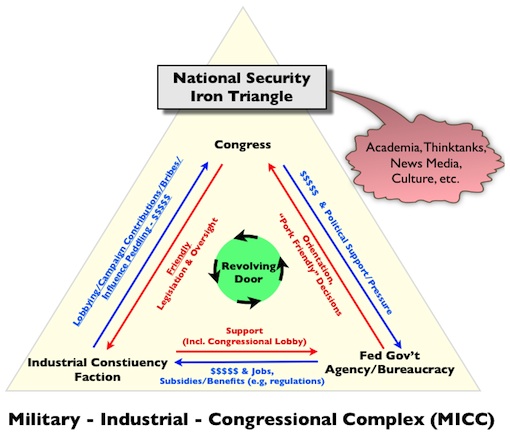
Some political scientists use the metaphor Iron Triangle as a short hand for describing the structural aspects of this web of influence relationships. The attached diagram depicts the triangle’s basic features for the MICC. Note its principle idea: the two mutually-reinforcing circulations: (1) a counter-clockwise circulation of influence peddling fueling (2) a concomitant clockwise circulation of money.
Continue reading “Chuck Spinney: Corruption in Congress – The Iron Triangle”
Winslow Wheeler: What Lays Beneath the Officer Ethics Scandals
Corruption, Cultural Intelligence, Idiocy, Military
The defense trade press and even some major media have recently produced reports about ethical problems in the US military officer corps. Bill Hartung writes at Huffington Post that “Military Ethics Reform Should Start at the Top,” advocating a reduction in our astoundingly–even historically–high officer bloat. Lt. Col. Danny Davis writes in Armed Forces Journal that our officers are “Seduced by Success” by winning, but only at the minor tactical level, against literally incompetent, almost unarmed enemies.
These are important articles, and I urge you to read them, but retired Army Major Don Vandergriff (who has written about officer education, how our over-officered military means an ineffective military, and more) brought to my attention an article that puts the disconnected media reports about individual examples of officer ethics problems into a broader and far more important perspective. This article, “A Crisis in Command and the Roots of the Problem” explains-at least to me-the fundamental origin of the problem and its solution. Written Jorg Muth (who has also written about the differences between German and American officer training before World War Two-a difference that hardly puts us in a good light), the “Crisis in Command” article explains how today's ethical problems started on the first day that West Point cadets showed up on that campus and how those problems will not go away until American military officers start listening to those they think they outrank–intellectually and morally as well as physically.
Indeed, if you are interested in ending the military sexual harassment now so widely reported in the press and debated in Congress, if you want to eliminate “toxic” and financially corrupt military officers, and if you want to get rid of those who tolerate or just fail to report them all, understand that those behaviors are more likely reinforced, than eliminated, by most of the changes being advocated in the press and Congress. The Jorg Muth article explains why I say this and what can be done to change the course our officer corps is on. Be warned, however, as important as reducing the bloated size of our officer corps is, the solution to our problems is not just to have a smaller number of ethics-crippled officers; it is not to give them a new set of judicially independent ethics enforcers, and it is not to tell them to go to an ethics training course. Muth explains; it is short but informative reading, I believe.
