Berto Jongman: Radioactive Mass Murder — Fukushima Impact Classified by Japanese Government, Nuclear Industry in Cover-Up Mode

03 Economy, 03 Environmental Degradation, 05 Energy, 07 Health, 07 Other Atrocities, 08 Proliferation, 08 Wild Cards, 10 Transnational Crime, 11 Society, Commerce, Corruption, Earth Intelligence, Government
0Shares
Berto Jongman
Berto Jongman

Radioactive ‘mass murder': nuclear industry keeps Fukushima impact in secret, worst to come

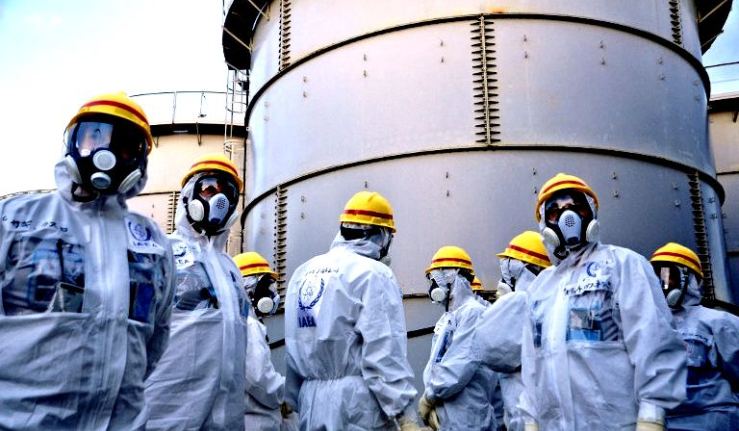
Radiation is a rather tricky enemy. You cannot see it, you cannot smell it yet it’s harmful for our ecosystem, our markets and our bodies. The Fukushima nuclear power plant disaster is still making headlines but no one knows the full truth about the ultimate impact of this accident. We should prepare for the worst case scenario, writes American democracy activist Harvey Wasserman in his article “50 Reasons We Should Fear the Worst from Fukushima”.
Click on Image to Enlarge

Impact of Fukushima a serious problem and deserves serious discussion and action however it is being kept out of the public eye thanks to Japan’s censorship and a global corporate media blackout, writes Mr. Wasserman in the first of his two part series at EcoWatch. The “see no evil, pay no damages” mindset dates back from the Bombing of Hiroshima.

Nuclear industry is a big business which doesn't want anyone to know what is happening at Fukushima in specific and whole “nuclear” cycle as a whole, underlines the activist.

The impacts of radiation emissions on human and ecological health are unknown primarily because the nuclear industry has resolutely refused to study them.

Continue reading “Berto Jongman: Radioactive Mass Murder — Fukushima Impact Classified by Japanese Government, Nuclear Industry in Cover-Up Mode”

Event: 18-19 FEB 14 Tampa FL Modern Warfare’s Complexity and the Human Dimension: Implications for Policymakers, Warfighters, NGOs and the Private Sector

#Events
0Shares

Modern Warfare’s Complexity and the Human Dimension: Implications for Policymakers, Warfighters, NGOs and the Private Sector

FREE

February 18-19, 2014

USF Patel Center for Global Solutions

Tampa, Florida

We are at a major inflection point after two wars, major upheaval and change in the Middle East, humanitarian challenges, new military technologies and changes in the character of conflict. The conference examines the increasingly important human, social and cultural dimension in contemporary and emerging warfare and conflict, while seeking to inform the debate about national strategy and military doctrine. Understanding the human domain is a key consideration for policy and strategy as so many conflicts now arise not from encounters between state-sponsored militaries but rather from among groups more or less embedded within civilian populations. Contemporary conflict and warfare increasingly involves adversaries (insurgents, terrorists, criminal networks, piracy, and guerillas) who exploit specific human environments, such as ungoverned areas, tribal social structures and stressed urban environments.

This conference seeks to aid overcoming inadequate understanding of the human domain for military, civilian agency, NGO and international organization decision-making. We endeavor to examine conflict and the human dimension because we are not as good as we need to be in taking ‘the human' into consideration as it impacts governance, politics, development, and security. A common critique of US efforts is US strategy and policy suffered from an inadequate understanding of the human domain’s implications for influence and engagement operations for pre-conflict, conflict and post-conflict. This shortfall equally impacts civil government agencies, NGOs, international organizations and the private sector. We anticipate this conference will contribute to building the collaborative networks necessary to enhance academic and government efforts to improve human domain capabilities to improve NGO, International Organization and government planning and operational support. Panels will illuminate key lessons of the wars and conflicts involving the US military in the last ten years and, furthermore, seek to inform our understanding of the challenges and implications of the social and cultural environment in contemporary and future warfare.

Learn more.

Robin Good: Academic Torrents = Big Data + Open Access

Access, Advanced Cyber/IO
0Shares
Robin Good
Robin Good

Big Data: Large Dataset Curation & Sharing with AcademicTorrents

AcademicTorrents is a new web service which allows any organization owning large datasets (no size limits) to easily distribute them without needing a dedicated infrastructure. The brainchild of Joseph Cohen and Henry Lo, two PhD students working at the University of Massachusetts in Boston, Academic Torrents facilitates the job of researchers, journalists and information analysts in finding, accessing, curating and downloading large-size datasets. Technically-speaking AcademicTorrents is a bittorrent-type redundant high-speed network and a full distributed system for sharing enormous datasets. As a P2P system it doesn't require intermediate servers, is also fully scalable, secure, fault-tolerant and can act as a reliable repository for data allowing fast downloads. Users can also search the full index, and can create curated datasets collections containing any kind of files and which can be downloaded as a full bundle. This type of system could prove to be an excellent resource for libraries storing digital papers as they would store books, and for simplifying the distribution requirements of any organization needing to publish, curate and share large datasets. “A robust distributed replication design allows libraries to utilize this system as their backbone. Providing fault tolerant hosting of curated data for a university, research lab, or home library. …Also, this system can be used as the foundation of a new open-access publishing system where libraries manage data instead of licenses for external data sources.”

Find out more: http://academictorrents.com/

More info: http://academictorrents.com/about.php

Browse Datasets: http://academictorrents.com/browse.php?cat=6

Browse Papers: http://academictorrents.com/browse.php?cat=5

Berto Jongman: WIRED on Crypto Breakthrough — Unhackable Software?

Advanced Cyber/IO
0Shares
Berto Jongman
Berto Jongman

Cryptography Breakthrough Could Make Software Unhackable

  • By Erica Klarreich, Quanta Magazine

As a graduate student at the Massachusetts Institute of Technology in 1996, Amit Sahai was fascinated by the strange notion of a “zero-knowledge” proof, a type of mathematical protocol for convincing someone that something is true without revealing any details of why it is true. As Sahai mulled over this counterintuitive concept, it led him to consider an even more daring notion: What if it were possible to mask the inner workings not just of a proof, but of a computer program, so that people could use the program without being able to figure out how it worked?'

The idea of “obfuscating” a program had been around for decades, but no one had ever developed a rigorous mathematical framework for the concept, let alone created an unassailable obfuscation scheme. Over the years, commercial software companies have engineered various techniques for garbling a computer program so that it will be harder to understand while still performing the same function. But hackers have defeated every attempt. At best, these commercial obfuscators offer a “speed bump,” said Sahai, now a computer science professor at the University of California, Los Angeles. “An attacker might need a few days to unlock the secrets hidden in your software, instead of a few minutes.”

Learn more.

Patrick Meier: Using UAVs for Search & Rescue

Geospatial, Innovation
0Shares
Patrick Meier
Patrick Meier

Using UAVs for Search & Rescue

UAVs (or drones) are starting to be used for search & rescue operations, such as in the Philippines following Typhoon Yolanda a few months ago. They are also used to find missing people in the US, which may explain why members of the North Texas Drone User Group (NTDUG) are organizing the (first ever?) Search & Rescue challenge in a few days. The purpose of this challenge is to 1) encourage members to build better drones and 2) simulate a real world positive application of civilian drones.

Learn more.