Patrick Meier: Social Media – The First 2,000 Years [from Ancient Graffiti to Digital Pee in the Virtual Forest…]

Cultural Intelligence
0Shares
Patrick Meier
Patrick Meier

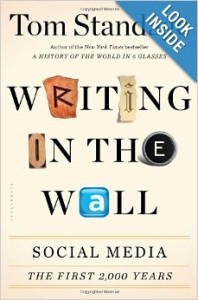
Social Media: The First 2,000 Years

What do Papyrus rolls and Twitter have in common? Both were used as a means of “instant” communication. Indeed, a careful reading of history reveals just how ancient social media really is. Further, the questions we pose about social media today have already been debated countless times over hundreds of years. Author Tom Standage traces this fascinating history of social media in his thought-provoking book Writing on the Wall: Social Media – The First 2,000 YearsIn so doing, Tom forces us to rethink our understanding and assumptions of social media use today. To be sure, this book will change the way you think about social media. I highlight some of the most intriguing insights below.
Read full post.

Amazon Page
Amazon Page

Papyrus rolls and Twitter have much in common, as each was their generation’s signature means of “instant” communication. Indeed, as Tom Standage reveals in his scintillating new book, social media is anything but a new phenomenon.

From the papyrus letters that Roman statesmen used to exchange news across the Empire to the advent of hand-printed tracts of the Reformation to the pamphlets that spread propaganda during the American and French revolutions, Standage chronicles the increasingly sophisticated ways people shared information with each other, spontaneously and organically, down the centuries. With the rise of newspapers in the nineteenth century, then radio and television, “mass media” consolidated control of information in the hands of a few moguls. However, the Internet has brought information sharing full circle, and the spreading of news along social networks has reemerged in powerful new ways.

A fresh, provocative exploration of social media over two millennia, Writing on the Wall reminds us how modern behavior echoes that of prior centuries—the Catholic Church, for example, faced similar dilemmas in deciding whether or how to respond to Martin Luther’s attacks in the early sixteenth century to those that large institutions confront today in responding to public criticism on the Internet. Invoking the likes of Thomas Paine and Vinton Cerf, co-inventor of the Internet, Standage explores themes that have long been debated: the tension between freedom of expression and censorship; whether social media trivializes, coarsens or enhances public discourse; and its role in spurring innovation, enabling self-promotion, and fomenting revolution. As engaging as it is visionary, Writing on the Wall draws on history to cast new light on today’s social media and encourages debate and discussion about how we’ll communicate in the future.

David Swanson: Citizen Activists Against Drones as Crime Against Humanity in Court from Coast to Coast

Cultural Intelligence, Peace Intelligence
0Shares
David Swanson
David Swanson

Citizen Activists Across the U.S. in Courts This Week for Protesting U.S. Weaponized Drones

WHO:

Citizen activists from the east coast to the west coast will be in court this week defending their actions protesting the United States Military and Central Intelligence Agency weaponized drone program.

WHAT:

The first trial will begin Monday February 3 in Sacramento, California for four activists arrested at Beale AFB in April 2013, while attempting to deliver a letter to the base commander addressing the illegality of US drones which kill innocent people and noncombatants in Pakistan and other countries. The letter is a citizen's declaration charging President Obama and all military personnel involved in the drone program with crimes against humanity and multiple violations of the law, including due process. (Letter is below.)

Meanwhile, in upstate New York, 17 activists are in the midst of an ongoing trial in a DeWitt, NY courthouse for an October 2012 protest at Hancock AFB protesting the use of the Reaper drones piloted from there that activists say perpetuate war crimes, and violations of human rights laws.

On Friday five activists will be in US District Court in Alexandria, VA appealing their trespass conviction at the Central Intelligence Agency in June, 2013 as they attempted to deliver a letter and seek a meeting with CIA Director John Brennan concerning CIA violations of international law related to illegal targeted drone killing in Pakistan, Yemen, Somalia and elsewhere.

Continue reading “David Swanson: Citizen Activists Against Drones as Crime Against Humanity in Court from Coast to Coast”

Rickard Falkvinge: Pirate Party Iceland & EU Nominate Manning & Snowden for Nobel Peace Prize

Cultural Intelligence, Peace Intelligence
0Shares
Rickard Falkvinge
Rickard Falkvinge

Pirate Party MPs, MEPs Jointly Nominate Snowden And Manning For Peace Prize

Civil Liberties:  Edward Snowden and Chelsea Manning have been nominated for the Nobel Peace Prize 2014 in a joint nomination by the Pirate MPs of Iceland and the Pirate MEPs of the European Parliament.

“Manning gave us an insight into the brutal reality of war and the two-facedness of political power. Snowden has revealed how states watch and control our information flows. Taken together, it’s a very strong image. That’s why we nominate these two together”, says Amelia Andersdotter, Member of European Parliament (Pirate).

“The revelations of Edward Snowden have, among other things, led to a large-scale inquiry into mass surveillance by the European Parliament. Making him a Peace Prize Laureate would be an additional way of saying that the democratic society stands behind his actions. Instead of giving the prize to powerholders, the Nobel Committee should give it to those who expose power”, says Christian Engström, Member of European Parliament (Pirate).

Full text of the nomination:

Continue reading “Rickard Falkvinge: Pirate Party Iceland & EU Nominate Manning & Snowden for Nobel Peace Prize”

SchwartzReport: Health — and Kindness — Are A) Vital Part of Socio-Economic & Ideo-Cultural Health and B) Destroyed by Legalized Financial Corruption

Cultural Intelligence
0Shares
Stephan A. Schwartz
Stephan A. Schwartz

Larry Dossey, one of the founders of the alternative and complementary medicine movement — and an SR reader, I am happy to say — has been studying the consequences of policy decisions that do not make national wellness a priority for four decades. Here is his excellent essay on what he calls “The Health Consequences of Our Fiscal Crisis.” It is not a happy story.

The Health Consequences of our Fiscal Crisis
Larry Dossey, MD, Executive Editor – Explore: The Journal of Science and Healing

See Also:

Happiness @ Phi Beta Iota

Chris Hedges: The Myth of Human Progress, The Collapse of Complex Societies — and the Salvation in Imagination and Resistance

Cultural Intelligence
0Shares
Chris Hedges
Chris Hedges

PHI BETA IOTA ALERT: This is one of the most thoughtful, poetic, and inspiring commentaries we have every posted.  Kudos to Contributing Editor Berto Jongman for finding it. Please do click through and read every word.

The Myth of Human Progress and the Collapse of Complex Societies

Truthdig, 26 January 2014

EXTRACTS:

We must develop a revolutionary theory that is not reliant on the industrial or agrarian muscle of workers. Most manufacturing jobs have disappeared, and, of those that remain, few are unionized. Our family farms have been destroyed by agro-businesses. Monsanto and its Faustian counterparts on Wall Street rule. They are steadily poisoning our lives and rendering us powerless. The corporate leviathan, which is global, is freed from the constraints of a single nation-state or government. Corporations are beyond regulation or control. Politicians are too anemic, or more often too corrupt, to stand in the way of the accelerating corporate destruction. This makes our struggle different from revolutionary struggles in industrial societies in the past. Our revolt will look more like what erupted in the less industrialized Slavic republics, Russia, Spain and China and uprisings led by a disenfranchised rural and urban working class and peasantry in the liberation movements that swept through Africa and Latin America. The dispossessed working poor, along with unemployed college graduates and students, unemployed journalists, artists, lawyers and teachers, will form our movement. This is why the fight for a higher minimum wage is crucial to uniting service workers with the alienated college-educated sons and daughters of the old middle class. Bakunin, unlike Marx, considered déclassé intellectuals essential for successful revolt.

. . . . . . .

Reinhold Niebuhr labeled this capacity to defy the forces of repression “a sublime madness in the soul.” Niebuhr wrote that “nothing but madness will do battle with malignant power and ‘spiritual wickedness in high places.’ ” This sublime madness, as Niebuhr understood, is dangerous, but it is vital. Without it, “truth is obscured.” And Niebuhr also knew that traditional liberalism was a useless force in moments of extremity. Liberalism, Niebuhr said, “lacks the spirit of enthusiasm, not to say fanaticism, which is so necessary to move the world out of its beaten tracks. It is too intellectual and too little emotional to be an efficient force in history.”

. . . . . . .

It is only those who harness their imagination, and through their imagination find the courage to peer into the molten pit, who can minister to the suffering of those around them. It is only they who can find the physical and psychological strength to resist. Resistance is carried out not for its success, but because by resisting in every way possible we affirm life. And those who resist in the years ahead will be those who are infected with this “sublime madness.” As Hannah Arendt wrote in “The Origins of Totalitarianism,” the only morally reliable people are not those who say “this is wrong” or “this should not be done,” but those who say “I can’t.” They know that as Immanuel Kant wrote: “If justice perishes, human life on earth has lost its meaning.” And this means that, like Socrates, we must come to a place where it is better to suffer wrong than to do wrong. We must at once see and act, and given what it means to see, this will require the surmounting of despair, not by reason, but by faith.

. . . . . . .

“Ultimately, the artist and the revolutionary function as they function, and pay whatever dues they must pay behind it because they are both possessed by a vision, and they do not so much follow this vision as find themselves driven by it,” wrote Baldwin. “Otherwise, they could never endure, much less embrace, the lives they are compelled to lead.”

Read entire transcript (5 screens).

For more video footage of Hedges’ speech, click here, here and here.

See Also:

A World Damaged by Psychopaths and Narcissists– Ian Hughes Interview Transcript Part 1

Marcus Aurelius: Military Leadership — the Many Failures and the Few Successes

Corruption, Ethics, Military
0Shares
Marcus Aurelius
Marcus Aurelius

This a “three-fer” on leadership and officership.  It provides some theory (from a Naval Special Warfare perspective), a media summary of how too many of our senior officers are not getting it right, and one officer's list of historical anecdotes when it was done right.

* The headliner, ADM McRaven's speech to USMA Class of 2015 500th Night, is the PDF file.  He gives  the theoretical overview.

* First below is the transmittal message for ADM McRaven's address.

* Second below is a counterpoint to ADM McRaven, a wave-top Washington Post summary of senior leader failures in leadership, judgment, and integrity.  While I think it is error-free, my sense is that the reality is several orders of magnitude worse than the info Post provides suggests.

* Third below is an address by LTC(Ret) Guy Lofaro, a former instructor at West Point.  From his own career, he provides some anecdotes that serve to provide illustrative examples to ADM McRaven's theory.

See Also:

Flag Treason @ Phi Beta Iota

Toxic Leaders @ Phi Beta Iota

Worth a Look: Book Reviews on Leadership for Epoch B

Continue reading “Marcus Aurelius: Military Leadership — the Many Failures and the Few Successes”

Jon Rappoport: Monsanto’s Round-Up THE Most Toxic — and False Testing by US Government…

01 Agriculture, 03 Economy, 03 Environmental Degradation, 06 Family, 07 Health, 07 Other Atrocities, 11 Society, Commerce, Corruption, Earth Intelligence, Government
0Shares
Jon Rappoport
Jon Rappoport

Monsanto’s Roundup: new deadly scam exposed

Roundup is the Monsanto herbicide that is touted as the cornerstone of GMO food crops. Monsanto claims these crops are genetically engineered to withstand heavy spraying of Roundup.

Therefore, the crops live and the weeds die. Breakthrough.

There are several key lies associated with these claims—but a new one has surfaced.

A study to be published this month indicts Roundup and, in fact, the general class of insecticides and herbicides. On what grounds? When they’re tested for safety, only the so-called “active ingredients” are examined.

The untested ingredients are called “adjuvants,” and they are said to be inert and irrelevant. But the new study concludes this is far from true. The adjuvants are actually there to INCREASE the killing power of the active ingredient in the herbicide or insecticide.

Safety tests don’t take this into account. “Active ingredients” are already toxic, but the adjuvants ramp up their poisonous nature even higher.

And the worst offender is Roundup.

Continue reading “Jon Rappoport: Monsanto's Round-Up THE Most Toxic — and False Testing by US Government…”