Chuck Spinney: Two Evaluations of Middle East After Arab Spring

08 Wild Cards
0Shares
Chuck Spinney
Chuck Spinney

Attached below are two very important reports by two of the most astute observers of conflicts in the Middle East.  The first is a precisely-focused report by Rami Khouri, editor at large of Lebanon's Daily Star.  Khouri analyzes how the recent assassination of Mohamad Chatah needs to be interpreted in the context of complexities of (1) Lebanon's domestic politics, (2) the Syrian war's  spilling over and exacerbation of the domestic conflicts in Lebanon, and (3) the larger Sunni-Shi'a conflict in the Arab-Persian world.

The second attachment, “A Long Ferment in the Middle East,” by Patrick Cockburn, is a great bookend to Khouri's incisive analysis.  Cockburn has produced a wide-ranging, brilliantly written portrait of the larger context in which Lebanon is but one crisis.   Cockburn analyzes the growing instability across the Middle East, especially from the viewpoint of how the emerging political retrenchments triggered by western interventions and western naivety on the one hand, and/or the local authoritarian or religious forces on the other, have worked so surprisingly well to undo the popular secular pressures that exploded during the so-called Arab Spring.  He ends with an imaginative comparison of the apparent Kurdish success in Iraq to the seeming failures of the Syrian rebels. Without implying any kind of criticism or detracting from his points, two additional factors might also be involved in the Kurdish success: the international role of Iraqi Kurdistan's oil wealth and Israel's shadowy involvement in Iraqi Kurdistan, including its subtle impact on fault lines in Turkish politics.

>FYI, I reformatted and highlighted both attachment to make my impressions of these important papers a little clearer (readers who find this distracting will find Kouri's original at this link and Cockburn's original at this link)

Chuck Spinney 

Stephen E. Arnold: Google Implements Semantic Mark-Up

Commerce, Corruption, IO Impotency
0Shares
Stephen E. Arnold
Stephen E. Arnold

Words are Boring and Google Will Fix it with Semantic Markup

The article titled How Semantic Search is Killing the Keyword on iMedia heralds the end of keyword-driven search in place of semantic search, or the user’s intention. Based mainly on Google’s work on the Knowledge Graph, a web of information that attempts to connect related data and provide a user with answers to questions they might not have known to ask. The article goes so far as to call keyword-centered content a thing of the past.

The article explains:

Continue reading “Stephen E. Arnold: Google Implements Semantic Mark-Up”

Chuck Spinney: Hugh Increase in US Oil Production – At What True Cost?

05 Energy, Earth Intelligence
0Shares
Chuck Spinney
Chuck Spinney

FYI … This seems to be a big deal, but given rising demand, I have no idea of the long term implications of shale boom or if we are witnessing some kind of a bubble?  see also this link.  CS.

2013 oil boom is biggest ever, data show

Posted on December 26, 2013 at 10:00 pm by Simone Sebastian in Crude oil, featured

HOUSTON — The United States’ average daily oil production is on track to surge by 1 million barrels per day this year, the biggest one-year jump in the nation’s history, according to federal data.

Continue reading “Chuck Spinney: Hugh Increase in US Oil Production – At What True Cost?”

Eagle: Charles Hugh Smith – Freedom Via Extreme Frugality

Cultural Intelligence
0Shares
300 Million Talons...
300 Million Talons…

The Only Leverage We Have Is Extreme Frugality 

Charles Hugh Smith

Debt is serfdom, capital in all its forms is freedom. The only leverage available to all is extreme frugality in service of accumulating productive capital.

There are only three ways to better oneself financially: marry someone with money, inherit money or accumulate capital/savings and invest it in productive assets. (We'll leave out lobbying the Federal government for a fat contract, faking disability, selling derivatives designed to default and other criminal activities.)

Continue reading “Eagle: Charles Hugh Smith – Freedom Via Extreme Frugality”

Jean Leivins: SLATE Falls Short in Covering the Sharing Economy

Commercial Intelligence, Cultural Intelligence, Earth Intelligence
0Shares
Jean Lievens
Jean Lievens

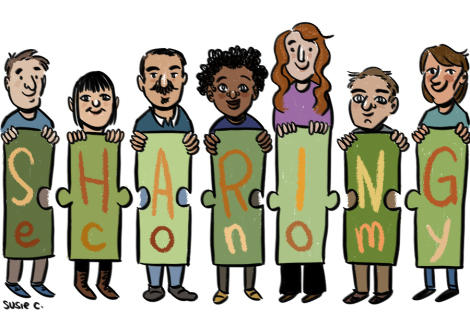
The only thing more tired than the “sharing economy” meme might be this opinion. While there’s truth in what he and many others before him have said, his post throws the baby out with the bath water. It shows a shallow understanding of the economic transformation underway, and this being Slate, with millions of readers, could turn a lot of people away from an important change.

Who is the Real Sharing Economy Sell Out? Maybe the Media

sharing-economyEXTRACT:

Yglesias’ big miss is that away from the headlines about the latest tech wonder, a real sharing economy is booming. Member-owned credit unions recently earned record profits, member-owned cooperatives are proliferating modeled off the successes like Mondragon, The White House is getting behind participatory budgeting for local governments, 20 states are considering some form of public banking, open source software is eating the software world, and grassroots sharing projects like seed banks, tool libraries, coworking and hacker spaces are spreading like kudzu.

This economy is substantial. Taken together, credit unions make up the fifth largest bank in the US. Cooperatives employ 100 million people globally (20% more than the Fortune 500) and have 800 million members. Coops span major industries – retail, agriculture, housing, transportation, manufacturing, energy, telecommunications, healthcare, and more. There are over 200,000 open source software projects worth around a half a billion dollars. One study put the value of fair use content at $4.5 trillion, one sixth of the US economy. I’m just scratching the surface of all that we share. The mutualized part of the sharing economy dwarfs all the tech-based sharing startups put together.

Whatever you want to call this economy, it’s the real story. While our civilization approaches economic and environmental collapse, the solutions lay right under our nose. This is arguably the biggest story today as our survival may hinge on how this emerging economy unfolds. The question is whether the mainstream media will bring it to the attention of a public desperate for real solutions. If Yglesias’ latest post is any indication, they will pass it up in favor of click bait to boost ad revenues.

Read full article.