Mindjet: 10 Reasons Visualization Rocks

Data, Design
0Shares
Nicola Frazer-Reid
Nicola Frazer-Reid

10 Reasons Visualization Rocks

Here at Mindjet, we think visualising information rocks — but more importantly, there’s a whole load of scientific proof as to why people find it so much easier to digest and work with information that’s displayed visually, rather than in traditional formats such as documents and spreadsheets. I’ve scoured the Web to find you these 10 great reasons to hop on the information visualisation train.

1. 93% of communication is non-verbal.

Or at least that’s what top psychologist Albert Mehrabian says, who argues in his Silent Messages research that the non-verbal elements of communication are particularly important for expressing feelings and attitude. It seems people tend to pay more attention to and trust the tone of a voice and visual cues, rather than the actual words being spoken.

Click on Image to Enlarge

2. Almost 50% of your brain is focused on visual processing.

And that’s according to research by David Van Essen. That’s a large part of your brain power going towards extracting information about the world with your eyes.

3. 70% of all your sensory receptors are in your eyes.

Sensory receptors are the nerves which respond to a stimulus in your internal or external environment. The fact that so many of these receptors are in our eyes makes it clear why we find it so much easier to absorb information visually.

Continue reading “Mindjet: 10 Reasons Visualization Rocks”

EVENT 19 September American University Washington DC GIGNET Academic Internet Governance (USA Region)

#Events
36Shares

Dear Colleagues,

Of interest to many, the United States regional Internet Governance Forum will take place on September 19, 2013 at American University in Washington, D.C. in the School of International Service.

GigaNet scholars involved in organizing the event at American University include Professor Nanette Levinson, Professor Derrick Cogburn, and Professor Laura DeNardis. We hope that many other GigaNet members will join us at this event, which will feature prominent leaders from the NTIA, the State Department, American technology companies, Internet governance institutions, and Internet freedom advocacy groups. The Honorable Larry Strickland is giving a morning address and Nanette, Derrick and I will keep you informed about the day-long program as it shapes up.

The event will address a host of critical topics including the intersection of national security and individual privacy (among other issues).

We would greatly appreciate it if you could help spread the word in social media and throughout your various networks. Regards, Laura DeNardis

Jean Lievens: The Rise of the Internet Dissidents — With Global Reach, Who Cannot Be Repressed

Culture
0Shares
Jean Lievens
Jean Lievens

The Rise of the Internet Dissidents

Manning, Snowden and Assange

by NOZOMI HAYASE

CounterPunch, 13 August 2013

NSA whistleblower Edward Snowden’s volcanic revelations of ubiquitous US surveillance are in their third month. The aftershocks felt around the world continue. As Russia granted Snowden temporary asylum, the White House fell into anger and dismay.

Computer scientist Nadia Heninger argued that leaking information is now becoming the “civil disobedience of our age”. The late historian and activist Howard Zinn described the act of civil disobedience as “the deliberate, discriminate, violation of law for a vital social purpose”. He advocated it saying that such an act “becomes not only justifiable but necessary when a fundamental human right is at stake and when legal channels are inadequate for securing that right”.

Snowden’s act was clearly one of civil disobedience. John Lewis, US Representative and veteran civil rights leader recently noted that Snowden was “continuing the tradition of civil disobedience by revealing details of classified US surveillance programs”.

Snowden is not alone. In recent years, there have been waves of dissent that revealed the depth of corruption and abuse of power endemic in this global corporate system. Before Snowden, there was Bradley Manning and Jeremy Hammond who shook up the trend of criminal overreach within the US government and its transnational corporate and government allies. Private Bradley Manning blew the whistle on US war crimes and activist Jeremy Hammond exposed the inner workings of the pervasive surveillance state. They took risks to alert the world about the systemic failure of representative government and the trend toward a dangerous corporate authoritarianism.

After Snowden was charged with espionage, WikiLeaks founder Julian Assange called for global support to stand with him:

“Edward Snowden is one of us. Bradley Manning is one of us. They are young, technically minded people from the generation that Barack Obama betrayed. They are the generation that grew up on the Internet and were shaped by it….”

Snowden, Manning and Assange are all part of an Internet generation that holds that transparency of governments and corporations is a form of check and balance on power. They believe in the power of information and in the public’s right to know. In an interview with Glenn Greenwald of The Guardian, Snowden described how his motive was “to inform the public as to that which is done in their name and that which is done against them.” He advocated for participation of ordinary people in decision-making processes as a vital part of democratic society indicating that the policies of national security agencies that he exposed should be up to the public to decide. This belief is shared by his forerunners.

Read full article.

Stephen E. Arnold: Google Corruption Goes Vertical — Google Search Integrity Score Now at 15% and Dropping

Commerce, Corruption, Government, Ineptitude
0Shares
Stephen E. Arnold
Stephen E. Arnold

Organic Results on Google a Shrinking Commodity

Posted: 09 Aug 2013 07:52 PM PDT

The free ride is over. Google seems to have decided it is time to make the most of AdWords, the Tutorspree Blog illustrates in, “How Google is Killing Organic Search.” The post begins by praising the Google of the past which, writer Aaron Harris accurately observes, “won search by providing the best organic results users had ever seen.” Since then, though, the company’s profit motive has been slowly strangling unpaid, organic search results.

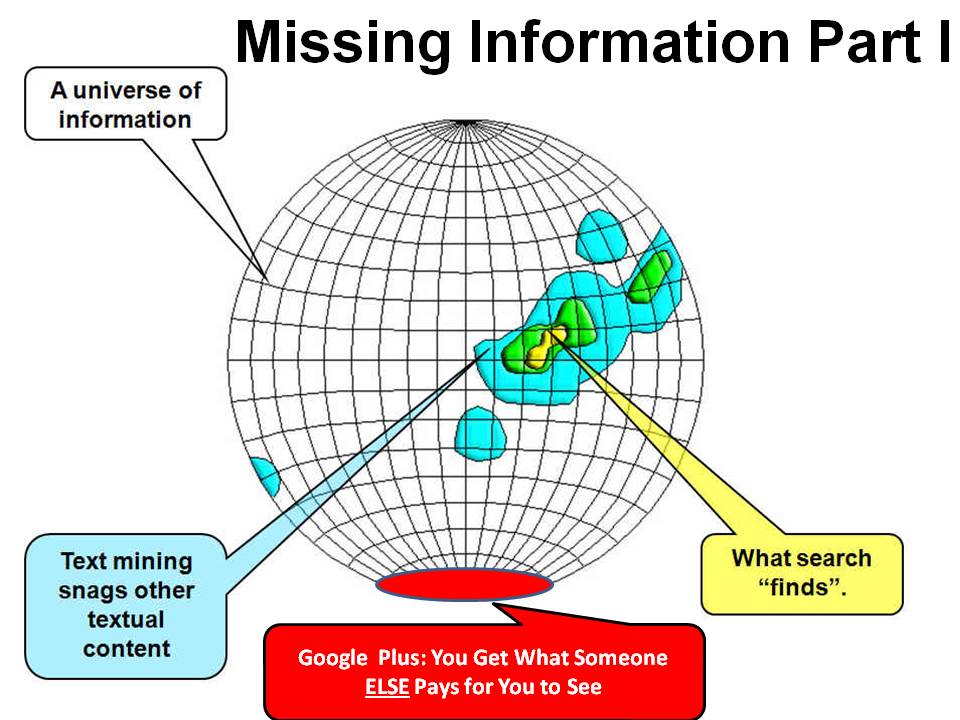
The post begins with an visual presentation. Harris took screen shots of some different Googley searches and calculated the percentage of each results page devoted to organic results. The low numbers (all under 15 percent) are particularly galling, he says, for local business owners who bought into Google’s promises that well-structured pages would mean high visibility. The post concludes:

“Google is building a new version of the search engine that made it great. This time, however, it is a search engine exclusive to the garden of Google products. If you compete with Google in any way, you’re in its crosshairs. Your chances of ranking high enough to garner traffic are virtually nil and getting smaller.

“The scariest part of this is that, if you sell something using the internet, regardless of whether or not you see yourself as a ‘local’ business – or think you’re competing with Google – Google sees you as competition. Searching for ‘Camera’ or ‘Buy a Dress Shirt’ gets you a nearly identical split of screen real estate as that of ‘local’ searches. Nearly everything leads back to a Google product except for an ever-decreasing amount of ‘Organic’ real estate.”

I wish I could say I was surprised, but Google is in business to make money, after all. They do seem to be more directly focused on that goal lately. Will the approach pay off, or will users turn to other search alternatives?

Cynthia Murrell, August 14, 2013

Sponsored by ArnoldIT.com, developer of Augmentext

Click on Image to Enlarge

Phi Beta Iota:  Long long ago, in a land far far away, this slide created by Stephen E. Arnold was modified by Robert David Steele to add the red bit at the bottom — a truth that was discovered by Brother Stephen, but a truth he was reluctant to spell out for an increasingly dumbed down drugged up public.  Google is massively well-funded fraud.  They are the Goldman Sachs of cyberspace.  The US Government is a village idiot in this domain, the laughingstock of the world, and particularly of the Israelis, Chinese, Iranians, and Russians.  INTEGRITY MATTERS.

SchwartzReport: Another Solar Energy Break-Through

05 Energy
0Shares

schwartzreport newHere is some more good news about solar. Click through to see the illustrations, it will make the story clearer.

Berkeley Scientists Announce Graphene Breakthrough That Will Lead to ‘the Next Generation of High-efficiency Solar Cel
TINA CASEY – Clean Technica

A team at Lawrence Berkeley National Laboratory has just announced a new breakthrough in the field of graphene research, leading to the next generation of high-efficiency solar cells, computers and other advanced technologies. Graphene, a new material that was discovered less than 10 years ago, is an ultra-thin, superstrong, superflexible electron conductor. As for how to explain the Berkeley Lab research in lay terms, let’s just say that if graphene had a personality it would have its own reality show, and it would give Total Divas a run for the money.

Read full article.

NIGHTWATCH: US Navy – Can You Spell Corrupt?

Corruption, Idiocy, Ineptitude, Military
0Shares
Click on Image to Enlarge

Aircraft carriers: feedback. A Brilliant and well-informed Reader reminded that Spain and Italy also have built aircraft carriers, making a total of seven builders. A search of the web indicates that nine navies have aircraft carriers and most have trouble doing so. Another Brilliant naval warfare expert and Reader calls them “big targets.” Feedback welcome.

Continue reading “NIGHTWATCH: US Navy – Can You Spell Corrupt?”