Here is the most low-tech explanation you will see on population growth, infant mortality and energy consumption, courtesy of the Swedish professor of global health, Hans Rosling. In the video below, Rosling makes strikingly clear through his lego demonstration that sustainable growth is only possible if we raise the living standards of the bottom two billion.
While the solution to this problem is elusive, there are few illustrations that you will find that present this global challenge in such clear terms as this video.
Cyber attacks, once primarily directed against networks to steal confidential information and wreak virtual havoc, have begun to expand and are now directly affecting the physical world. For example, the recent hacking of the Associated Press's Twitter account by the Syrian Electronic Army and subsequent tweet about an explosion at the White House caused the U.S. stock market to decline almost 1% before the news was revealed as a hoax. In 2010 the computer worm Stuxnet was discovered and implicated in the attack that caused physical damage to centrifuges at Iranian nuclear enrichment facilities. In 2012 a hacker built and revealed a simple device that can open Onity-brand electronic locks (which secure over 4 million hotel room doors) without a key.
The growing Internet of Things — the connection of physical devices to the internet — will rapidly expand the number of connected devices integrated into our everyday lives. From connected cars, iPhone-controlled locks (versions of which here,here, and here are in or close to production), to the hypothetical “smart fridge” that will one day order milk for me when I've run out, these technologies bring with them the promise of energy efficiency, convenience, and flexibility. They also have the potential to allow cyber attackers into the physical world in which we live as they seize on security holes in these new systems.
In March 2008, eleven military veterans or family members, all with PTSD, participated in a pilot program where each received 10 to 15 hours of EFT, a form of Energy Psychology, over a 5-day period at a location in San Francisco. This pilot program and its follow-up are the centerpiece of OPERATION: Emotional Freedom, a full-length documentary film. The 10-minute excerpt here shows brief segments from the intake interviews of four of these participants, all combat veterans, snippets of their treatment, and brief segments of their comments at the end of the 5 days. The text embedded in the film shows their initial symptoms and their progress three months later. The improvements held on one-year follow-up.
The myriad protests from Istanbul to São Paulo have one thing in common – growing dissent among the young, educated and better-off protesting against the very system that once enriched them. And therein lies the danger for governments
If the “new protest” can be summed up, it is not in specifics of the complaints but in a wider idea about organisation encapsulated on a banner spotted in Brazil last week: “We are the social network.”
. . . . . . .
What does ring true, however, is his assertion that a driving force from Tahrir Square to Occupy is a redefinition of notions of both what “freedom” means and its relationship to governments that seem ever more distant. It is significant, too, that many recent protests have taken place in the large cities that have been most transformed by neoliberal policies.
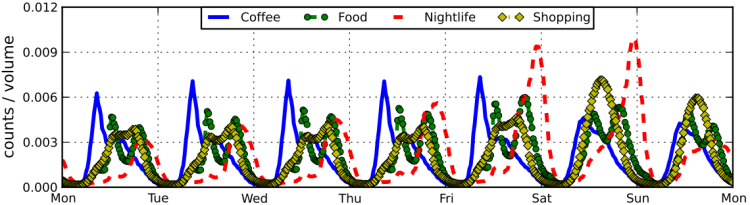
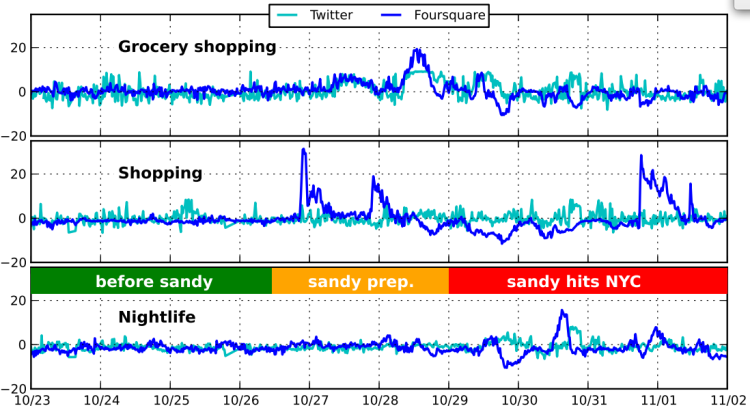
“When rare events at the scale of Hurricane Sandy happen, we expect them to leave an unquestionable mark on Social Media activity.” So the authors applied the same methods used to produce the above graph to visualize and understand changes in behavior during Hurricane Sandy as reflected on Foursquare and Twitter. The results are displayed below .
Click on Image to Enlarge
“Prior to the storm, activity is relatively normal with the exception of iMac release on 10/25. The big spikes in divergent activity in the two days right before the storm correspond with emergency preparations and the spike in nightlife activity follows the ‘celebrations’ pattern afterwards. In the category of Grocery shopping (top panel) the deviations on Foursqaure and Twitter overlap closely, while on Nightlife the Twitter activity lags after Foursquare. On October 29 and 30 shops were mostly closed in NYC and we observe fewer checkins than usual, but interestingly more tweets about shopping. This finding suggests that opposing patterns of deviations may indicate of severe distress or abnormality, with the two platforms corroborating an alert.”
Click on Image to Enlarge
In sum, “the deviations in the case study of Hurricane Sandy clearly separate normal and abnormal times. In some cases the deviations on both platforms closely overlap, while in others some time lag (or even opposite trend) is evident. Moreover, during the height of the storm Foursquare activity diminishes significantly, while Twitter activity is on the rise. These findings have immediate implications for event detection systems, both in combining multiple sources of information and in using them to improving overall accuracy.”
Now if only this applied research could be transfered to operational use via a real-time dashboard, then this could actually make a difference for emergency responders and humanitarian organizations. See my recent post on the cognitive mismatch between computing research and social good needs.
Technology is transforming how everybody builds solutions and faster access to the latest technology gives you an unfair advantage. I work in Silicon Valley and we benefit from that unfair advantage. This is because the technology being invented here is not incremental but disruptive.
EXTRACT:
You will notice the inclusion of Guardtime signatures. By signing all objects with Guardtime signatures it means we no longer have to trust the cloud provider – another game changer! A technology that scales so well it has been included in rysylog.
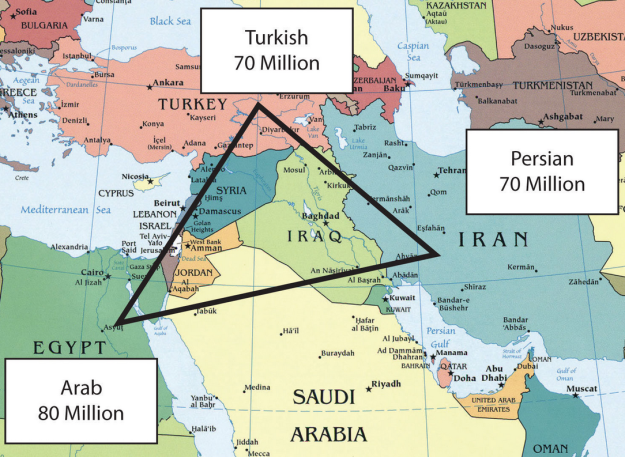
This map that I recently found – Arabs, Persians, and Turks – is a good starting point. When do you think this map was created? I think it reflects thinking from closer to the time Egypt and Syria formed the United Arab Republic than today. The population figure of 70 million for Turkey is within the last ten years, but the thinking is dated.