Narus is a company, now a wholly owned subsidiary of Boeing, which provides real-time network traffic and analytics software with enterprise class spyware capabilities.[1][2] It was co-founded in Israel in 1997 by Ori Cohen, who had served as Vice President of Business and Technology Development for VDONet, an early media streaming pioneer, and Stas Khirman.[3]
Many large Web companies have failed to adopt a decades-old encryption technology to safeguard confidential user communications. Google is a rare exception, and Facebook is about to follow suit.
Revelations about the National Security Agency's surveillance abilities have highlighted shortcomings in many Internet companies' security practices that can expose users' confidential communications to government eavesdroppers.
Secret government files leaked by Edward Snowden outline a U.S. and U.K. surveillance apparatus that's able to vacuum up domestic and international data flows by the exabyte. One classified document describes “collection of communications on fiber cables and infrastructure as data flows past,” and another refers to the NSA's network-based surveillance of Microsoft's Hotmail servers.
Most Internet companies, however, do not use an privacy-protective encryption technique that has existed for over 20 years — it's called forward secrecy — that cleverly encodes Web browsing and Web e-mail in a way that frustrates fiber taps by national governments.
Lack of adoption by Apple, Twitter, Microsoft, Yahoo, AOL and others is probably due to “performance concerns and not valuing forward secrecy enough,” says Ivan Ristic, director of engineering at the cloud security firm Qualys. Google, by contrast, adopted it two years ago.
What does Big Data mean in the context of disaster response? Big (Crisis) Data refers to the relatively large volume, velocity and variety of digital information that may improve sense making and situational awareness during disasters. This is often referred to the 3 V’s of Big Data.
Volume refers to the amount of data (20 million tweets were posted during Hurricane Sandy) while Velocity refers to the speed at which that data is generated (over 2,000 tweets per second were generated following the Japan Earthquake & Tsunami). Variety refers to the variety of data generated, e.g., Numerical (GPS coordinates), Textual (SMS), Audio (phone calls), Photographic (satellite Imagery) and Video-graphic (YouTube). Sources of Big Crisis Data thus include both public and private sources such images posted as social media (Instagram) on the one hand, and emails or phone calls (Call Record Data) on the other. Big Crisis Data also relates to both raw data (the text of individual Facebook updates) as well as meta-data (the time and place those updates were posted, for example).
Ultimately, Big Data describe datasets that are too large to be effectively and quickly computed on your average desktop or laptop. In other words, Big Data is relative to the computing power—the filters—at your finger tips (along with the skills necessary to apply that computing power). Put differently, Big Data is “Big” because of filter failure. If we had more powerful filters, said “Big” Data would be easier to manage. As mentioned in previous blog posts, these filters can be created using Human Computing (crowdsourcing, microtasking) and/or Machine Computing (natural language processing, machine learning, etc.).
Click on Image to Enlarge
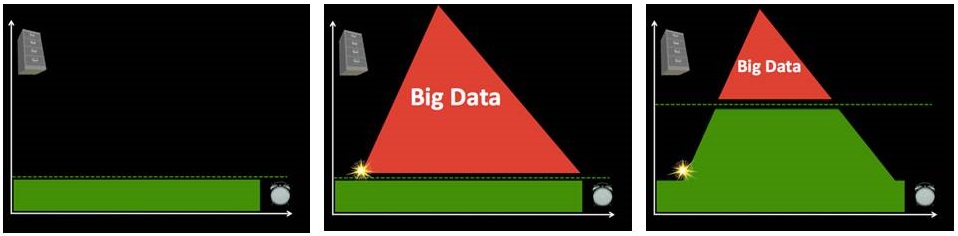
Take the [first] graph, for example. The horizontal axis represents time while the vertical one represents volume of information. On a good day, i.e., when there are no major disasters, the Digital Operations Center of the American Red Cross monitors and manually reads about 5,000 tweets. This “steady state” volume and velocity of data is represented by the green area. The dotted line just above denotes an organization’s (or individual’s) capacity to manage a given volume, velocity and variety of data. When disaster strikes, that capacity is stretched and often overwhelmed. More than 3 million tweets were posted during the first 48 hours after the Category 5 Tornado devastated Moore, Oklahoma, for example. What happens next is depicted in the [second] graph below.
Humanitarian and emergency management organizations often lack the internal surge capacity to manage the rapid increase in data generated during disasters. This Big Crisis Data is represented by the red area. But the dotted line can be raised. One way to do so is by building better filters (using Human and/or Machine Computing). Real world examples of Human and Machine Computing used for disaster response are highlighted here and here respectively.
A second way to shift the dotted line is with enlightened leadership [third graphic]. An example is the Filipino Government’s actions during the recent Typhoon. More on policy here. Both strategies (advanced computing & strategic policies) are necessary to raise that dotted line in a consistent manner.
See also:
Big Data for Disaster Response: A List of Wrong Assumptions [Link]
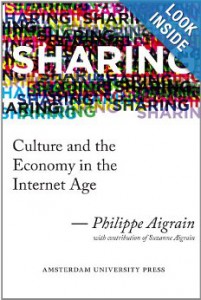
In the past fifteen years, file sharing of digital cultural works between individuals has been at the center of a number of debates on the future of culture itself. To some, sharing constitutes piracy, to be fought against and eradicated. Others see it as unavoidable, and table proposals to compensate for its harmful effects. Meanwhile, little progress has been made towards addressing the real challenges facing culture in a digital world.
Sharing starts from a radically different viewpoint, namely that the non-market sharing of digital works is both legitimate and useful. It supports this premise with empirical research, demonstrating that non-market sharing leads to more diversity in the attention given to various works. Taking stock of what we have learnt about the cultural economy in recent years, Sharing sets out the conditions necessary for valuable cultural functions to remain sustainable in this context.
An in-depth exploration of digital culture and its dissemination, Sharing offers a counterpoint to the dominant view that file sharing is piracy. Instead, Philippe Aigrain looks at the benefits of file sharing, which allows unknown writers and artists to be appreciated more easily. Concentrating not only on the cultural enrichment caused by widely shared digital media, Sharing also discusses new financing models that would allow works to be shared freely by individuals without aim at profit. Aigrain carefully balances the needs to support and reward creative activity with a suitable respect for the cultural common good and proposes a new interpretation of the digital landscape.
Here is the final bit explaining the complete corruption of the financial sector; it deals with the debasing of the the rating agencies. It is blatantly obvious from many sources that the Obama Administration Justice Department has failed to serve the public interest. We are five years past the 2008 meltdown, and it cannot be denied that no real effort has been made at the Federal level to hold these corporations, or the men and w! omen who control them, accountable. Thus, I do not see how it is going to be possible to avoid another meltdown. The system is simply too corrupt, I think it is going to implode again because of its unregulated greed.
Everything Is Rigged: The Biggest Price-Fixing Scandal Ever
Thanks to a mountain of evidence gathered for a pair of major lawsuits by the San Diego-based law firm Robbins Geller Rudman & Dowd, documents that for the most part have never been seen by the general public, we now know that the nation's two top ratings companies, Moody's and S&P, have for many years been shameless tools for the banks, willing to give just about anything a high rating in exchange for cash.
In incriminating e-mail after incriminating e-mail, executives and analysts from these companies are caught admitting their entire business model is crooked.
“Lord help our fucking scam . . . this has to be the stupidest place I have worked at,” writes one Standard & Poor's executive. “As you know, I had difficulties explaining ‘HOW' we got to those numbers since there is no science behind it,” confesses a high-ranking S&P analyst. “If we are just going to make it up in order to rate deals, then quants [quantitative analysts] are of precious little value,” complains another senior S&P man. “Let's hope we are all wealthy and retired by the time this house of card[s] falters,” ruminates one more.
Syria: Today Syrian Information Minister al-Zohbi replied to yesterday's rant by the Saudi Foreign Minister, Saud al Faisal. Al-Zohbi said, “The violence in Syria is being caused by Saudi arms, Saudi money and terrorists linked to Saudi Arabia.” He also said that Saud al Faisal had blood on his hands.
Syria's Al-Baath newspaper said al Faisal is “crazy” and that “Faisal's statements… prove not only that he has become senile and out of touch with reality, but that the Wahhabi regime is falling apart.”
Comment: The Syrian Minister did not blame the West for the uprising, curiously,
In Feedback a Brilliant and perceptive Reader pointed out that the fighting in Syria is about power and regional leadership as much as it is about sectarian dominance. The Baath government in Damascus is the proxy for Iran. Its survival advances Iran's claim to be the regional hegemon and is a major setback to Saudi Arabia's claim.
The Syrian opposition is the proxy for Saudi Arabia which is determined to resist Iranian inroads in the Arab world as much as it resists the spread of Shiite Islam. Saudi Arabia is making a major commitment in Syria to block Iran and stands to lose much clout if the Baathist regime in Damascus lasts.
The Turks attempted to make the leadership power struggle triangular, but the demonstrations seem to have helped undermine the Turkish bid.
A technology proposed to ARPA-E uses electricity to convert natural gas to high octane gasoline, specialty chemicals, and hydrogen in a single process efficiently powered by electricity. The electricity can be generated by efficient turbines. The conversion reactors are modular and can be placed near pipelines in units which can be scaled as needed. Each modular unit using 1 megawatt of energ can produce 50 barrels of gasoline and approximately equal volume of hydrogen. This can provide fuel for transportation, electricity generation and hydrogen from natural has which can be piped from Somalia's natural gas resources.
The electron beams provide very high wall plug efficiency making the process very profitable. $1 a gallon based in today's market price, including operation and maintenance, not including capital costs.
If biomass is added to the process a portion of the output will be diesel and jet fuel.
The high energy electron beam technology works by modifying the hydrocarbon polymers. These devices can be used to remediate water at high speed as they generate massive free radicals which cut all carbin bonds, killing all organisms in water, sewage and sludge. A pilot plant funded by the EPA was operating successfully for many years in Miami, Florida.