Reference: 2011 State of the Future
United Nations & NGOs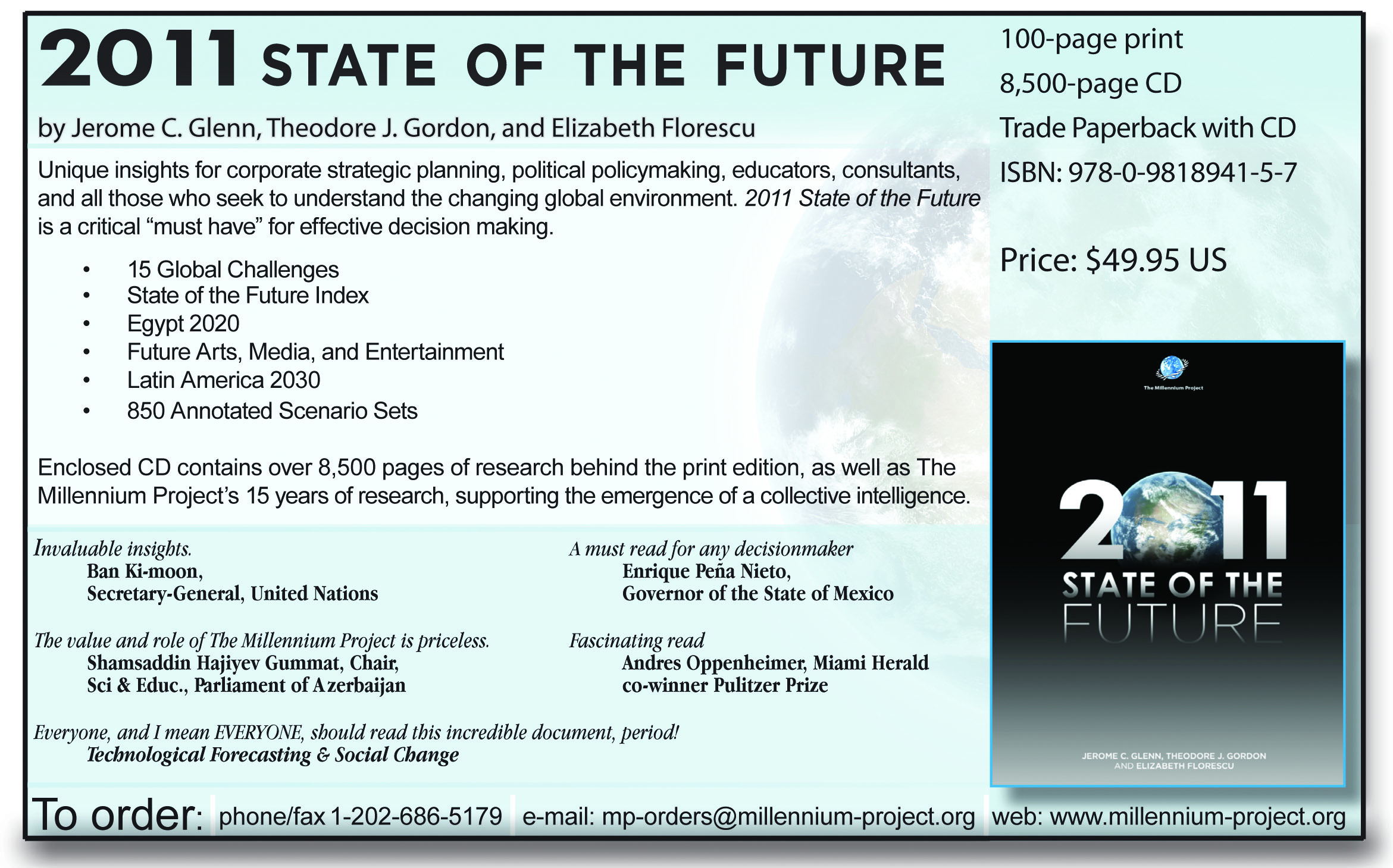
This is a long-standing, deeply developed, and priceless contribution to the global dialog. The fifteen global challenges, listed below, are those of the United Nations Millenium Project.
Search: public administration in 21 century
Searches
UPDATE: Abstract modified by Tom Atlee
New Abstract posted.
4 Comments Received
Harrison Owen: Public Administration in the 21st Century
In the Dark of Night: Public Administration in the 21st Century
Harrison Owen: Public Administration in the 21st Century II
In the Dark of the Night: Public Administration in the 21st Century II
Preliminary reception: What did not work need not be attacked or over-thrown, but it does need to be under-stood, as in “Lessons Learned,” and displaced, as Buckminster Fuller and Mahatma Gandhi both articulated–both favoring, as I do, a non-violent measured and very public approach–transparency as the bridging method. The more this dialog goes forward, the more I see Information Operations as the essence of Public Administration in the 21st Century, with Public Diplomacy including Faith-Based Diplomacy, Commercial Ethics and Lessons Learned, and Civil Affairs all playing a huge role as a facilitator of the birthing process for a new process that is (public) intelligence driven, rooted in holistic integrity, and not at all about command & control or “the plan” but rather at enabling emergence with clarity, diversity, and integrity…more of less the point of the book INTELLIGENCE for EARTH: Clarity, Diversity, Integrity, & Sustainability (EIN, 2010), but now to be refined in the mass market book, Manifesto for Truth: Intelligence with Integrity . . . in the Public Interest (Evolver Editions, July 2012).
– – – – – – –
Jason “JZ” Liszkiewicz asked me to address this one, and I do so gladly.
The signal difference between public administration of the past and of the future is this: governments are no longer central, indeed, governments are so clogged up that many are routing around them.
Public Administration in the 21st Century will be characterized by three major attributes:

1) The public, not the government, will define the rules of the road, the objectives of public policy, and the costs to be authorized. Elites and “experts” are in disgrace for the foreseeable future.
2) Information-sharing and sense-making will be public, not secret. Information, not money, will be the driver of behavior, priorities, and spending. Information, not authority, will be the means by which diverse and disparate entities are harmonized as a virtual whole.
3) “Administration” will be a mis-nomer. The field now called “public administration” is morphing very rapidly into a living discipline that for lack of a better term (yet) I call public intelligence. With everything fragmented and fraud being the norm, there is a need for public intelligence professionals who can help the public connect with truthful information (I love Steve Colbert's truthiness concept).
This is such an interesting topic to me personally that I am going to take some time to review my notes from my preparation for my 1987 written final examination for my Masters in Public Administration (MPA) from the University of Oklahoma (OU), and prepare a new essay on the core concepts and how they are changing.
Step 1: 16 Jul 1200 Fast online literature review (5 page annotated bibliography).
Step 2: 19 Jul 2200 New Abstract (below the line)
Step 3: Essay Document (soon)
Continue reading “Search: public administration in 21 century”
Avaaz.org: Taking Down Rupert Murdoch?
09 Justice, Advanced Cyber/IO, Civil Society, Cultural Intelligence, Ethics
Hacking murdered children's phones, paying off police, destroying evidence of crimes, threatening politicians — UK leaders say Rupert Murdoch's empire has “entered the criminal underworld”. For decades, Murdoch has ruled with impunity — making and breaking governments with his vast media holdings and scaring opponents into silence, but we're fighting back, and winning!
Murdoch's reign of fear is breaking down, and many are on the edge of speaking out against his tactics. The dam is about to break in the US, Australia and elsewhere, but we need to give it an urgent push by investigating Murdoch further, organising high profile opposition, and making sure that our politicians pass laws that will clean up our media for good. Let's make it happen together:
Our community kept campaigning on this issue when almost everyone else in the UK gave up hope. Because we're people-powered, we don't have the same fear of Murdoch that almost everyone else does. It's part of the promise that people power has for change in the world. Today, hope is breaking out in the UK — let's take it global.
Chuck Spinney: How the GOP Became a Death Cult
09 Justice, 11 Society, Civil Society, Corruption, Cultural Intelligence, Government
Zombies on the March
How the GOP Became a Death Cult
By Werther*
Electric Politics, 18 July 2011
Does anyone still remember the GOP of the chowder and marching society, Jell-O salads, Buicks, and cloth coats? Is it conceivable that a Republican could have written the following? —
“Should any political party attempt to abolish social security, unemployment insurance, and eliminate labor laws and farm programs, you would not hear of that party again in our political history. There is a tiny splinter group, of course, that believes you can do these things. Among them are H. L. Hunt (you possibly know his background), a few other Texas oil millionaires, and an occasional politician or business man from other areas. Their number is negligible and they are stupid.”
That was President Eisenhower, writing to his brother Edgar in 1954.
But the Republican Party of 2011 is not your grandfather's GOP, not by a long shot. To be sure, the party always had its share of crackpots, like Robert K. Dornan or William E. Dannemeyer. But the crackpot outliers of two decades ago have become the vital center today: Steve King! Michele Bachman (now a leading presidential candidate as well)! Paul Broun! Patrick McHenry! Virginia Foxx! Louie Gohmert! The Congressional Directory now reads like a casebook of lunacy.
The Republican Party of 2011 believes in three principal tenets (the rest of their platform is essentially window dressing):
1. They solely and exclusively care about their rich contributors, and have built a whole catechism on the protection and further enrichment of America's plutocracy. Their caterwauling about deficit and debt is so much eyewash, intended to con the booboisie. Whatever else President Obama has accomplished (and many of his purported accomplishments are highly suspect), his $4-trillion deficit reduction package did perform the useful service of smoking out Republican hypocrisy. The GOP could not abide so much as a one-tenth of one percent increase on the tax rates of the Walton family (net worth: $86 billion) or the Koch brothers, much less a repeal of the carried interest rule that permits billionaire hedge fund managers to pay income tax at a lower effective rate than cops or nurses.
2. They worship at the altar of Mars. While the me-too Democrats have set a horrible example of keeping up with the Joneses with respect to waging war, they can never match GOP stalwarts such John McCain or Lindsey Graham in their sheer, libidinous enthusiasm for invading other countries. McCain wanted to mix it up with Russia — a nuclear-armed state — during the latter's conflict with Georgia in 2008 (remember? — “we are all Georgians now,” a slogan that did not, fortunately, catch on), while Graham has been persistently agitating for attacks on Iran and intervention in Syria. And these are not fringe elements of the party; they are the leading “defense experts” who always get tapped for the Sunday talk shows. If we are to believe Eric Cantor, a majority of House Republicans will not vote to raise the debt ceiling; yet these are the same people who just passed a defense appropriations bill that increases spending by $17 billion over the prior year's defense appropriation. To borrow Chris Hedges' formulation, war is the force that gives meaning to their lives.
3. Gimme that old time religion. Pandering to religious nuts is a full-time vocation in the GOP. Beginning in the 1970s, religious cranks ceased simply to be a minor public nuisance and grew into the major element of the Republican rank and file. Pat Robertson's strong showing in the 1988 Iowa Caucus signaled the gradual merger of politics and religion in the party. The results are all around us: if the American people poll more like Iranians or Nigerians than Europeans or Canadians on questions of evolution versus creationism, scriptural inerrancy, the existence of angels and demons, and so forth, that result is due to the rise of the Religious Right, its insertion into the public sphere by the Republican Party, and the consequent normalizing of formerly reactionary or quaint beliefs. The Constitution to the contrary notwithstanding, there is now a de facto religious test for the presidency: major candidates are encouraged (or coerced) to “share their feelings” about their “faith” in a revelatory speech; or, some televangelist like Rick Warren dragoons the candidates (as he did with Obama and McCain in 2008) to debate the finer points of Christology, with Warren himself, of course, as the arbiter. Politicized religion is also the sheet anchor of the culture wars. But how did this toxic stew of beliefs come completely to displace Eisenhower Republicanism?
Phi Beta Iota: This article is also recommended by Contributing EditorJohn Steiner.
DefDog: The Clash of Generations by Tom Friedman
03 Economy, 06 Family, 09 Justice, 11 Society, Civil Society, Corruption, Cultural Intelligence, Government, IO Deeds of War
Interesting perspective—especially the common focus on justice against crony capitalism.
Published: July 16, 2011
EXTRACT
Indeed, if there is one sentiment that unites the crises in Europe and America it is a powerful sense of “baby boomers behaving badly” — a powerful sense that the generation that came of age in the last 50 years, my generation, will be remembered most for the incredible bounty and freedom it received from its parents and the incredible debt burden and constraints it left on its kids.
. . . . . . .
I was struck by one big similarity between what I heard in Tahrir Square in Cairo in February and what one hears in Syntagma Square today. It’s the word “justice.” You hear it more than “freedom.” That is because there is a deep sense of theft in both countries, a sense that the way capitalism played out in Egypt and Greece in the last decade was in its most crony-esque, rigged and corrupt deformation, letting some people get fantastically rich simply because of their proximity to power. So there is a hunger not just for freedom, but for justice. Or, as Rothkopf puts it, “not just for accounting, but for accountability.”
Read full article at Friedman's page….
See Also:
Clash of generations: Britain will be rent, not by class warfare, but by an age divide, a new book argues
The Economist, Feb 11th 2010 | from the print edition
David Willetts, The Pinch: How the Baby Boomers Took their Children’s Future—and Why They Should Give it Back (Atlantic Books, 2011)
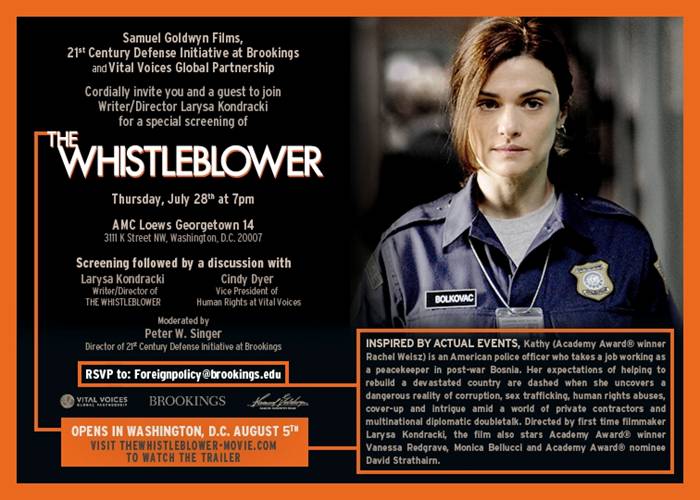
Event: 7 pm 28 Jul DC Movie The Whistleblower (Hosted by the Brookings Institution & Vital Voices Global Partnership
Corruption, Movies, Peace Intelligence