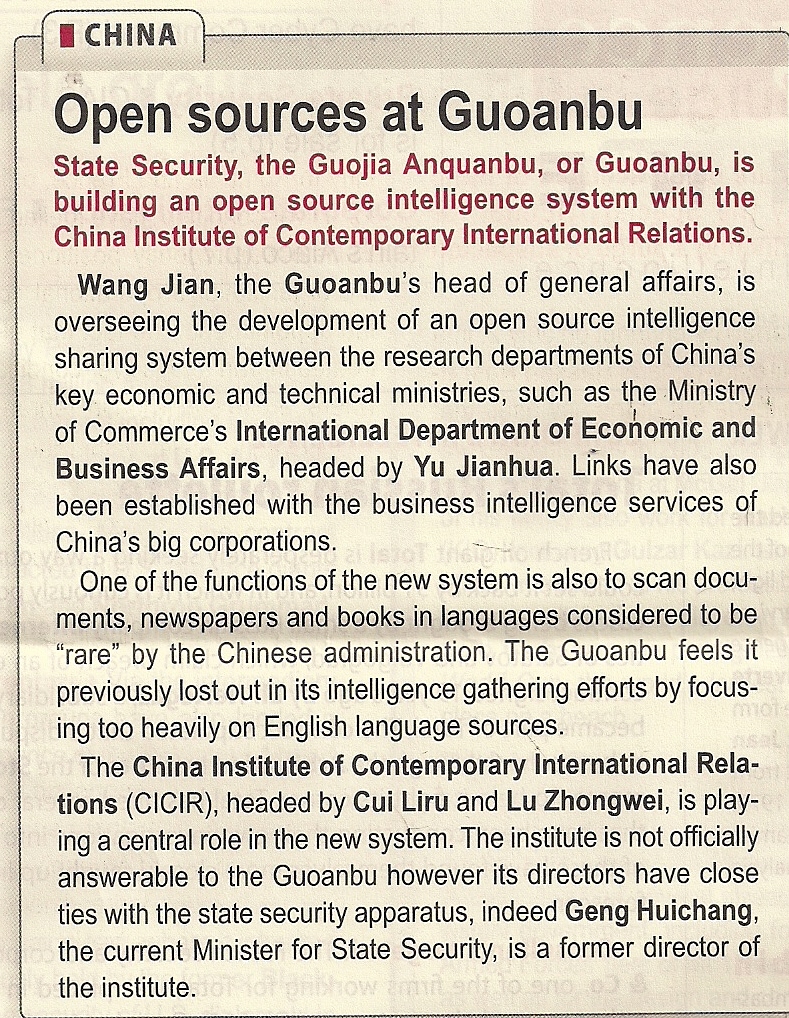
Phi Beta Iota:Intelligence Online is the one subscription we cannot live without. See their other offerings as well. Reading between the lines, it would appear the Chinese no longer feel “behind” the English-language world, and are doing what the English-language world should have been doing since 1988: focusing on reality as it is depicted in all other languages.
I don't usually present another organization's fundraiser in the middle of our Co-Intelligence Institute fundraiser, but this is an exception I feel strongly about.
Generating real wisdom together – not just knowledge and resources (as valuable as these are) – requires talking together. Furthermore, vast domains of our humanity flourish and deepen through conversation. And in both cases, the QUALITY of conversation makes all the difference in the world.
Collectively humanity now knows a lot about how to make powerful, enjoyable, meaningful conversations. A large and rapidly growing field of study and practice stewards these deeply human technologies and explores how to develop them further and use them better for broader benefit. These people bring to life a fundamental co-intelligence precept – accessing the wisdom of the whole on behalf of the whole.
Some of the most dedicated and creative people among those professionals are members of the National Coalition for Dialogue and Deliberation. It is a home base, a learning community, an unparalleled resource – and it could be more. In my opinion, tNCDD nurtures one of the most important networks for the future of the planet. I consider its thrival essential. Furthermore, I have the highest respect for its co-founder and director, Sandy Heierbacher, a grounded, heartful, effective change agent. Her contribution to us all awes me.
NCDD's resource center alone is a priceless gift to each and every one of us. See, in particular, their Beginner's Guide and their “Best of the Best” page .
It goes without saying that I value any support you can give the Co-Intelligence Institute, But I want to urge you here to lend your support to NCDD, whether or not you donate to CII. As I tighten my own belt, I have given NCDD $100. Please read the note below that Sandy sent to me and other NCDD members and consider what you can do.
“This path-breaking collaborative work illuminates complex social and political relationships that constitute governing authority in a changing world. New questions provoke deeper reflection than the term ‘global governance' typically stimulates. Specialists need to read this fine book, and so do students.” Louis W. Pauly, Canada Research Chair in Globalization and Governance, University of Toronto
“This volume makes and illustrates an important fact about global governance today: it isn't only or always the institutional form of actors – be they states, corporations, or NGOs – but their relationships with key constituencies and with one another that shape governance outcomes. Authority, the essence of governance, comes in many guises. I recommend this book highly.” John Gerard Ruggie, Harvard University
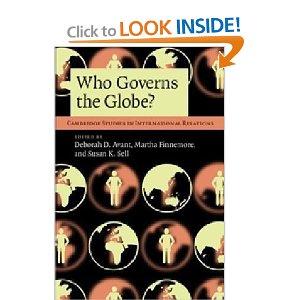
Product Description
Academics and policymakers frequently discuss global governance but they treat governance as a structure or process, rarely considering who actually does the governing. This volume focuses on the agents of global governance: ‘global governors'. The global policy arena is filled with a wide variety of actors such as international organizations, corporations, professional associations, and advocacy groups, all seeking to ‘govern' activity surrounding their issues of concern. Who Governs the Globe? lays out a theoretical framework for understanding and investigating governors in world politics. It then applies this framework to various governors and policy arenas, including arms control, human rights, economic development, and global education. Edited by three of the world's leading international relations scholars, this is an important contribution that will be useful for courses, as well as for researchers in international studies and international organizations.
As part of its expanding counterterrorism program in Somalia, the CIA also uses a secret prison buried in the basement of Somalia’s National Security Agency (NSA) headquarters, where prisoners suspected of being Shabab members or of having links to the group are held. Some of the prisoners have been snatched off the streets of Kenya and rendered by plane to Mogadishu. While the underground prison is officially run by the Somali NSA, US intelligence personnel pay the salaries of intelligence agents and also directly interrogate prisoners. The existence of both facilities and the CIA role was uncovered by The Nation during an extensive on-the-ground investigation in Mogadishu.
The hacktivists behind a hack on The Sun‘s website claim to have extracted an email archive which they plan to release later on Tuesday.
News International's systems were hacked on Monday night. As a result, visitors to The Sun‘s website were redirected towards a fake story on the supposed death of Rupert Murdoch by infamous hacktivist collective LulzSec. The group also redirected visitors to the main News International website to the LulzSec Twitter feed. In addition, the hack may have allowed LulzSec to gain access to News International's email database.
Sabu, a prominent member of LulzSec, said via Twitter that the group was sitting on emails of News International staffers that it planned to release on Tuesday.
The courtiers in the Hall of Mirrors that is Versailles on the Potomac are lining up to give Leon Panetta advice on how to manage the Pentagon in the coming era of budget “constraints.” Most of this wisdom takes the form of platitudes of how important it is to have a strategy and to make the hard choices needed to budget for that strategy. Duh!
My current favorite is Dr. Daniel Goure’s recent blog on the web page of the Lexington Institute, a pro-defense “think tank.”
Goure starts his advisory by saying:
Let’s be honest. The current U.S. defense program is underfunded, even at over $500 billion a year in the base budget and another $100 billion plus in contingency expenses.
Goure then goes on to discuss the need for vision, particularly concerning controlling personnel and health costs and avoiding duplication by transferring work done in government facilities, and by the military, to contractors. In other words, when times are tough, return to the old game of protecting industry at the expense of the soldier and the taxpayer.
Thanks for your honesty, Daniel, but more of the same won’t cut it this time.