Using the tools of corporations to reprogram global society and distribute a new cultural operating system
Image byfdcomite, courtesy of Creative Commons license.
Now that the Evolver network and brand have established themselves to a certain extent, I want to look ahead to developments I hope to see in the near future, with this organization and other initiatives. For the next phase of development, I propose the term “business shamanism.” “Corporate alchemy” would be a viable alternative.
. . . . . . . .
We tend to forget that Roosevelt's New Deal was not a good-hearted gift to the working classes but a compromise to stave off mass uprising. The current oligarchy has determined that it will make no such deal this time around. I suspect they assume that the pulverizing of the populace with mind-numbing media, psychotropic drugs, police state tactics, and poison food had the desired effect. And they may be right.
. . . . . . . .
Phi Beta Iota: Below the line are excerpts. Click on the title to read the entire rant. The author is educated and thoughtful, his rant is provoking and worth studying.
Speakers:
Daniel Ellsberg, Former US Military Analyst
Clay Shirky, Independent Internet Professional; Adjunct Professor, Interactive Telecommunications Program, New York University
Neville Roy Singham, Founder and Chairman, ThoughtWorks
Peter Thiel, President, Clarium Capital; Managing Partner, Founder's Fund
Moderator:
Paul Jay, CEO and Senior Editor, The Real News Network
Additional speakers TBA
A panel of leading thinkers explores WikiLeaks and its implications for access
to information, security, first amendment rights, innovation, and more.
The author is a US Army Col who retired to Italy in 1996. He has written prolifically for the past thirty years and remains active in various informal capacities.
Andrew Carpenter responds (Robert Steele's opening at end):
I offer here a cautionary note in three areas.
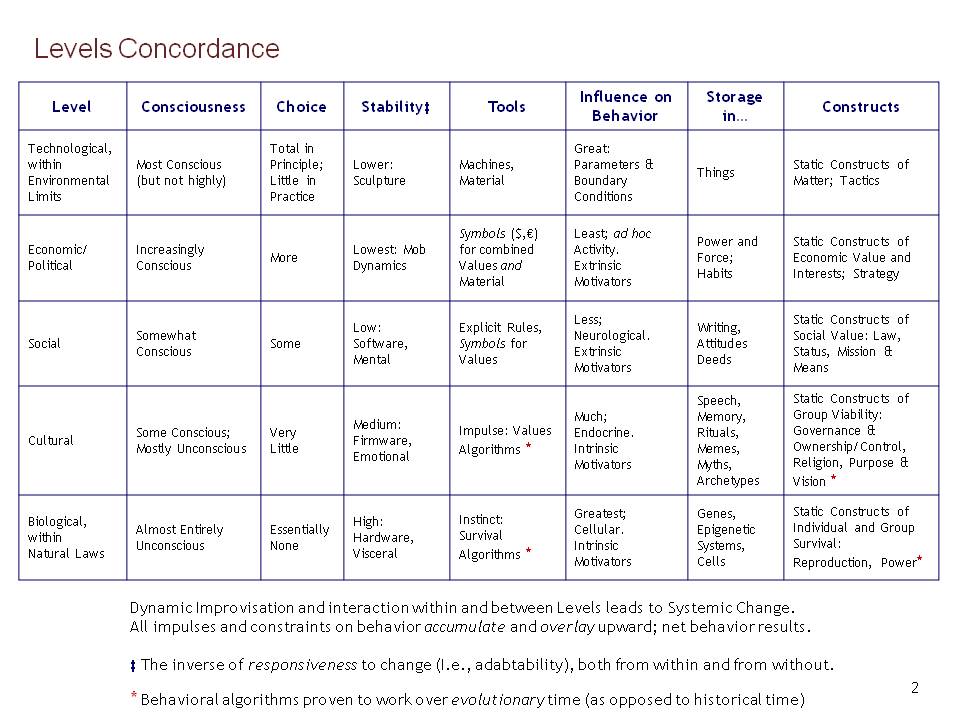
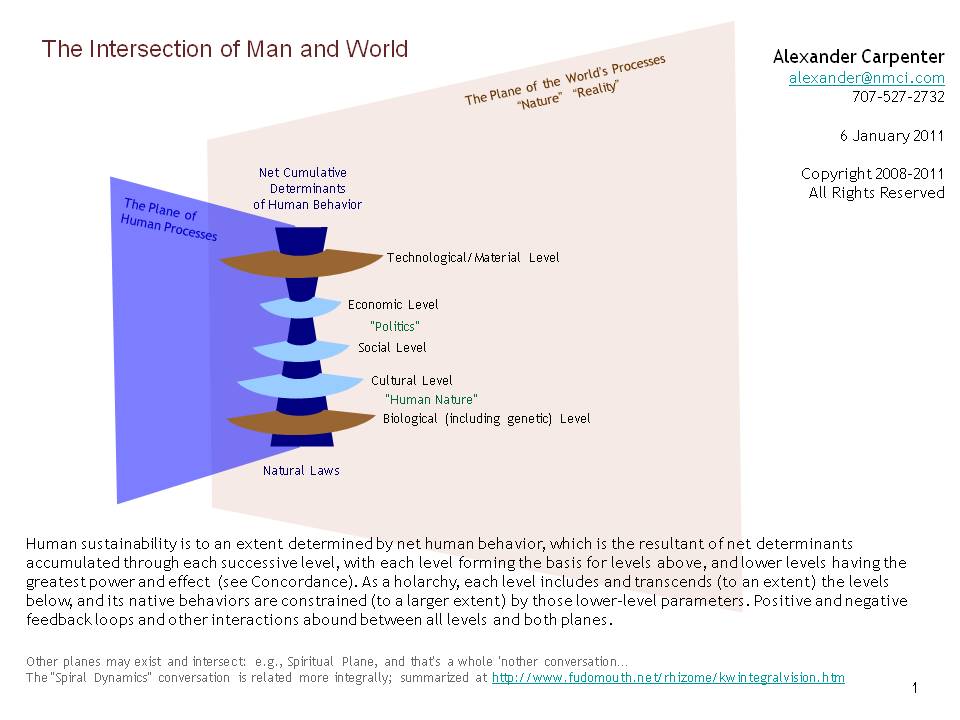
First, Robert, I get that you have a prior commitment to electoral reform, and that's your proprietary thing close to your heart. I note that when you write about it, when you present its rationale and its principles, they are cast in terms of values that are rooted in culture. Your overriding conversation is cultural; yet the proposed solution is social. There is a distinct layering of effective content and influence in our human world; without understanding that layering one is lost at trying to make sense of that world. That is one reason (of many, but this dissonance is fundamental) so many would-be “change agents” are so ineffectual.
To begin to try to start to introduce you to entering into an initial exploration of what in conventional Cartesian terms is a hierarchy of powers (but which is is actuality a holarchy), I am attaching a file that is not a literal sequential exposition of that holarchy (and I recommend you look up that notion for starters, as it is one of the conceptual keys to liberation from our conditioning), a pointillistic file that is a series of illustrations and reminders of structural relationships to support an actual internal conversation in mental-and-emotional real-time, and not a lesson in and of itself. It has not the slightest pretension to being complete. The concepts therein are a visitation from a different paradigm, and cannot be learned through reasoned discourse from within our established mental frameworks, only experienced gradually such that the old paradigm is subsumed into a larger awareness that leaves it behind like counter-intuitive Einsteinian relativity and quantum physics have “left behind” the more-mechanistic and less-sublime Newtonian and Cartesian world-view.
The reason I distinguish between the cultural and social levels in this context is that making new rules (social level) won't change people's net overall behaviors, only new core motivators (cultural level) will. After all, the old rules haven't worked in our present configuration, why would just changing to new ones work without other shifts? New rules alone is like putting lipstick on a pig, like building a house on sand, and a classic case of legislating (a social tool) morality (cultural values). Famous, in all cases, for not working, as values (for good or for ill) will always find a way around, under, over, or directly through rules. We've seen it a gazillion times.

 Business Shamanism