Final Review: Boring, Limited, Not for General Audience
January 3, 2011
After reading this book, which I found to be extremely boring, I have to give Pierre Sprey very high marks for his substantive contributions to the C-SPAN Book interview of the author. My summary of that interview is therefore an important part of my summary of this book. It can be seen at Phi Beta Iota the Public Intelligence Blog by searching for the two names Pierre Sprey William Hartung without quotes or brackets.
I reduce the book to four from five stars because it is a lazy book–no charts, no maps, just a blast of names and dates and numbers–VERY boring. However righteous, this book could have been much better.
Comments:
+ 29B per year in revenue from the Pentagon, probably is low number, is not that much.
+ Lockheed grossly exaggerates job numbers and refuses to back them up.
+ Lockheed wins with low bids and the Pentagon acquisition folks are so inept or politically influenced they accept that.
+ Lockheed is the poster child for a broken acquisition system–quite right–that does not make them the bad guys.
The assassination of Salmaan Taseer has shown only too clearly the growing extremism in Pakistan, the radicalisation of its society and the polarisation that is taking hold. This is not just between the religious and the secular, but also the polarisation that the “war on terror” has caused between the various religious sects.
Is the Global War in Terror Creating More Problems than it is Solving?
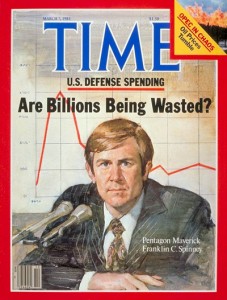
Chuck Spinney
The late historian Chalmers JOHNSON popularized the term “blowback” to describe the unintended grand-strategic consequences resulting from interventionist foreign policies and military actions. The term blowback dates to the CIA's internal history of the US’s 1953 Iranian coup that threw out the Iran's democratically elected Prime Minister Mohammed Mossadegh (a progressive social reformer who wanted to nationalize the oil industry among other things) and replaced him with the tyrannical American puppet Shah Mohammed Reza Pahlevi. No one can doubt that contemporary problems with Iran today are rooted in resentments dating back to the 1953 coup.
I have been researching this topic myself for four or five years now and am familiar with almost every other book in this genre, and I can unequivocally say that this is now the definitive work on the world's financial and banking system, the history of money and power in Western civilization, and the dire prognosis for our economy and our personal freedoms, in general, as a result. It is vastly superior to “The Creature from Jekyll Island”, to compare it to one other fine book on the subject that is now outdated, both in terms of its complete historical coverage, as well as a completely up to date perspective on recent financial history and a deeply insightful analysis of our current debt crisis, why it was let out of control, and who would benefit from its ultimate unwinding. Quite frankly, looking back four to five years from now, this could be the most profound non-fiction work of our times. Robert Hemphill, Credit Manager for the Federal Reserve Bank in Atlanta, when speaking on the same topic as this book, stated, “It is the most important subject intelligent persons can investigate and reflect upon.” I couldn't agree more, and even encourage many unintelligent persons to give it a go. The mechanics of money and finance have a profound affect on every person's life and well being, and is inextricably linked to the fabric of our society and our freedom. Yet it is almost completely ignored and poorly understood by the common man. As Henry Ford said, “It is well that the people of this nation do not understand our banking and monetary system, for if they did, I believe there would be revolution before tomorrow morning.” It's time we all started to understand what's been going on and how it will affect our immediate future.
The Pentagon likes to refer to combat euphemistically as “kinetic” activity. This very important report documents the truly impressive advances in battlefield medicine in Afghanistan to cope with the kinetic activity that hurts our troops. The bottom line: the ratio of killed to wounded has decreased at an amazing rate, because many troop suffering from heretofore fatal wounds involving the destruction of multiple limbs, severe groin, traumatic brain injuries, massive losses of blood, and battlefield shock are now surviving, albeit many in a severely handicapped state. The need to provide quality care and rehabilitation to the severely wounded (as well as the lessor wounded–particularly those with the sharply rising cases of the milder forms of brain trauma) is an as yet unaccounted for cost of the Afghan war that will haunt the American medical system and the larger society for generations.
We can only imagine what is happening to the Afghan civilians on the receiving end of our kinetics.
KHAKREZ DISTRICT, Afghanistan — Intensified fighting and a larger troop presence in Afghanistan in 2010 led to the highest American combat casualties yet in the war, as the number of troops wounded by bullets, shrapnel and bombs approached that of the bloodiest periods of the war in Iraq.
But the available data points to advances in the treatment of the fallen, as the rate at which wounded soldiers who died reached a wartime low.
More than 430 American service members died from hostile action in Afghanistan last year through Dec. 21, according to official data released by the Pentagon last week at the request of The New York Times.
This was a small fraction of those struck. Nearly 5,500 American troops were wounded in action — more than double the total of 2,415 in 2009, and almost six times the number wounded in 2008.
In all, fewer than 7.9 percent of the Americans wounded in 2010 died, down from more than 11 percent the previous year and 14.3 percent in 2008.
Cable from the U.S. Embassy in Tel Aviv says Israeli officials wanted Gaza's economy ‘functioning at the lowest level possible consistent with avoiding a humanitarian crisis.'
Israel told U.S. officials in 2008 it would keep Gaza's economy “on the brink of collapse” while avoiding a humanitarian crisis, according to U.S. diplomatic cables published by a Norwegian daily on Wednesday.
Three cables cited by the Aftenposten newspaper, which has said it has all 250,000 U.S. cables leaked to WikiLeaks, showed that Israel kept the U.S. Embassy in Tel Aviv briefed on its internationally criticized blockade of the Gaza Strip.
The territory, home to 1.3 million Palestinians, is run by the Islamist Hamas group, which is shunned by the West over its refusal to recognize Israel, renounce violence or accept existing interim Israeli-Palestinian peace deals.
“As part of their overall embargo plan against Gaza, Israeli officials have confirmed to (U.S. embassy economic officers) on multiple occasions that they intend to keep the Gazan economy on the brink of collapse without quite pushing it over the edge,” one of the cables read.
Israel wanted the coastal territory's economy “functioning at the lowest level possible consistent with avoiding a humanitarian crisis”, according to the Nov. 3, 2008 cable.
Herewith are the first two parts of Jeff St Claire's important multipart series on the systemic corruption and corporatization of the environmental movement.
A Concise History of the Rise and Fall of the Enviro Establishment
New Year's Edition
December 31, 2010 – January 2, 2011
EXTRACT: Watt, Gorsuch, Levelle and Crowell were magnificent villains for fundraising: direct mail revenues of the top environmental groups exploded tenfold from 1979 to 1981. Green became the color of money, and the rag-tag band of hardcore activists who populated the Hill in the 1970s gave way to a cadre of Ivy League-educated lobbyists, lawyers, policy wonks, research scientists and telemarketers. Executives enjoyed perks and salaries that rivaled those of corporate CEOs.
A Concise History of the Rise and Fall of the Enviro Establishment
By the end of Reagan’s second term, the big environmental organizations were well-pickled in the political brine of Washington, with freshness and passion drained out.
. . . . . .
EXTRACT: Under instructions from Bush, Lujan ordered the Bureau of Land Management to fast track the purchase of the Goldstrike Mine by Barrick Resources, a Toronto-based company controlled by financier Peter Munk. The way thus lubricated, Barrick acquired the 1,800 acre gold mine near Elko, Nevada, for the princely sum of $9,500. By the time the mine is shuttered, the Goldstrike will yield an estimated $10 billion in gold. In 1995, in consideration for his favors, George Bush was invited to join Barrick’s board of advisers.
Phi Beta Iota: The work of Jeffrey St. Claire and CounterPunch are representative of public intelligence in the public interest–the work suffers from being isolated and lacking holistic integrity–there is no means for the public to “connect the dots” or evaluate each predatory move in situ and in context. That is the emergent challenge and opportunity of the 21st Century.



 Final Review: Boring, Limited, Not for General Audience