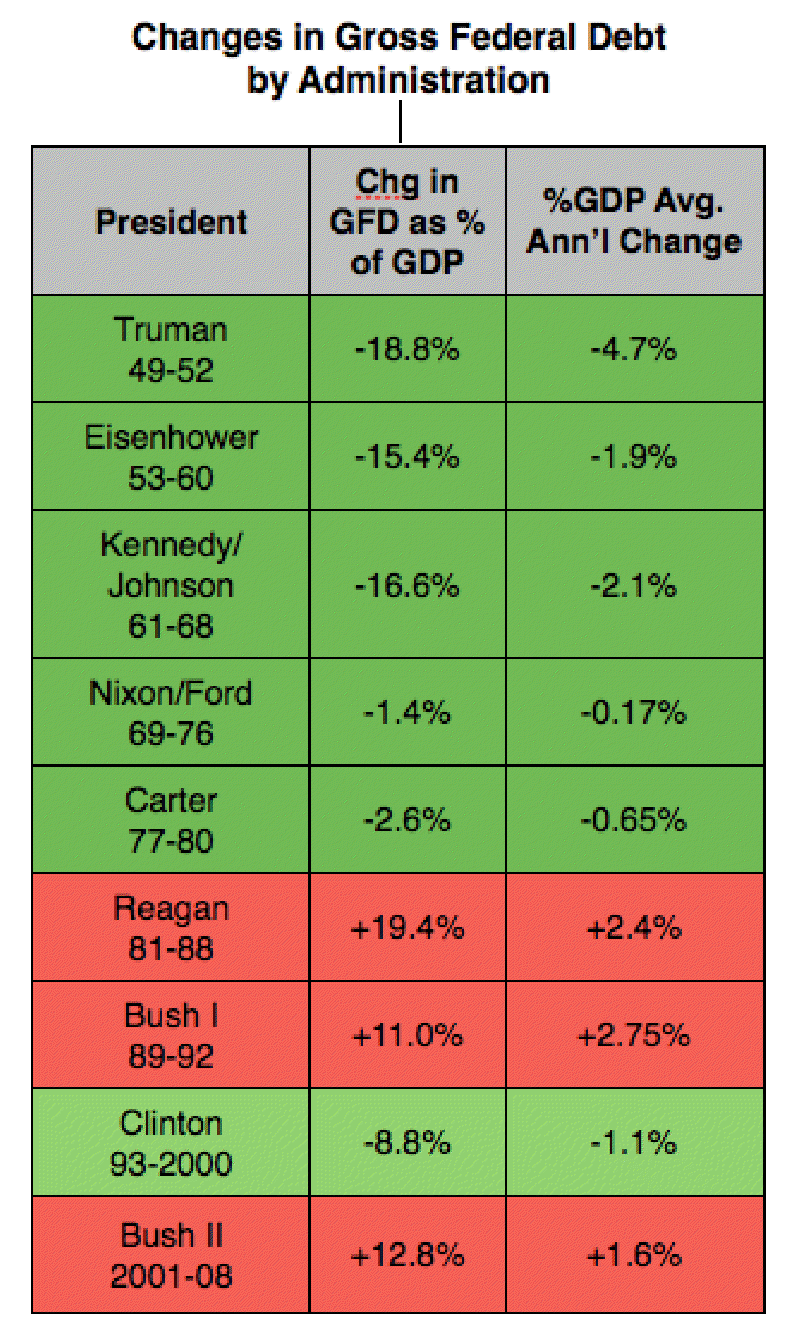
Obama inherited a federal deficit that was spinning out of control (mostly because of decreased tax take and increased expenditures for automatic stabilizers, e.g. unemployment insurance), and pressure is growing to cut Social Security (perhaps the most efficiently run program in government) while placing Defense (one of the most inefficiently run programs) off limits. These political pressures are not new and in fact have been building up for years. So, as a first cut into a complex issue, perhaps it is time for the angry masses to ask which political party put them into the fiscal straight jacket that is setting them up for this horrible choice?
A. Democrats?
B. Moderate Republicans?
C. Right Wing Republicans?
Hint:
Green => Reductions in the burden of Gr. Fed. Debt (as measured by the debt to GDP ratio)
Red => Increases in the burden of Gr. Fed. Debt
KABUL (Reuters) – When NATO leaders gather for a summit in Lisbon next week, where Afghanistan will top the agenda, they can expect a message waiting for them from the Taliban.
That message may well be a violent demonstration of their staying power, even though Washington and U.S. and NATO commanders have been talking up recent successes in Afghanistan before the summit and a strategy review by President Barack Obama next month.
This comes as many European NATO members begin to look at how long they can keep justifying their commitments to an increasingly unpopular war, and as Obama remains committed to beginning a gradual drawdown of U.S. troops from July 2011 before the 2014 goal set by Kabul to take total security responsibility.
President Obama was urged by the few White House insiders from whom he still takes advice to leave the country on his ten-day Asian trip, his longest trip abroad since becoming president, in order to not inflict any more damage to the Democratic Party in the wake of one of the worst electoral defeats for the party of an incumbent president in recent history. According to sources close to the White House, who put themselves in great danger by even talking to members of the media, the plans to have Obama leave for a visit to India, Pakistan, Indonesia, South Korea, and Japan are an attempt to get Obama out of the country while top Democrats can sort through the political disaster created for the party by Obama's increasingly detached-from-reality presidency.
Virtual political guerrilla warfare has broken out between Obama's inner circle on one hand and senior Democratic officials, including outgoing House Speaker Nancy Pelosi, Democratic Party strategist James Carville, former Demcratic National Committee chairman Howard Dean, and, behind-the-scenes, Vice President Joe Biden and former President Bill Clinton, on the other.
Phi Beta Iota: This is a remarkable “hit job” that will need much more corroboration. We see two underlying stories that merit exploration. First Story: Obama is scaring his own party. It took a lot to piece together all the little bits that have been hyped together here. Second Story: Obama is beginning to see that he can only win a second term as an Independent, without Biden and without Clinton II. What we do know is that Obama's advisors to date have been a mix of pogomists, pollsters, and political groupies. If he ever gets a grip on strategic reality and commits to restoring the Republic with Electoral Reform, he could still be the George Washington of the 21st Century. On this article, at this time, we stand with Barack Obama and not his detractors.
Complete Madsen reprint below the line so our military colleagues do not have to visit the other site.
Sneaking subs into waters off the west coast — its happened before
By Wayne Madsen
The firing of a submarine-launched ballistic missile by a Chinese Jin-class submarine off the coast of southern California last Monday at the height of evening rush hour in Los Angeles was not the first time the U.S. Navy's anti-submarine warfare sensors in the Pacific have failed.
In 1981, a Soviet Victor-class nuclear submarine successfully evaded the Navy's Sound Surveillance System (SOSUS) network of underwater hydrophones, Towed Array Sensor System (TASS) ships, and P-3 sonobuoy-equipped aircraft and popped up off the Oregon coast alongside a Soviet fishing fishing trawler.
Phi Beta Iota: We only know that we do not know the full story. We do believe that China and Russia are furious over Wall Street to Washington financial irresponsibility. The Chinese have a sense of humor, having previously popped a submarine up directly behind a US carrier after sneaking through an entire carrier battle group. This could be related to blocking any further US military exercises in the waters around Taiwan. The US Government really does not “understand” how quickly Taiwan is going to follow Hong Kong into mainland control. Sadly, we cannot rely on the US Navy or the US Government to be open with its own public on what is known about this matter.
Complete Madsen reprint below the line so our military colleagues do not have to visit the other site.
Starting with extensive data, which showed that Americans began to change their borrow-and-spend ways long before the start of the crisis, we — as authors of Spend Shift — set off across the country to find people who were reinventing their lives in the wake of the “Great Recession.” The stories we gleaned help us see how the crisis has rearranged our priorities, awakened our creativity, and reconnected us to the people and things that really matter. The faces of the Spend Shift suggest that the consumer is adaptable, business is adaptable, and the future is not as dim as it appears.
WASHINGTON, Nov. 9, 2010 /PRNewswire-USNewswire/ — Fears of false flag and foreign funded covert operations designed to influence U.S. policy drove the Senate Foreign Relations Committee to launch exhaustive investigations and call for warranted enforcement of the Foreign Agents Registration Act (FARA). A newly declassified March 17, 1961 memo unsealed and released by the National Archives and Records Administration on October 21, 2010 outlined the Senate's rationale for investigating Israel lobbying groups and other foreign agents active across the United States.
“In recent years there has been an increasing number of incidents involving attempts by foreign governments, or their agents, to influence the conduct of American foreign policy by techniques outside normal diplomatic channels…..there have been occasions when representatives of other governments have been privately accused of engaging in covert activities within the United States and elsewhere, for the purpose of influencing United States Policy (the Lavon Affair).”
The Lavon Affair refers to a false flag Israeli terrorist bombing plot code named “Operation Susannah” against U.S. targets in Egypt. It was designed to reverse U.S. policy pressuring British withdrawals and reverting control of the Suez Canal to Egypt. Israeli agents infiltrating as Arabs were discovered, arrested and criminally prosecuted in Egypt when their explosives malfunctioned, leading to a crisis in the Israeli government.
Here's a short essay on a new software tool my team built called Momentum. It does something pretty unusual and worthy of note. It uses crowdsourcing (by leveraging the work of 500 million users on global social networks) to make open source intelligence gathering easy.*
___________________
Here are some real life events: A YouTube video sparks massive ethnic riots in China. 3 Colombians start a Facebook group that puts 5 million protesters on the streets. The online manifesto of a disturbed man holding hostages at a US corporation. The list of keywords that China's great firewall blocks. A YouTube video showing Iranian militia actually shooting protesters. The list goes on and on.
These are the kinds of events that should be detected by OSINT analysts. However, they aren't detecting them. Why not? The tools they are using don't make finding this information easy.
Here's why. A major problem with the tools that automate open source intelligence gathering is that relevance, serendipity (the propensity of making fortunate discoveries while looking for something else), and timeliness (the ability to find content that matters quickly) are considered tradeoffs. You can't focus on relevance without losing serendipity and you can't focus on serendipity without losing timeliness.
For example:
I am gathering open source intelligence on Iran using the Web. But I run into the following problems with the tools I normally use: