Phi Beta Iota: Read every word. Highlights include:
;1) Every province is difference (see General Zinni's characterization of the six different Viet-Nam wars in Battle Ready)
2) Climate and Ops Tempo, not the Taliban, are the major challenge
3) Taliban losing, resorting more to terror against civilians
4) NATO works–could not have done AF without NATO C4I
5) Not a single word about civilian stabilization & reconstruction assistance, which appears to be dead in the water with AID pulling back
Our Conclusion: Having tried and failed at everything else, we are now at the cusp of the “Brass Hour” in both IQ and AF but the military is failing to do the homework needed to present a compelling case for fur a “Berlin Airlift” into both countries that overwhelms the population with what we should have used the first time around: language-qualified Muslim engineers from Indonesia and Malaysia and Turkey, along with a mini-Marshall Plan that wages peace without end. One Tribe at a Time, Yes, But Bring Peace Goods with You….
Nicht Schwerpunkt as a Prescription for Defeat by a 1000 Cuts
Operation Barbarossa
Recent events like the Fort Hood Massacre and the bungled attempt to fire bomb the airliner bound for Detroit have focused attention on and encouraged our escalating intervention in Yemen, which has been taking place quietly, as if Iraq, Afghanistan, and Pakistan were not enough to keep our strategic planners and stretched out military forces occupied. Our reactions to events in the so-called Long War on Terror suggest an aimless spreading of effort throughout the Middle East and Central Asia. This aimlessness brings to mind a comment General Hermann Balck, a highly decorated German officer in WWII, made to a small group of reformers in the Pentagon in the early 1980s. The subject was Operation Barbarossa, or Germany's invasion of the Soviet Union in June 1941. Balck pithily dismissed the German strategy shaping that invasion with the words: “Nicht Schwerpunkt.” Balck was saying there was no focus or main effort to the German invasion, and without a focus, there was no way to harmonize the thousands of subordinate efforts. The result was a spreading of effort that led to eventual overextension as can be seen in the following map.
Now the Eastern Front of WWII is very different from the ridiculously misleading label of a Central Front in the Long War on Terror. But the idea of schwerpunkt is germane to both efforts, and the US is showing all the signs of spreading and over extending its efforts which accompany a nicht schwerpunkt.
This is no small thing. As the American strategist Colonel John Boyd showed in his famous briefing, Patterns of Conflict, the idea of a schwerpunkt is central to organizing all effective military operations. It is far more than a simple question of concentrating forces. According to Boyd, the idea of a “Schwerpunkt represents a unifying medium that provides a directed way to tie initiative of many subordinate actions with superior intent as a basis to diminish friction and compress time in order to generate a favorable mismatch in time/ability to shape and adapt to unfolding circumstances.” Now this is a very compressed statement, pregnant with information, and based on a lot of research, but it nevertheless makes it self evident that there is no comparable unifying medium in America's Long War on Terror. Our failure to form a schwerpunkt is just as much a prescription for paralysis and defeat by a thousand cuts in a guerrilla war as it is in a mechanized conventional war between standing armies.
To see why, consider please the following three attachments:
UN-SPIDER (“United Nations Platform for Space-based Information for Disaster Management and Emergency Response”) aims at providing universal access to all types of space-based information and services relevant to disaster management by: being a gateway to space information for disaster management support; serving as a bridge to connect the disaster management and space communities; and being a facilitator of capacity-building and institutional strengthening
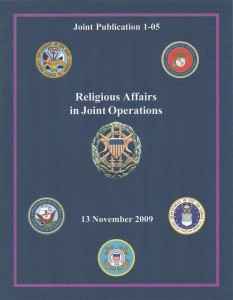
This handbook is nothing more than a Chaplain's Rice Bowl. It has nothing to do with what we were hoping for, Religious Engagement. For that, see the two references below by Capt Doug Johnston, USN (Ret), still the Top Gun on the topic. JCS needs to completely rewrite this publication, triple it in breadth and depth, and get a grip on religious engagement tactics, techniques, and procedures before, during, and after operational engagement.