Very important article from one of the very best reporters covering the Middle East
Walking Into the Al-Qaeda Trap
Touch Yemen, Get Burned
By PATRICK COCKBURN
December 31, 2009
Skip to End of Article:
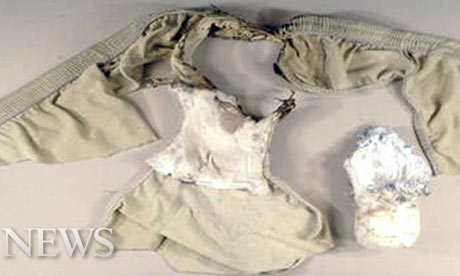
It is extraordinary to see the US begin to make the same mistakes in Yemen as it previously made in Afghanistan and Iraq. What it is doing is much to al-Qa’ida’s advantage. The real strength of al-Qa’ida is not that it can ‘train’ a fanatical Nigerian student to sew explosives into his underpants, but that it can provoke an exaggerated US response to every botched attack. Al-Qa’ida leaders openly admitted at the time of 9/11 that the aim of such operations is to provoke the US into direct military intervention in Muslim countries. It is a formula which worked under President George W Bush and it still appears to work under President Barack Obama.
In Yemen the US is walking into the al-Qa’ida trap. Once there it will face the same dilemma it faces in Iraq and Afghanistan. It became impossible to exit these conflicts because the loss of face would be too great. Just as Washington saved banks and insurance giants from bankruptcy in 2008 because they were “too big to fail,” so these wars become too important to lose because to do so would damage the US claim to be the sole super power.
In Iraq the US is getting out more easily than seemed likely at one stage because Washington has persuaded Americans that they won a non-existent success. The ultimate US exit from Afghanistan may eventually be along very similar lines. But the danger of claiming spurious victories is that such distortions of history make it impossible for the US to learn from past mistakes and instead to repeat them by intervening in other countries such as Yemen.
I would argue further that Barack Obama's election to the presidency of the United States was essentially an American sophistication, a national exercise in seeing what was not there and a refusal to see what was there—all to escape the stigma not of stupidity but of racism. . . .
Mr. Obama's economic thinking (or lack thereof) adds up to a kind of rudderless cowboyism combined with wishful thinking. You would think that in the two solid years of daily campaigning leading up to his election this nakedness would have been seen. . . .
On the foreign front he has been given much credit for his new policy on the Afghan war, and especially for the “rational” and “earnest” way he went about arriving at the decision to surge 30,000 new troops into battle. But here also were three months of presidential equivocation for all the world to see, only to end up essentially where he started out.
And here again was the lack of a larger framework of meaning. How is this surge of a piece with America's role in the world? . . .
I think that Mr. Obama is not just inexperienced; he is also hampered by a distinct inner emptiness—not an emptiness that comes from stupidity or a lack of ability but an emptiness that has been actually nurtured and developed as an adaptation to the political world
With year one drawing to a close, the truth of the Obama presidency is laid bare: retrenchment abroad, and redistribution and the intrusive regulatory state at home. . . .
It is different today, there is a cold-bloodedness to American foreign policy. “Ideology is so yesterday,” Secretary of State Hillary Clinton proclaimed not long ago, giving voice to the new sentiment. . . .
History and its furies have their logic, and they have not bent to Mr. Obama's will.
Comment: This is pathetic.No one now serving in the White House is capable of telling the President the truth–that our $75 billion a year is wasted, that the agencies are suffering from 1950's mindsets with 1970's technology and security and legal blinders that are the operational equivalent of castration.Until the President, General Jones, and Admiral Blair are willing to recognize reality, this will continue to be a national disgrace.Condi Rice has a chance to fix all this (IC Memo, DHS Memo), as did Admiral McConnell (One Pager), the pathos is that until the President is willing to break some china and cut some budget whiile launching a multinational multifunctional information-sharing and sense-making network that defaults to NOT SECRET, the USA will continue to be Stupid Nation as opposed to a Smart Nation as we proposed in 1995.Within DoD, they keep doing the wrong thing righter instead of the right thing faster, better, cheaper. This is a tragedy of historic proportions.
Thomas Lipscomb is a fellow of the Annenberg Center for the Digital Future (USC). as published in Huffington Post.
It isn't the terrorists who have created the morass of asinine travel restrictions. They are thoughtlessly piled on by CYA-schooled public servants willing to do anything but really seriously think about what they are doing.
Incompetent State Department consular officials and poor enforcement of visa procedures that have been in place long before the personal computer, the Xerox machine or even the jet airliner are the problem here. And we aren't hearing a word about it.
Better the American public should be forced to endure another blizzard of press releases announcing another round of ridiculous indignities by dazzling Rube Goldberg technology rather than have our press and our government demand an accounting from the employees at a government bureaucracy who can't even comply with their own time-tested procedures.
1. No existing search procedures will find virtual diapers full of explosives.
2. US blew it–they approved the individual by name in advance of take-off from The Netherlands. Had the US had its act together, it had enough information to warrant a full body search “with significance” as the Spanish like to say.
Full Story Online
Spy Agencies Failed to Collate Clues on Terror
By MARK MAZZETTI and ERIC LIPTON December 31, 2009
The National Security Agency intercepted discussions of a plot by leaders of Al Qaeda in Yemen, but spy agencies did not combine the intercepts with other information.
. . . . . . .
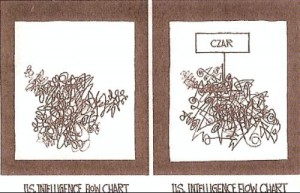
In some ways, the portrait bears a striking resemblance to the failures before the Sept. 11 attacks, despite the billions of dollars spent over the last eight years to improve the intelligence flow and secret communications across the United States’ national security apparatus.
WASHINGTON — The finger-pointing began in earnest on Wednesday over who in the alphabet soup of American security agencies knew what and when about the Nigerian man charged with trying to blow up an airliner.
. . . . . . .
Eleanor Hill, staff director of the joint Congressional inquiry into Sept. 11, called the emerging story “eerily similar to the disconnects and missteps we investigated.”
“There seems to have been the same failure to put the pieces of the puzzle together and get them to the right people in time,” Ms. Hill said.
In the wake of the latest terrorist incident (the ‘underpants bomber’) President Obama has identified the U.S. National Security Establishment as flawed and singled out the U.S. Intelligence System for failing to “connect the dots” in spite of having significant information about the alleged terrorist before he tried to execute his plan. Of course the talking head counter-terrorism “experts” have also taken up the hue and cry that the U.S. is in mortal danger because of what President Obama called “systemic failures” within the National Security Establishment. This is rather troubling since much the same litany was heard after the East African embassy bombings in 1998, the bombing of the USS Cole in 2000 and of course the tragic events of September 11, 2001. Indeed the publicly available facts suggest that yet again the U.S. Intelligence System failed to analyze the available information, identify a clear threat and to produce an assessment of this threat.
The public intelligence network (PIN, as in pin stuck in the side of the organization) might be:
– an advisory board, advising the institution via the board of directors.
– an intelligence service in support of the board
– a virtual and non-voting public “member” of the board of directors.
The PIN would key off the agenda of the board, using it where it makes sense, and criticizing it or adding to it where needed. It would help to have the cooperation of board members who would keep the PIN informed, and to speak on its behalf during board meetings. Otherwise, the management can continue to monitor what the PIN is saying to the board, and this is a benefit to the board because it maintains pressure between board meetings.
In Nineteen Eighty-Four, George Orwell described a superstate called Oceania, whose language of war inverted lies that “passed into history and became truth. ‘Who controls the past', ran the Party slogan, ‘controls the future: who controls the present controls the past'.”
Barack Obama is the leader of a contemporary Oceania. In two speeches at the close of the decade, the Nobel Peace Prize winner affirmed that peace was no longer peace, but rather a permanent war that “extends well beyond Afghanistan and Pakistan” to “disorderly regions and diffuse enemies”. He called this “global security” and invited our gratitude. To the people of Afghanistan, which America has invaded and occupied, he said wittily: “We have no interest in occupying your country.”