Google just announced that it's invited cities in nine metro areas across the US to explore “what it would take” to bring its Google Fiber gigabit internet service to more locations. “People are hungrier than ever for faster Internet, and as a result, cities across America are making speed a priority,” Google says. “We've long believed that the Internet’s next chapter will be built on gigabit speeds, so it’s fantastic to see this momentum.” Google says up to 34 cities in all could potentially receive Fiber service. The nine metro areas where those cities are located include:
It’s an odd thing, really. in certain precincts of the left, especially across a broad spectrum of what could be called the economic left, our (by which I mean humanity’s) accelerating trajectory toward the climate cliff is little more popular as a topic than it is on the right. In fact, possibly less so. (Plenty of right-wingers love to talk about climate change, if only to deny its grim and urgent scientific reality. On the left, to say nothing of the center, denial takes different forms.)
Sometimes, though, the prospect of climate catastrophe shows up unexpectedly, awkwardly, as a kind of non sequitur—or the return of the repressed.
I was reminded of this not long ago when I came to a showstopping passage deep in the final chapter of anarchist anthropologist David Graeber’s The Democracy Project: A History, a Crisis, a Movement, his interpretive account of the Occupy Wall Street uprising, in which he played a role not only as a core OWS organizer but as a kind of house intellectual (his magnum opus, Debt: The First 5,000 Years, happened to come out in the summer of 2011). Midway through a brief discourse on the nature of labor, he pauses to reflect, as though it has just occurred to him: “At the moment, probably the most pressing need is simply to slow down the engines of productivity.” Why? Because “if you consider the overall state of the world,” there are “two insoluble problems” we seem to face: “On the one hand, we have witnessed an endless series of global debt crises…to the point where the overall burden of debt…is obviously unsustainable. On the other we have an ecological crisis, a galloping process of climate change that is threatening to throw the entire planet into drought, floods, chaos, starvation, and war.”
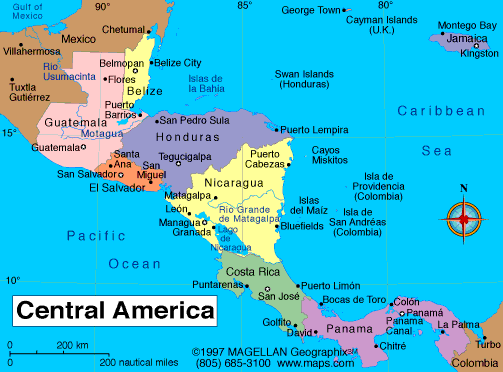
After the recent summit of the Community of Latin American and Caribbean States (CELAC), at which the U.S. was not represented, Washington is trying to get revenge in Central America. On February 2 presidential and parliamentary elections took place in El Salvador and Costa Rica.
Click on Image to Enlarge
Most predictions indicated the possibility that leftist politicians may come to power in these countries: in Costa Rica the leader of the Broad Front, Jose Maria Villalta; and in El Salvador, Salvador Sanchez Ceren, the candidate from the Farabundo Marti National Liberation Front (FMLN). It was not ruled out that there could be a second round of elections, as in both countries there were record numbers of presidential candidates; the electorate was divided, and it was difficult to get enough votes to win. That is what occurred.
In Costa Rica, Villalta was unexpectedly eliminated from the presidential race, having taken third place among the candidates. The propaganda campaign conducted against him by the local oligarchs and U.S. intelligence, who portrayed him as a «Bolivarian agent» financed by «populist» countries, played a role. «My opponents could not accuse me of corruption, so they called me a communist,» lamented Villalta. Now Araya Monge, the candidate from the ruling National Liberation Party; and Luis Solis Rivera of the Citizens’ Action Party, whose political platform is described in the media as «leftist», will fight for victory.
However, one should not have any illusions. The “leftness” of Solis Rivera is highly dubious. He has been in good standing at the American embassy since he studied at Tulane University in New Orleans and at the University of Michigan as a Fulbright Scholar. Solis Rivera could be called the political understudy of Oscar Arias, the former president of Costa Rica and an agent of Washington’s influence in Central America used for systematic attacks on «populist regimes».
ECUADOR INITIATIVE: Transition Proposals Toward a Commons-Oriented Economy and Society
Sponsored by the National Institute of Advanced Studies of Ecuador, carried out by the Free/Libre Open Knowledge (FLOK) Society.
Marc Gauvin is actively engaged in the Ecuador endeavor. Establlishing true value is as important as establishing true cost — the first is social value, the second ecological value.
B.I.B.O. is an acronym referring to “Bounded Input Bounded Output” The sine-qua-non requirement for stability in the types of systems that include any money system. Passivity refers to a particular case of BIBO where output never exceeds input or in the case of currency, debt is always less or equal to prices i.e. money is not a negotiable object as explained in this document).
BIBO precisely defines stability in Control Systems Engineering. Understanding BIBO as applied to money systems is crucial as it provides a powerful basis for logically dispelling the current false money paradigm. It explains why almost everything we have been conditioned to believe about money is logically and mathematically inconsistent and the exact opposite of what is scientiically required to bring stability to money. The conclusion of having applied Control Systems and Stability theory to money can be best summarised by the following theorem:
The documentary ‘Thinking Cities' deals with one of the most dramatic societal trends happening today: urbanization. The world population is expected to soar to more than 9 billion people by 2050, with roughly 70 percent living in cities. At the same time, Information Communications Technology (ICT) is extending its reach.
Focus is on the science of cities. Cities concentrate everything, both good and bad. ICT pervasiveness is the game changer. ICT is like water, but carries intelligence. Mayors — not Governors, Prime Minsters, or Presidents — are the center of gravity for achieving 21st Century hybrid governance. Urban Mechanics and Participatory Urbanism are emerging. Apps now available for citizens to report anything from potholes on, while optimizing city respopnsiveness to those reports in the aggregate. This is not just about efficiency, it is about rebuilding trust with the citizens. At the same time the new approach enables bottom-up resilience — solar collected at the house level feeding the grid, for example.
In two recent articles we explained the hows and whys of gold price manipulation. The manipulations are becoming more and more blatant. On February 6 the prices of gold and stock market futures were simultaneously manipulated.