I find it hard to believe the United States is bringing back debtor prisons, but that appears to be the case, as reported in the Guardian, arguably the best and most independent newspaper in the English language. The elimination of debtor prisons was something the Founders took as a very serious goal for their new country. So much for the Founders, they are trumped by the new private for-profit prison trend.
Here is what I think is the truth. We could make the conversion to non-carbon energy within a generation if we could muster the political and social will to do so. Sadly, I am afraid the secret government within the government that is controlled in large measure by carbon energy intere! sts, combined with the almost grotesque ignorance of the American electorate will not allow it to happen. But it could be done, and it would be significantly cheaper for customers, would create tens of thousands of jobs, as weel as improving the economy.
Stanford Woods Institute for the Environment Senior Fellow Mark Jacobson says the United States has the technology and logistical ability to convert to all-renewable energy sources by 2050-if we can manage to exercise the social and political will to do so. He’s the guy who told David Letterman we already have enough wind to power the entire world ‘seven times over.” Now he has proven his point with a groundbreaking roadmap to clean energy for all 50 U.S. states.
With colleagues from academia and industry, Jacobson-a professor of civil and environmental engineering at Stanford and a senior fellow at the Precourt Institute for Energy-recently developed detailed plans that three states (New York, 2/18/13; Washington, 1/14/14; and California, yesterday-2/22/14) could use to switch over their energy infrastructures from conventional fuels to 100% renewable resources by 2050. As Jacobson uses the term, ‘infrastructure” includes electric power, transportation, heating/cooling, and industry uses. ‘Renewable power” is derived primarily from wind, water, and sunlight (WWS), generating electricity and electrolytic hydrogen.
Some findings of research behind the plans:
Powering the U.S. with only wind, water, and solar energy sources would save the average consumer $3,400 per year.
Over 15 years, driving an electric car could save $20,000-$40,000 in energy costs.
In 2013, states endowed with greater wind power had energy costs increase 3 cents; all other states (except Hawaii) saw costs increase 4 cents.
Large offshore wind farms could reduce hurricane storm surges up to 80% and wind speeds up to 50%.
Powering the country solely with WWS could generate a 3% GDP uptick.
Building the infrastructure for a global community of a commons-based peer society
Realizing, merging, funding, organizing & expanding the global commons – knowledge, culture, means of production and land property.
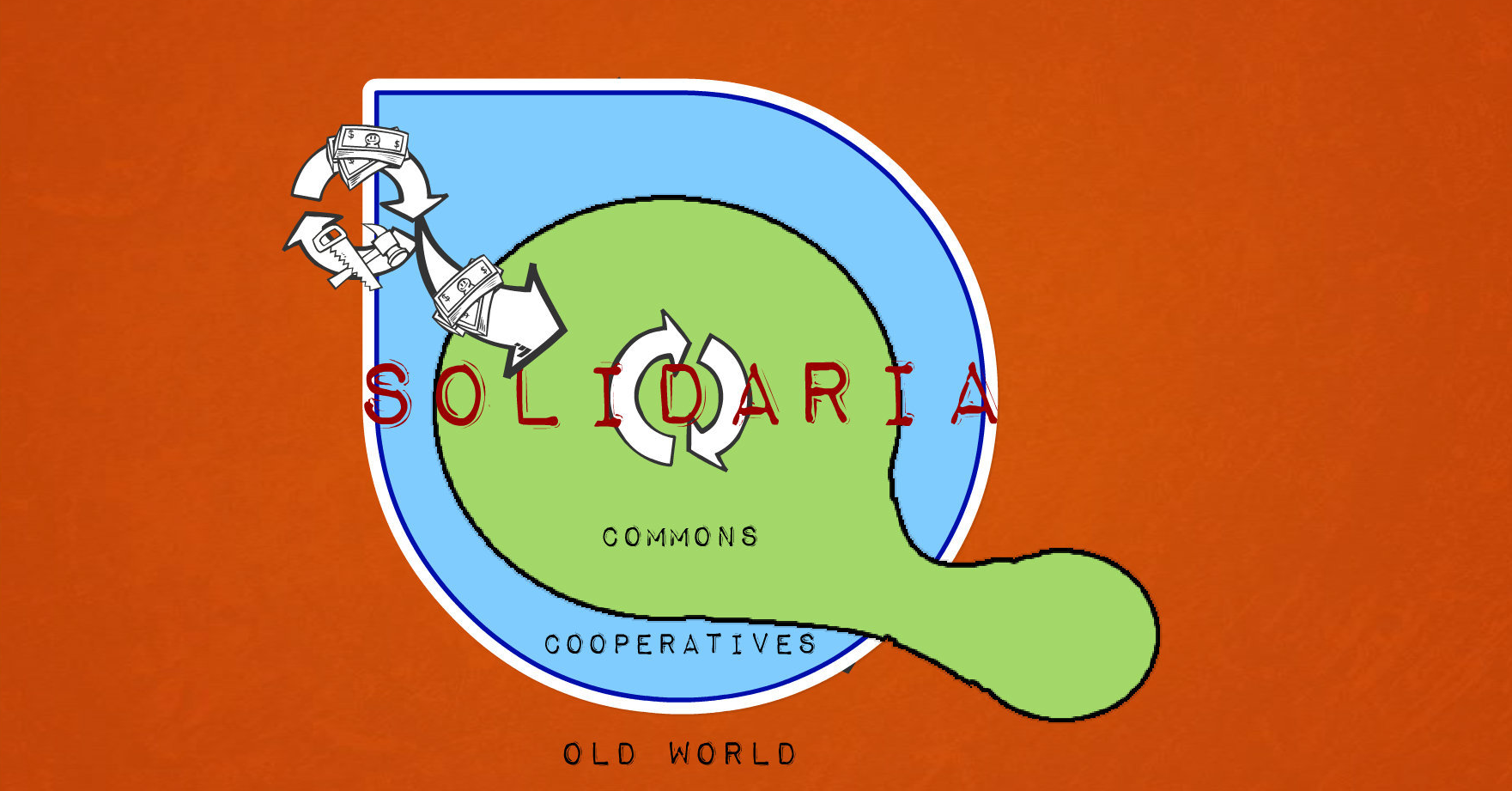
Solidaria will open up a space where all our activity is aimed towards extending the commons – open knowledge and freeculture as well as the material commons like housing, property and means of production!
Clikc on Image to Enlarge
It enables you to work in cooperatives of the commons based peer-to-peer economy, no matter if you’re working in the knowledge economy or in a classical field. And it enables you to work for the commons even in projects that normally wouldn’t be economically viable – and still make a living off it! The decision which project you want to work on does not depend on the question if it is convertible into something commercial – all that matters is that you are contributing to the commons.
And it gives you back the power over how the economy works by opening up economic and environmental decisions to all stakeholders – it’s not the capitalist elite deciding anymore, but also not only the people inside the cooperatives, it’s everyone!
It gives you the opportunity to consume inside the commons-based economy wherever possible. It also opens up powerful ways of collaborative consumption or producing things yourself.
And last but not least it even gives you the possibility to financially support the extension of the commons even with the big part of consumption that is not possible inside of it yet.
One of our favorite data outfits has been profiled at the British legal news site The Lawyer in, “The London Startup Giving Meaning to Big Data.” Our own Stephen E. Arnold did an extensive interview with the firm’s director Mats Bjore last November for his excellent Search Wizards Speak series. Though much more brief than his piece, the Lawyer write-up emphasizes one of this company’s key advantages—its commitment to connecting the dots between data sources. That focus has led clients to seek out Silobreaker for data-related security work. We’re told:
1. Eindhoven, Netherlands
2. Pune, India
3. Nicosia, Cyprus
4. Dublin, Ireland
5. Raleigh, North Carolina
6. Hong Kong
7. Malmo, Sweden
8. Tel Aviv, Israel