Occupy Wall Street has directed our attention to the extreme concentration of wealth resulting from decades of policy designed to trickle down prosperity. Through using a single type of bank debt currency, we allocate our labor and resources to benefit a global elite instead of our communities. Can we engage our local leaders and municipal governments to break this currency monoculture? Can global examples of currency ecology provide a map for improving educational experiences, enhancing the arts and building resilience to the fragility of central bank finance mechanisms?
If you have been following the news recently you would have seen a spate of articles regarding Erik Prince’s latest business venture, Frontier Resources Group.
At this point those who follow PMSC issues should all know who Erik Prince is. But for those who have dropped in from Mars suffice it to say that he is cofounder and former CEO of the well-known private security firm formerly known as Blackwater, then Xe Services, and now Academi.
Prince recently became chairman of FRG, a Hong Kong-listed company of which China’s state-backed investment fund Citic owns 15 per cent. According to the Oman Observer, Prince himself has share options in the firm that would convert to a 9 per cent stake.
Consider this Phase 2 in Mr. Prince’s evolution and public image rebranding in his post-Blackwater era.
Cryptocurrency: MtGox, the oldest and once-largest bitcoin exchange, appears to have a serious problem. Since about a week ago, clients’ bitcoin withdrawals have been deducted from their account, but the clients never received the money – the money withdrawn was effectively disappeared into thin air. The community is furious and as of now, MtGox has racked up over USD 38 million in such unfulfilled withdrawals.
MtGox was once the undisputed king of the hill among bitcoin exchanges. If MtGox froze its trading, which has happened, then bitcoin trading froze as a whole – the exchange was that dominant. In the past year, other exchanges have gradually sprung up, and today, MtGox accounts for about one-third of trade – it’s still a very strong player, even if not dominant.
MtGox has always had various regulatory problems transferring funds in and out of US Dollars, but according to client testimonies and reviews, other central-bank currencies – euros, yen – have always worked like clockwork. Since about a week back, though, withdrawals of bitcoin – the opposite of central-bank currency – from the exchange have started to fail in a seemingly random fashion.
When bitcoin funds are transferred, that normally happens instantly – the received sees the funds within seconds. That’s one of the strengths of bitcoin: you can transfer money, unlimited amounts of money, anywhere in the world instantly and unstoppably.
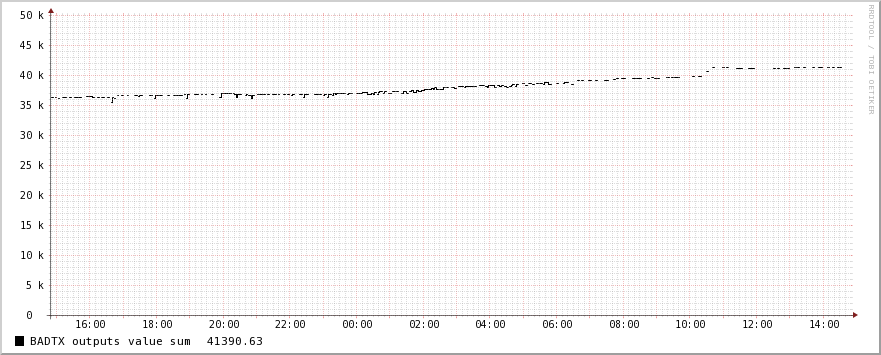
Since about a week ago, MtGox has not processed all requested bitcoin withdrawals and many clients have not received their bitcoins. Instead, some of the withdrawals were processed while the rest of the withdrawals remain frozen in an undetermined condition. Affected users are upset by this since the money is gone from their account, but the bitcoins have not been transferred to the client’s control. As of noon on February 4, The Gox Report has this chart, which is based on MtGox’ own internal data:
Note the bottom, the sum of all “failed transactions” (BADTX), which is technospeak for “withdrawals where the money is gone from the client’s account but where the funds were not actually transferred to the client”. The total of such withdrawals, a total that has been steadily climbing since about January 25, has now reached 41,390. That amount is in bitcoin, and each bitcoin is worth $934 by MtGox’s own rate, making the disappeared client money exceed 38 million US dollars. That’s not exactly small change.
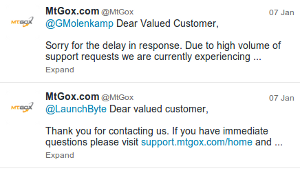
MtGox’ twitter account as of noon on Feb 4. It’s full of autoreplies, the newest response to a client being one month old.
Three years ago, I highlighted exchanges as one of four areas where the bitcoin community positively must improve to go mainstream. The above problem of the missing 38 million dollars is exacerbated by the fact that MtGox does not respond to clients’ questions until well over a week has passed, at which point a canned autoresponse is given. Additionally, there has not been any communication whatsoever about the ongoing problem. The lack of a phone number, the non-responses to client concerns over tens of millions of missing dollars, and the complete absence of messages about the situation does not make a professional operation.
Instead, clients of tens of millions of dollars are left on their own trying to figure out what is going on, if they’ll get their funds or not, and if so, when, and what the underlying problem could possibly be.
(I was recently asked by the Wall Street Journal in what ways MtGox failed to live up to Wall-Street-level professionalism, and declined to respond at the time. This is one of those ways. There are others, that are worse, that I have not published yet. That WSJ article concerned delays in withdrawals to dollars and euros, which could be explained by legacy-banking inertia; up until ten days ago, MtGox had executed bitcoin withdrawals perfectly.)
Looking at the bitcoin services forum, there are tons of complaints with the current exchange services. The entrepreneur should identify several opportunities here, just by looking at the front page of “discussions”, which read more like outraged complaints – mostly about MtGox.
As of February 4, clients are left speculating in these threads what the reason for this behavior is – whether it’s legitimate technical problems coupled with abysmal communication, deliberate fraud, possible insolvency, a technical attack on MtGox, or a number of other theories.
DISCLOSURE
The author is personally affected by MtGox’ behavior, having a six-figure dollar amount in such non-executed withdrawals. He considered Gox to be a safer repository for bitcoin than his own probably-hackable computer. That judgment may not have been accurate.
UPDATE: One hour after this article was published, MtGox broke the week-long silence with a statement saying little more than “we’re working on it”. In the statement, they also claim that the problem applies “primarily to large transactions”, a statement that doesn’t seem entirely correct when compared to client statements and testimonies on the bitcoin forums.
We’ve previously noted that General Electric should be held partially responsible for the Fukushima reactor because General Electric knew that its reactors were unsafe: 5 of the 6 nuclear reactors at Fukushima are General Electric Mark 1 reactors. GE knew decades ago that the design was faulty.
This book exposes the myths of mainstream economics behind the public discourse and explains why current policies fail to serve the vast majority.
How much do economists really know? In most cases, they claim to have profound knowledge but in fact understand little and obscure almost everything. Most people are convinced that economics should be left to the ‘experts’, when they themselves are perfectly capable of understanding it. This book explains that mainstream economics serves the interests of the rich through its logical inconsistency and unabashedly reactionary conclusions. John F. Weeks exposes the myths of mainstream economics and explains in straightforward language why current policies fail to serve the vast majority of people in the United States, Europe and elsewhere. Their failure to serve the interests of the many results from their devoted service to the few.
Here we are. A system in perpetual crisis. Less and less able to accomplish basic functions.
A system being led by an economic and political leadership increasingly divorced from reality.
A self-aggrandizing leadership unable to do anything but engage in exercise of complex futility (political – healthcare/national insecurity) or fantasy (economic – the shadow banking system). A complexity made worse by applying technological patches/fixes/solutions to a system in decline.
However, that isn’t where it ends. Humanity has more in store for it than bureaucracy and markets can make possible.
Something new is coming and its arrival distorts the current system.




 MtGox’
  1,400 Sue General Electric, Toshiba and Hitachi for Fukushima Disaster