CIA runs all-source analytic competition for universities — neither the Open Source Center nor Open Source Intelligence (OSINT) are anywhere to be found.
Phi Beta Iota: This was probably a variation of the superb Mid-Career Course (CIA's mini-war college) analytic exercise but lacking the meat that is to be found in the Mid-Career Course: the opportunity to learn that walking around and talking to PEOPLE is what fills in the gaps and leads to a more complete view. Also lacking here, as it is in the Mid-Career Course, is any tutorial on analytic tradecraft, or any reference to external legal ethical human, online, and analog sources that generally have the 80% or more of the knowledge that CIA is simply not able to access because of its secrecy blinders.
Paul Krugman recollects a point he made years ago that Chuck Spinney and Joseph Stiglitz and Martin Auerbach have been pressing home for over a decade. Absentee landlords and capital flight from the heartland. TWO sucking chest wounds.
Dean Baker raises an important point here: it’s really awfully late in the game to be saying that the important inequality issue is college graduates versus non-graduates. It’s not clear that this was ever true, and it certainly hasn’t been true for a while.
I wrote about this years ago, using Ben Bernanke’s maiden testimony as Fed chair as an entry point. As I said then, Bernanke — like many others — had made:
a fundamental misreading of what’s happening to American society. What we’re seeing isn’t the rise of a fairly broad class of knowledge workers. Instead, we’re seeing the rise of a narrow oligarchy: income and wealth are becoming increasingly concentrated in the hands of a small, privileged elite.
Charles Hugh Smith raises the question of how much of the U.S. economy consists of the actual output of goods and services, versus the friction entailed in producing them. As a small example, he cites a physicians’ group that includes ten doctors — and twelve billing clerks.
The larger and more hierarchical institutions become, and the more centralized the economic system, the larger the total share of production that will go to overhead, administration, waste, and the cost of doing business. The reasons are structural and geometrical.
My ghost is here to tell Americans that we need to start tightening our belts and lowering the cost of living.
The Downside of Adversarial Approaches to Conflict
This is another example of how the two-party adversarial system prevents necessary change. Both parties make it impossible for the other party to talk common sense. Which ever party first brings up belt-tightening will be attacked by the other party for temporary advantage. There would be mantras like: “The other party wants you to believe the American dream is dead. They want you to start revising your dreams downward. That kind of pessimism can only lead America down the road to ruin.”
The organizers of the spreading Occupy initiative are taking their awareness and moral indignation right to corporate territory—Wall Street, the corporate lobbies in Washington, D.C. and their likes around the nation. The denizens of corporate territory have taken notice, with varying degrees of alarm, hoping that wintry weather will thin out the encampments.
But the corporate plunderers have not changed their behavior, continuing to dominate, outsource labor, deceive, pump the war machine, pollute, demand taxpayers bailouts, and guarantee and provide open checkbooks for the election campaigns of their indentured politicians.
A number of commentators have noted the unusual gathering of liberal/green folks and conservative/libertarian folks that constitute the Occupy Wall Street movement. While admitting the movement has a long way to go to actually represent “the 99%” (e.g., From Occupy Wall Street to Occupy the Neighborhoods), its transpartisan membership is part of its appealing legitimacy as a “We the People” movement.
Along these lines, this morning I stumbled on a TIME article (below) from 20 months ago – “The Dropout Economy” by conservative columnist Reihan Salam. In light of OWS, and coming from a prominent conservative, it appears intriguingly prophetic in its appreciative description of emerging youth-led community-based alternative economics and culture.
Dear friends: This Gary Horvitz blog post, which I just received by email, is very complementary to what I sent out yesterday, albeit from a more birds-eye view. – Tom Atlee
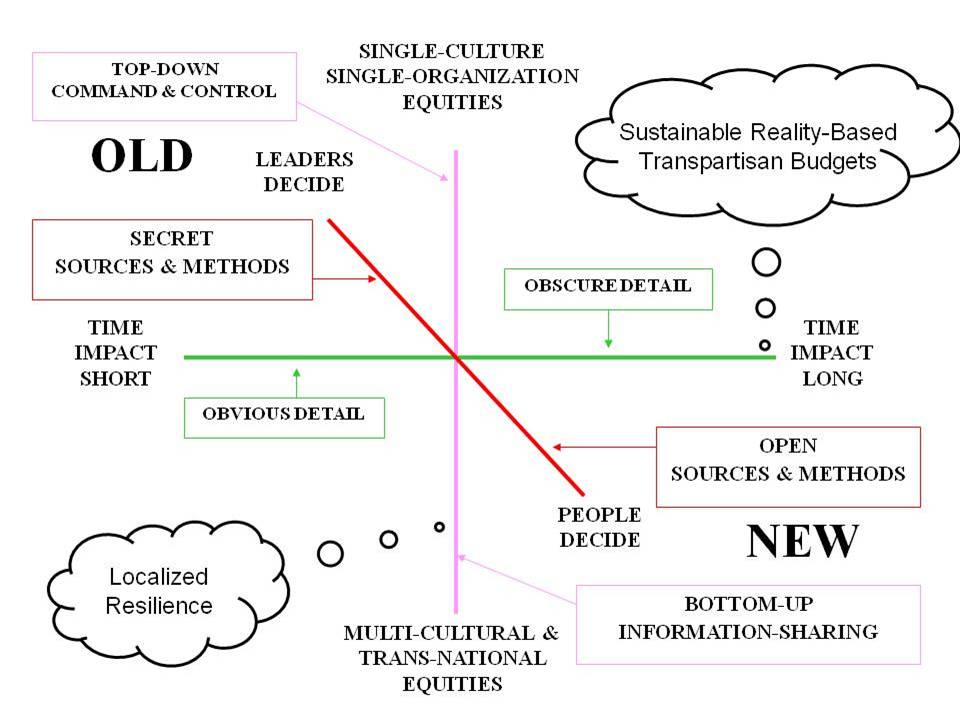
The Occupation is gaining depth and breadth, nationally and globally. The appearance is that spontaneous actions have arisen and continue to proliferate, cross-pollinate and act independently from the original occupation on Wall Street itself. Though there is a groundswell of coordination, no one is directing, no manifestos have appeared. No leaders have been elected. No one speaks for it all. The message may appear to be muddled, yet action appears everywhere and support materializes as if on cue. This is an open source movement.
To the extent that the metaphor of software development applies, we are speaking of the source code of a popular uprising, the core framework of a perpetually liquid process that is accessible to everyone for development and augmentation. No one owns it, no one controls it, no one approves new forms of usage in advance. There is no hierarchy. No one person or committee of meta-users decides which portions are to be discarded. It's all out there all the time, available for improvisation. It's evolving everywhere simultaneously. It's a circle whose perimeter is nowhere and whose center is everywhere.
Phi Beta Iota: The author speaks of the Story of Us, the Story of Me, and the Story of Now. Earlier Matt Taibbi focused on how OWS is a conscious pervasive rejection of what US society (and global society) have become among the one billion rich with five billion poor disenfranchised. We are watching the death of Epoch A and the rise of Epoch B. The US Government will be the last to “get it,” which is why everyone else is routing around the US Government. Absent the triumph of the Electoral Reform Act of 2012, and the emergence of a universal candidate with a coalition cabinet and a balanced budget, the US Government will remain both toxic and irrelevant.