SchwartzReport: Lack of Integrity in the US Media – On Murdoch & Petraeus

Commercial Intelligence, Corruption, Cultural Intelligence, Media

schwartz reportWhy the US media ignored Murdoch's brazen bid to hijack the presidency

Did the Washington Post and others underplay the story through fear of the News Corp chairman, or simply tin-eared judgment?

The Guardian,

So now we have it: what appears to be hard, irrefutable evidence of Rupert Murdoch‘s ultimate and most audacious attempt – thwarted, thankfully, by circumstance – to hijack America's democratic institutions on a scale equal to his success in kidnapping and corrupting the essential democratic institutions of Great Britain through money, influence and wholesale abuse of the privileges of a free press.

In the American instance, Murdoch's goal seems to have been nothing less than using his media empire – notably Fox News – to stealthily recruit, bankroll and support the presidential candidacy of General David Petraeus in the 2012 election.

Read rest of article.

Continue reading “SchwartzReport: Lack of Integrity in the US Media – On Murdoch & Petraeus”

SchwartzReport: Fake Images Impacting on Humans

Commercial Intelligence, Corruption, Cultural Intelligence, Media

schwartz reportHow fake images change our memory and behaviour

Rose Eveleth

BBC, 13 December 2012

Doctored images can affect what we eat, how we vote and even our childhood recollections. The question scientists are asking is why there’s nothing we can do to stop it.

The year was a memorable one – looking back at the unforgettable images over the past 12 months, you might think of apocalyptic-looking clouds over Manhattan during Hurricane Sandy, or Mitt Romney’s children mistakenly standing in a line spelling out the word “MONEY”, or even the winning US Powerball lottery ticket that became the most shared picture on Facebook. There’s only one problem. All these images are fake.

It would be fine if we could dismiss these images as a fleeting joke, an amusing but harmless tidbit shared among our friends and followers, if it weren’t for the fact that our minds appear to have a curious but fundamental glitch. People tend to think of their memories as a transcript, a rough history of events from some early age until the very moment they are experiencing. But human memory is far more like a desert mirage than a transcript – as we recall the past we are really just making meaning out of the flickering patterns of sights, smells and sounds we think we remember.

Read full article with examples of doctored images.

Tom Atlee: Call for Support, Plans for 2013

Cultural Intelligence
Tom Atlee
Tom Atlee

Supporting work for co-intelligent societies

Thank you for your interest in and support for the Co-Intelligence Institute. For more than 15 years CII has been researching and reporting democratic innovations and recently also introduced emerging ideas and resources for co-intelligent economics.

As 2012 comes to a close, we eagerly look forward to 2013 and more work creatively addressing the design challenges of living in human communities on Planet Earth.

We at CII imagine a time when wise participatory politics and economics converge into a powerful force for a better world for all people. We specialize in finding, creating and promoting initiatives, methods, ideas, visions and resources that show how wise participatory politics and economics are possible.

Twice a year we seek your partnership in doing this work on behalf of current and future generations. We ask for your financial support now.

In 2012 we undertook a number of diverse projects and collaborations including cross-boundary conversations between Left and Right in the US and pioneering the new field participatory sustainability with an international team.

A high point in our 2012 work came five months ago with the publication of EMPOWERING PUBLIC WISDOM: A PRACTICAL VISION OF CITIZEN-LED POLITICS by Tom Atlee, supported by the Co-Intelligence Institute. Clearing a path to a wiser form of politics and governance, this watershed book inspired a cover story featuring Tom Atlee’s work in “The Intelligent Optimist” (formerly “Ode Magazine”).

Continue reading “Tom Atlee: Call for Support, Plans for 2013”

Berto Jongman: New Fragile States Landscape

Earth Intelligence
Berto Jongman
Berto Jongman

The New Fragile States Landscape: Shades, Shifts and Shake-ups

by Juana de Catheu & Emmanuel Letouzé

Global Observatory, Wednesday, December 12, 2012

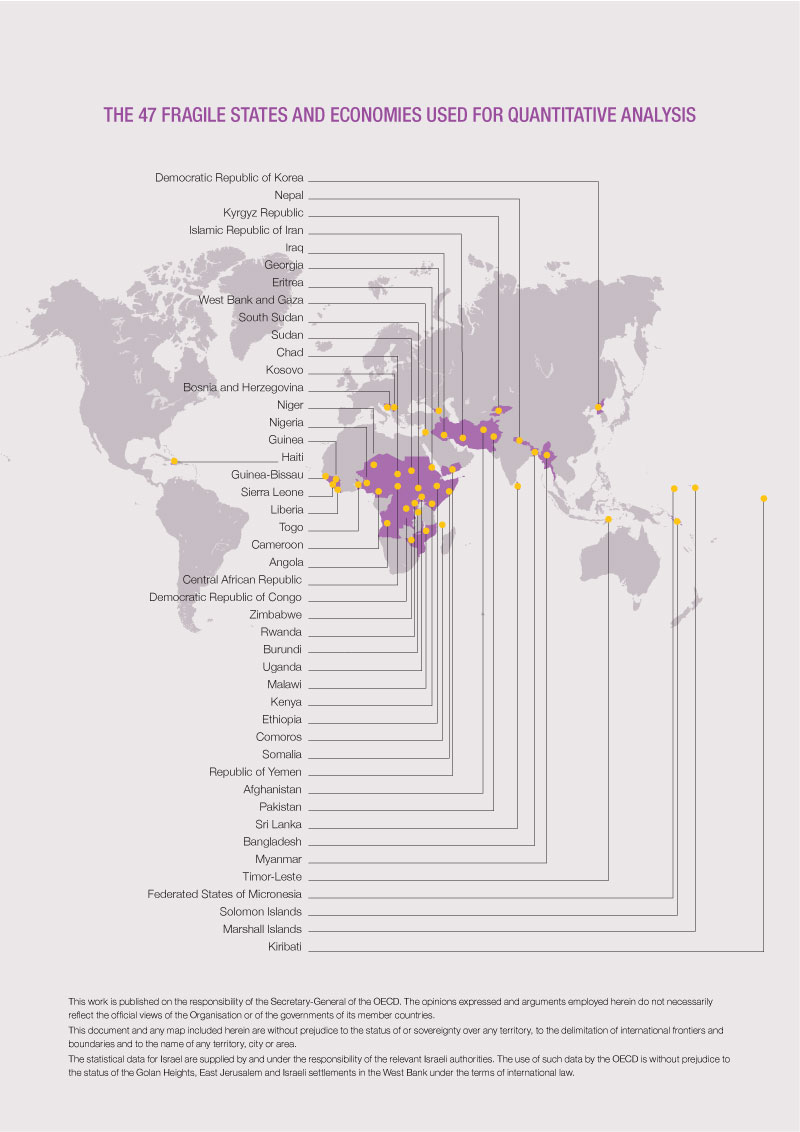
This article summarizes the main findings and arguments presented in the recent OECD report Fragile states 2013: Resource flows and trends in a shifting world, by its co-authors.

Click on Image to Enlarge

From Afghanistan to Zimbabwe, fragile states face common challenges: they host less than one-fifth of the world’s population yet are home to one-third of the world’s poor; they are more vulnerable to external and internal shocks—including armed violence—than other countries; and, in contrast to other developing countries who have managed significant progress towards the MDGs, not one of these countries has achieved a single Millennium Development Goal. They constitute most of the MDG deficit: seven in ten infant deaths and six in ten undernourished people are found in fragile states. Struggling to meet the challenges of basic survival, poverty-stricken populations in fragile situations are less equipped to deal with volatile changes, whether political, environmental, or economic. Behind these symptoms of fragility lays a limited state ability to develop mutually constructive relations with society and to carry out basic governance functions.

But, paraphrasing Tolstoy’s line, “Every unhappy family is unhappy in its own way,” all fragile states are fragile in their own way. The 47 countries and economies used for quantitative analysis in the 2013 OECD report on fragile states constitute a diverse group, adding to the challenge of effective engagement and significant development impact. Some of them–including Angola, Nigeria, Ethiopia, Chad, Mozambique and Rwanda–have been among the fastest-growing countries of the past decade, whereas over the same period, in contrast, countries like Sudan, Chad, Eritrea, and Zimbabwe lost economic ground.

Read full summary.


SchwartzReport: Global Religious Landscape

Cultural Intelligence

schwartz reportThe Global Religious Landscape

A Report on the Size and Distribution of the World’s Major Religious Groups as of 2010

Executive Summary

Worldwide, more than eight-in-ten people identify with a religious group. A comprehensive demographic study of more than 230 countries and territories conducted by the Pew Research Center’s Forum on Religion & Public Life estimates that there are 5.8 billion religiously affiliated adults and children around the globe, representing 84% of the 2010 world population of 6.9 billion.

The demographic study – based on analysis of more than 2,500 censuses, surveys and population registers – finds 2.2 billion Christians (32% of the world’s population), 1.6 billion Muslims (23%), 1 billion Hindus (15%), nearly 500 million Buddhists (7%) and 14 million Jews (0.2%) around the world as of 2010. In addition, more than 400 million people (6%) practice various folk or traditional religions, including African traditional religions, Chinese folk religions, Native American religions and Australian aboriginal religions. An estimated 58 million people – slightly less than 1% of the global population – belong to other religions, including the Baha’i faith, Jainism, Sikhism, Shintoism, Taoism, Tenrikyo, Wicca and Zoroastrianism, to mention just a few.1  At the same time, the new study by the Pew Forum also finds that roughly one-in-six people around the globe (1.1 billion, or 16%) have no religious affiliation. This makes the unaffiliated the third-largest religious group worldwide, behind Christians and Muslims, and about equal in size to the world’s Catholic population.

Read full summary.

Phi Beta Iota: The report is severely deficient in failing to distinguish between Sunnis and Shi’ites, and between Catholics, conventional Protestants, and the Evangelicals and Pentecostalists. That kind of granularity is essential to religious intelligence and counterintelligence.  Religions — and tribes — are the new ground zero for serious all-source analytics.

SchwartzReport: Global Warming = More Volcanic Activity

Earth Intelligence

schwartz reportLink Found Between Global Warming and Increased Volcanic Activity

DARREN QUICK – GizMag

Another piece of the climate change trend falls into place.

SOURCE: Steffen Kutterolf, Marion Jegen, Jerry X. Mitrovica, Tom Kwasnitschka, Armin Freundt and Peter J. Huybers.
A detection of Milankovitch frequencies in global volcanic activity. Geology. November 30, 2012, doi: 10.1130/G33419.1

It’s no secret that volcanic eruptions can cool the planet by spewing ash and droplets of sulfuric acid into the atmosphere that obscure the sun. Now researchers at Germany’s GEOMAR Helmholtz Centre for Ocean Research Kiel and Harvard University have found evidence that suggest the reverse could also be true. The researchers have discovered a strong historical link between global temperature increases and increases in volcanic activity.

Using observations of ash layers in cores taken from the seafloor around the Pacific region, the researchers reconstructed the history of volcanic eruptions for the past one million years. When they compared this data with the climate history, they found that periods of fast, global temperature increases and associated ice melting were followed with periods of high volcanic activity.

Read full article.

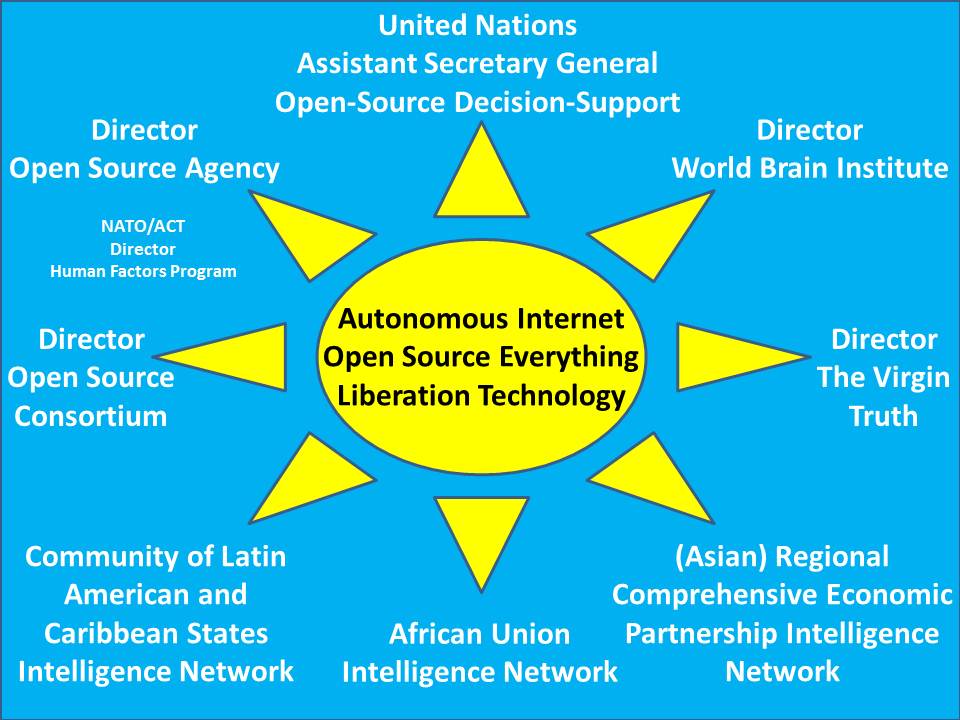
Graphic: UN 0 Big Picture View of Global Intelligence with Integrity Supporting Documents Added

#OSE Open Source Everything, Advanced Cyber/IO, Autonomous Internet, Earth Intelligence, Peace Intelligence
Click on Image to Enlarge

Related Point Papers

Doc (2):  Open Source Agency Synopsis 2012

Doc (2):  2012 Reflections on UN Intelligence 2.3 21 Dec 2012

Doc (1):  Virgin Truth 2.6

Background Articles

Doc (29):  2012 Reflections on UN Intelligence 2.2 20 Dec 2012

Doc (21):  Steele The Craft of Intelligence 3.3

Miscellaneous:

Slide (1):  Big Picture

Doc (1):  2013 Public Governance Abstract

Doc (1):  Open Source Everything 500 words 1.4

See Also:

2012  THE OPEN SOURCE EVERYTHING MANIFESTO: Transparency, Truth & Trust

2010  INTELLIGENCE FOR EARTH: Clarity, Diversity, Integrity & Sustainability

2008  COLLECTIVE INTELLIGENCE: Creating a Prosperous World at Peace

noble gold