I am ambivalent about whether Chuck Hagel has the managerial and bureaucratic skills to make the kind of Sec of Defense we need to clean out the Pentagon's Augean Stables — but the outrageous neocon assault on him because he does not kowtow to the Likud party line is over the top, as Steven Walt explains below.
Agree that we are at a potentially historic transition point. However, the Atlantic Council lacks the strategic analytic model to make the most of its otherwise formidable brain trust. Agree on the need for a new mental map, but they chose the wrong map. See the HourGlass Strategy as an alternative (also below the line).
The report misses multiple big possibilities including the eight tribes, M4IS2, and OSE.
1. Frame second-term policies from a more strategic and long-term perspective, recognizing the magnitude of the moment and the likelihood that the United States’ actions now will have generational consequences.
Absolutely. Understanding emergent public governance trends rooted in true cost and whole system analytics, which harness the distributed intelligence of the five billion poor, not in this report.
2. Continue to emphasize what has been called “nation-building at home” as the first foreign policy priority, without neglecting its global context.
Left unsaid is the need to establish a plan, coincident with the creation of a 450-ship Navy, a long-haul Air Force, and an air-liftable Army, to close most of our military bases around the world, and bring all of our troops – and their purchasing power – home.
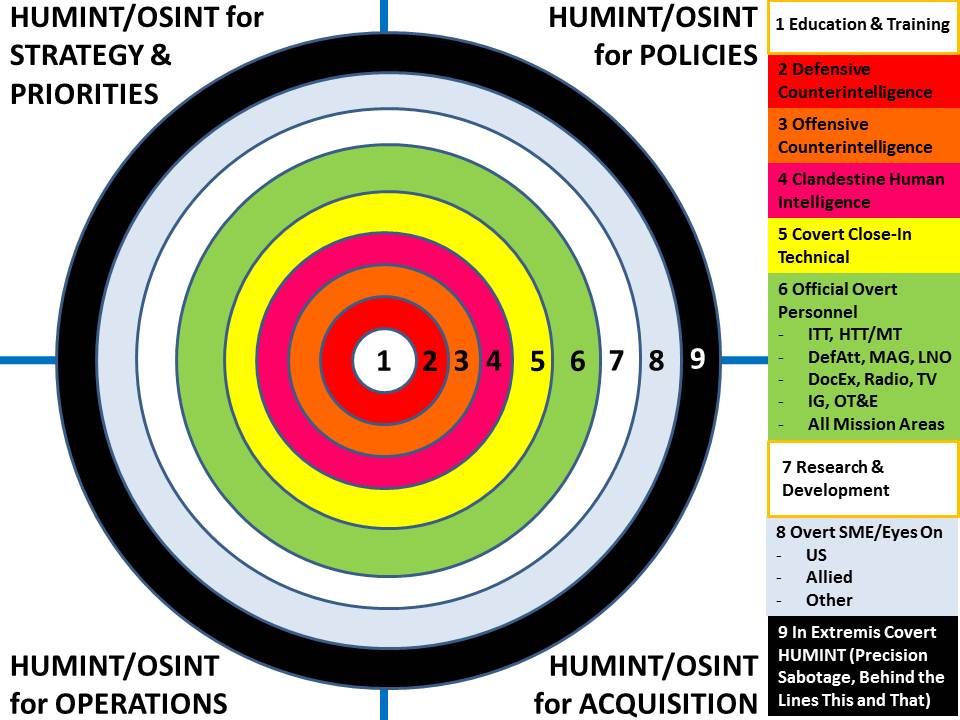
Citation: Robert David STEELE Vivas, “Graphic: Nine HUMINT/OSINT Circles,” Phi Beta Iota the Public Intelligence Blog, 17 December 2012
This corrects the earlier oversight of not integrating education & training (our first defense and our most reliable eyes and ears are our own people), along with research & development, must be fully integrated with, not isolated from, the fifteen slices of Human Intelligence (HUMINT) / Open Source Intelligence (OSINT).
In my “quickie” article published less than an hour after the news broke about the Connecticut school shooting, I tried to inject some historical context into the discussion – and do it as fast as possible. Since we know that many if not most “lone nut” massacres are actually false-flag operations, we might as well assume that this one is too. Getting that message out early, in order to shape public opinion while it is still malleable, should be a top priority of everyone who wants to put the real terrorists out of business.
THEN we can get around to picking apart the details. Enter Lori Price and Clare Kuehn.
Lori Price of Citizens for Legitimate Government quickly and brilliantly deconstructs false-flag massacres. If you are going to subscribe to one email news service, other than VT, it should be CLG News.
Lori asks a very good question here: Was Adam Lanza’s internet record scrubbed?
The ongoing spat between the cyber community and the United Nation’s International Telecommunications Union (ITU) reveals a much larger crisis that the world is increasingly facing – the crisis of the legitimacy of representation.
The UN and the Internet are arguably two of humanity’s greatest accomplishments of the 20th century: both bring the world closer by facilitating dialogue and though each has its flaws most would agree that the world is a better place because of their creation.
With so much in common then, why do the two communities find themselves embroiled in conflict?
The underlying issue, I would argue, is that in the same way the United Nations changed the world’s expectations around how problems are solved, so too is the Internet in bringing about a sea change in how citizens expect to be represented in both government and markets.
The UN was designed based on the principle of representative government. As citizens, our voices are represented via a proxy delegate appointed by the proxy government charged with representing our will.
This system, when implemented well, has succeeded in reducing violent conflict, increasing qualities of life and reducing civil strife by empowering citizens with the means to provide an input into their governance.
The digital revolution and direct popular representation
The conflict we’re beginning to see comes from the fact that the tools of the Internet are enabling individuals to represent themselves in conversations previously managed by proxy representatives.
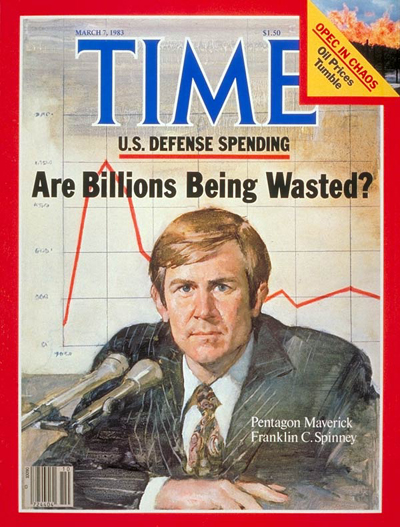
In October, the inevitable was announced: Struggling Newsweek magazine would be finished as a print publication as of the end of the year. But the last mass newsweekly left, Time, also made an announcement of sorts: It was out of the factchecking business.