NO LABELS Tries Again — Still Corrupt, Still Clueless

Civil Society, Corruption, Cultural Intelligence, Government, Idiocy, Politics
Two Parties, One Idiot Idea

Phi Beta Iota:  they have been scorned out of existing twice now, but evidently Mike Bloomberg and his friends have not given up kludging together three failures to try to make lemonade, all three corrupt to the bone:

Independent Voters / Jackie Salit, well-funded stalking horse for Bloomberg, does not play well with others and specifically ignores both grass-root Independents and the six small parties.

Americans Elect, despite a great deal of money, could not overcome the abject obviousness of its internal corruption and the abysmal even shocking ineptitude of its web design and content management teams.

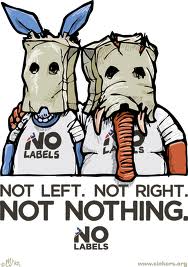
No Labels —  the  cartoon says it all.  These people really do not “get” the travesty of their dismissal of the six small parties that have been blocked from ballot access, or the shallowness of their general intellect.  No Labels, No Brains, No Balls.

Below the line is the email that went out across the land today.  What is shocking is the number of progressives angry at Obama who really think No Labels might be on to something.  For an example of what an honest viable alternative to the two-party tyranny might look like, see We the People Reform Coalition.  We can still save 2012, but it will require organized people, not organized false flag money.

ON A CONSTRUCTIVE NOTE:  If NO LABELS and Americans Elect would come together to sponsor an Electoral Reform Summit in early September 2012, they could restore the integrity of America.  They are probably not capable of making that ethical and intellectual leap, but if they did, they would in one instant achieve their alleged goals dishonored behind closed doors, and open the way for the Second Republic.  Add the six small parties, Occupy and the Tea Party and the Independents without Jackie Salit playing games, and it is “game over.”  There is NOTHING stopping the election of a coalition cabinet and a reform ticket in November 2012 except a lack of FOCUS by all those who share the same desire: to create a prosperous America at peace, to restore America the Beautiful.  We are the passive silent majority at this time.  We need to be the active vocal majority for the next 90 days.  90 days.

See Also:

THE OPEN SOURCE EVERYTHING MANIFESTO: Transparency, Truth & Trust

Steele at Hackers on Two-Party Tyranny & Battle for the Soul of the Republic

Continue reading “NO LABELS Tries Again — Still Corrupt, Still Clueless”

Carnegie Council Competitive Ethics Just Business: Two Interviews on Competitive Intelligence – Richard Horowitz and Cynthia Cheng Correia

Commercial Intelligence, Knowledge
Julia Taylor Kennedy

Two Interviews on Competitive Intelligence – Richard Horowitz and Cynthia Cheng Correia

Carnegie Council Competitive Ethics Just Business

July 3, 2012

JULIA TAYLOR KENNEDY: Welcome to Just Business. I'm Julia Taylor Kennedy.

Thomas Jefferson once said, “I consider ethics, as well as religion, as supplements to law in the government of man.”

One field that really illustrates the distinction we all draw in our professional lives between ethics and law is competitive intelligence. Today on the show I'll talk to two competitive intelligence specialists to unpack the legal and ethical lines they draw each day.

First, a primer on competitive intelligence, known as CI for short. When the renowned Harvard Business School professor Michael Porter broke types of business competition into five categories in the 1970s, he established his legacy. Nearly every first-year MBA student now must internalize Porter's five forces. They are competitive threats, like substitute products, long-time industry rivals, and others.

Porter's forces also spawned a new industry, competitive intelligence. It's a service that some companies develop internally. Others hire a consulting firm. The main goal is to keep tabs on the competition and to project what competitive threats lie ahead.

This is a vital resource, but it's also one that businesses don't like to talk about because it seems kind of shadowy.

Continue reading “Carnegie Council Competitive Ethics Just Business: Two Interviews on Competitive Intelligence – Richard Horowitz and Cynthia Cheng Correia”

Winslow Wheeler: GAO’s June 14 F-35 Report Understates Its Own Findings; Uses Misdirecting DOD Criteria

Commerce, Commercial Intelligence, Corruption, Economics/True Cost, Government
Winslow Wheeler

Phi Beta Iota:  Until governments commit to true-cost economics (and of course to telling the truth and being fully transparent) they will not achieve full legitmacy and efficacy in serving the public interest.  The work of one man, Winslow Wheeler, should shame all governments by example, but especially the US Government, where no fraud, waste, or abuse is neglected as long as Members of Congress get their 5% kick-back.

How the F-35 Nearly Doubled In Price (And Why You Didn’t Know)

On June 14 — Flag Day, of all days — the Government Accountability Office released a new oversight report on the F-35: Joint Strike Fighter: DOD Actions Needed to Further Enhance Restructuring and Address Affordability Risks. As usual, it contained some important information on growing costs and other problems. Also as usual, the press covered the new report, albeit a bit sparsely.

Fresh bad news on the F-35 has apparently become so routine that the fundamental problems in the program are plowed right over. One gets the impression, especially from GAO’s own title to its report, that we should expect the bad news, make some minor adjustments, and then move on. But a deeper dive into the report offers more profound, and disturbing, bottom line.

Continue reading “Winslow Wheeler: GAO's June 14 F-35 Report Understates Its Own Findings; Uses Misdirecting DOD Criteria”

Mati Nissani: Strategic Lessons from the Rand Paul Fiasco

Corruption, Cultural Intelligence, Government

Strategic Lessons from the Rand Paul Fiasco

“Without revolutionary theory, there can be no revolutionary movement.”—Lenin

 …by  Moti Nissani, Ph.D. Prof. Emeritus, Wayne State University

Rand Paul

Summary: For many years, the liberty movement’s aspirations and actions have been focused on the presidential candidacy of Congressman Ron Paul.

In Early June, this strategy backfired, following Rand Paul’s (Ron’s son) endorsement of Mitt Romney, a most dedicated servant of the Banking-Militarist Complex.

This essay argues that revolutionaries can draw two valuable lessons from Rand Paul’s about-face.

First, they must realize once and for all that electoral politics in the USA cannot possibly bring meaningful change, and hence, that more radical strategies are required.

Second, to survive, to retain its relevance, to deserve the gratitude of future generations, the liberty, environmental, social justice, and peace movements must merge into a single revolutionary movement.

Continue reading “Mati Nissani: Strategic Lessons from the Rand Paul Fiasco”

Tom Atlee: Vibrant, effective responses to disaster? YES! say two remarkable women…

Cultural Intelligence
Tom Atlee

Vibrant, effective responses to disaster?

As powerful economic, ecological, and social imbalances work themselves out in and around our lives, we face some pretty hard times – some of us already, some of us more than others, most of us increasingly. Each of us hopes we can ameliorate the impacts on ourselves, our communities and the people and things we care about. In addition, some of us seek to creatively channel the energies of crisis and catastrophe in ways that over time will make the world a better place. But in any case, chances are high that hard times will be more frequent for most of us in the coming decades.

Recently I've run across the work of two women – Rebecca Solnit and Roz Diane Lasker – whose perspectives on crisis and catastrophe offer insights and tools for hope.

Activist writer and journalist Solnit's book A PARADISE BUILT IN HELL: THE EXTRAORDINARY COMMUNITIES THAT ARISE IN DISASTER – a book I cannot recommend highly enough – tells vivid stories from the 1906 San Francisco Earthquake, the September 11th attacks, and Hurricane Katrina's battering of New Orleans, among other disasters. She describes how grassroots acts of effective engagement, heroism and sacrifice, and emergent communities of mutual aid are by far the most prevalent responses to localized collective tragedy. Despite news reports to the contrary, these positive grassroots responses are far more prevalent than mass panic and crime and often far more effective than official intervention – an assertion backed by fascinating sociological research. She shows how official relief and government engagement can help a community's self-organized response but, alas, all too often undermine it. Occasionally official reactions result in even more extensive suffering and destruction than the original calamity, which itself may have been caused in part by the misguided or self-interested activities of governments or corporations. (The actual exploitation or engineering of disaster for profit and power is explored in another book, Naomi Klein's THE SHOCK DOCTRINE: THE RISE OF DISASTER CAPITALISM.)

Continue reading “Tom Atlee: Vibrant, effective responses to disaster? YES! say two remarkable women…”

Michel Bauwens: The Emerging Fourth Sector

Collective Intelligence, Commercial Intelligence, Communities of Practice, Cultural Intelligence, Culture, Earth Intelligence, Economics/True Cost, P2P / Panarchy
Michel Bauwens

Richly deserving of careful attention.

The Emerging Fourth Sector

The Three Traditional Sectors

Businesses create and distribute goods and services that enhance our quality of life, promote growth, and generate prosperity. They spur innovation, reward entrepreneurial effort, provide a return on investment and constantly improve their performance responding to market feedbacks. They draw on the skills, effort and ingenuity of individual workers, and share with them the economic value created by the enterprise.

Non-profit organizations give us ways to celebrate, build and protect the many human values that give rise to healthy, thriving communities. They have worked to ensure that all people have adequate necessities of life, including clean air, water, food and shelter; an equitable share of wealth and resources; and opportunity to develop their full physical, mental and spiritual potential. They create spaces to celebrate the joy of culture and artistic expression, and reveal opportunities for generosity. They have helped protect the environment, working to ensure that human capacities, technologies and organizations sustain and support, not systemically alter, degrade or destroy, the Earth, its diversity of life or the ecological systems that support life. They remind us that many species share this planet and depend on each other, and that humanity must not only care for itself, but must steward an entire world.

Continue reading “Michel Bauwens: The Emerging Fourth Sector”

Jon Lebkowsky: Higgs Boson Culture Hack….first steps

Cultural Intelligence, Earth Intelligence, Knowledge
Jon Lebkowsky

Higgs Culture

Whether it was the Higgs Boson, or just a reference to the actual particle, the CERN discovery is already generating cultural waves and memes.

How to explain Higgs boson discovery | Science | The Guardian

1 day ago … Everyone's talking about the ‘God particle' – but what if someone asks you to explain it. Well, it depends if…
What Can We Do With the Higgs Boson? | Wired Science | Wired.com1 day ago … How can you discuss the Higgs discovery with non-scientists? It is a great start to a discussion about science
The Higgs boson walks in into a church. The priest: We don't allow Higgs bosons in here. Higgs boson: But without me how you can have mass?
noble gold