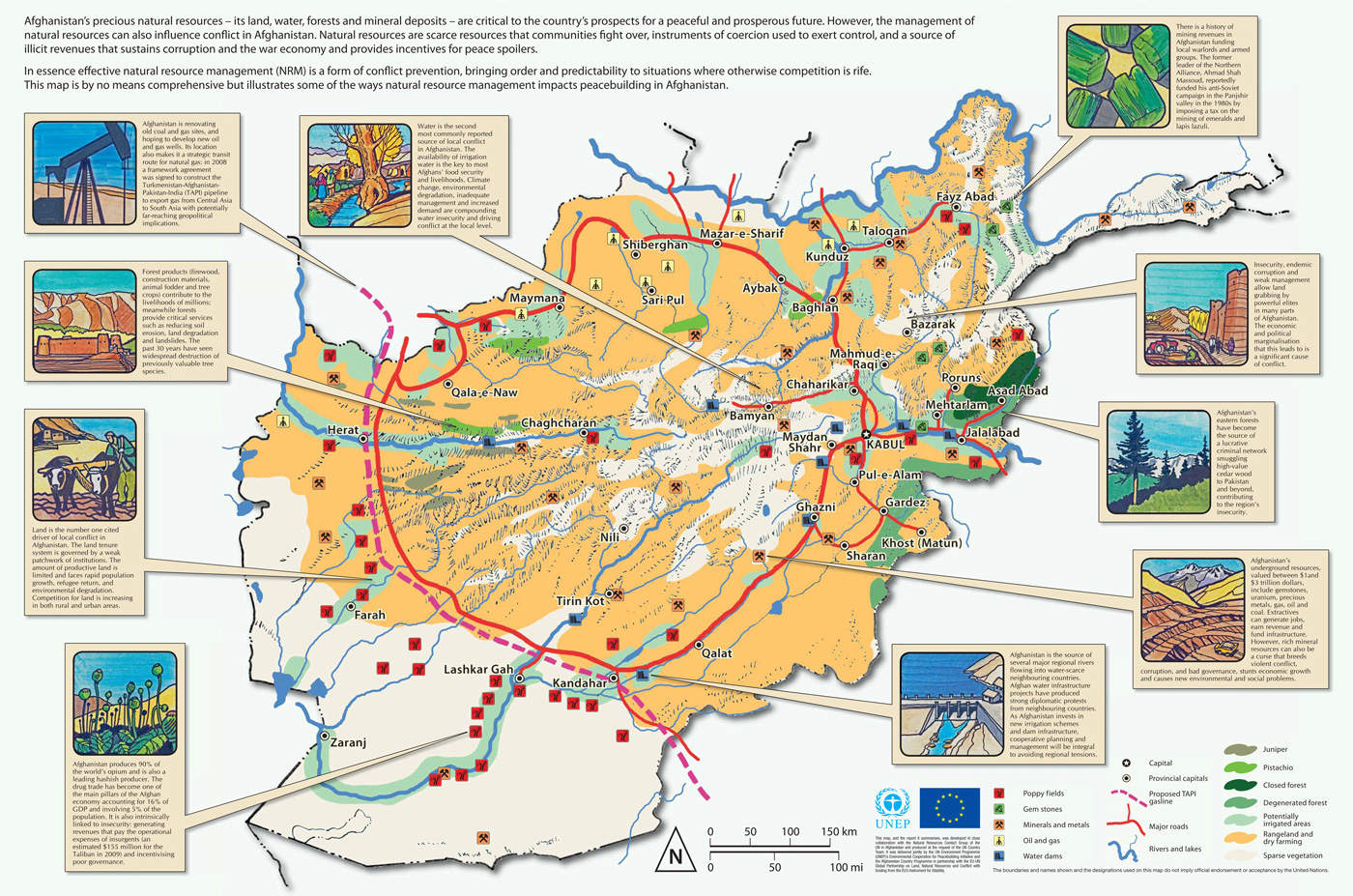
Graphic: Afghanistan Water Equals Peace
03 Environmental Degradation, 04 Inter-State Conflict, 05 Civil War, 12 Water, Earth Intelligence, Peace Intelligence
The truth at any cost lowers all other costs — curated by former US spy Robert David Steele.
 Recommended by Berto Jongman
Description
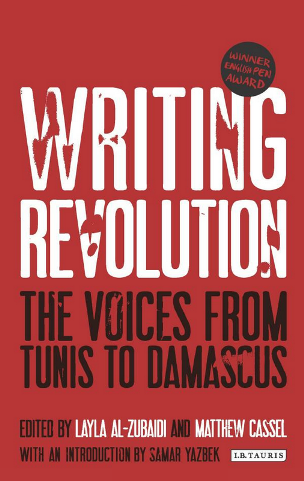
From Cairo to Damascus and from Tunisia to Bahrain, Layla Al-Zubaidi and Matthew Cassel have brought together some of the most exciting new writing born out of revolution in the Arab world. This is a remarkable collection of testimony, entirely composed by participants in, and witnesses to, the profound changes shaking their region. Situated between past, present and future – in a space where the personal and the political collide – these voices are part of an ongoing process, one that is at once hopeful and heartbreaking. Unique amongst material emanating from and about the convulsions in the Arab Middle East, these creative and original writers speak of history, determination and struggle, as well as of political and poetic engagement with questions of identity and activism. This book gives a moving and inspiring insight into the Arab revolutions and uprisings: why they are happening and what might come next.
Table of Contents
Introduction by Samar Yazbek
1. Greetings to the Dawn: Living through the Bittersweet Revolution (Tunisia) by Malek Sghiri
2. Cairo, City in Waiting (Egypt) by Yasmine El Rashidi
3. Bayou and Laila (Libya) by Mohamed Mesrati
4. We Are Not Swallows (Algeria) by Ghania Mouffok
5. The Resistance: Armed with Words (Yemen) by Jamal Jubran
6. Coming Down from the Tower (Bahrain) by Ali Aldairy
7. Wishful Thinking (Saudi Arabia) by Safa Al Ahmad
8. And the Demonstrations Go On: Diary of an Unfinished Revolution (Syria) by Khawla Dunia
About the Editors
Matthew Cassel is a journalist and photographer covering the Middle East for Al Jazeera English. Cassel first learned about the region through his human rights and media work in Palestinian refugee camps. Over the past decade he has worked in the occupied Palestinian territories, Lebanon, Egypt, Turkey, Syria, Jordan, Bahrain and elsewhere. Formerly Assistant Editor of the The Electronic Intifada online journal, he is connected to activists, journalists, writers, artists and others at the forefront of the movement for change in the region.
Nemonie Craven Roderick is a literary agent. She has contributed to Sight & Sound, Roads & Kingdoms and The Blackwell Encyclopedia of Literary and Cultural Theory, amongst other publications.
Layla Al-Zubaidi is Director of the Heinrich Böll Foundation in South Africa, and was previously based in Beirut and Ramallah. She has published on cultural resistance and freedom of expression, and is co-editor of Democratic Transition in the Middle East: Unmaking Power (Routledge, 2012). She is also on the Executive Committee of Freemuse — World Forum on Music and Censorship.
There are some interesting and provocative materials on counter-insurgency and 4th generation warfare at two very different websites.
The Fabius Maximus website has an essay, with many important links, titled “How I learned to stop worrying and love Fourth Generation War. We can win at this game.” Find it at http://fabiusmaximus.com/2013/
George Kenny's very different and diverse website at electricpolitics.com has an interview with a thinker in the Army, Col. Gian Gentile. It addresses the various fallacies of the Petraeus/COIN dogma that resulted in the surge in Iraq (the action that allowed some in the US to pretend that “we won” there and the catastrophe now occurring there is some sort of separate event) and that has prolonged the agony in Afghanistan (while we pretend we are preserving something worth preserving). While this interview starts slowly, it becomes very interesting and thought provoking, I believe. Find it at http://www.
I highly respect all the discussants in these two pieces and I defer to much of their knowledge on the subject, which is deeper than mine. However, there is an element on which I dissent. They focus much of their energy on how to “win” these conflicts. I am not at all sure that is the correct focus. These conflicts (call them whatever you want) occur mostly in very alien societies with massively corrupt, wantonly un-empathetic, and/or grotesquely incompetent governments. Not only is “helping” the government side the equivalent of pushing a very wet string, but also why is it that we feel compelled to take a side in those conflicts where one side is repulsive and the other is hideous? Trying to win by taking one of those sides is a fool's errand, and it has proven our undoing since the end of World War II — and especially in recent years. That we pretend ourselves to be superior to the culture in these countries, and behave accordingly, does not exactly help either.
The situation in Syria, where we side with one of the many insurgents, is merely a variation on these themes.
There are alternatives; we should be exploring them.

Ramez Naam is the author of More than Human: Embracing the Promise of Biological Enhancement, which offers a tour of emerging technologies and makes a case for embracing human enhancement, showing readers how these technologies are powerful new tools in humanity’s quest to improve ourselves, our offspring and our world. His latest book, The Infinite Resource: The Power of Ideas on a Finite Planet is now published.
Naam is a professional technologist who helped create two of the most widely used pieces of software in the world: Microsoft’s Internet Explorer and Microsoft Outlook. He is currently the CEO of Apex Nanotechnologies, which develops software for nanotechnology researchers. He also serves on the advisory board of the Institute for Accelerating Change, is a Senior Associate of the Foresight Institute, and is a member of the World Future Society. He is the recipient of the 2005 H. G. Wells Award for Contributions to Transhumanism.

Whither The Internet In An Age Of Cyber-Espionage?
As everyone should know by now, not quite two weeks ago the latest nugget from Edward Snowden via Glenn Greenwald and co-authors was revealed, and was that the NSA and its UK counterpart the GSHQ “have successfully cracked much of the online encryption relied upon by hundreds of millions of people to protect the privacy of their personal data, online transactions and emails.” The measures used to accomplish this include covertly controlling the setting of encryption standards, more powerful brute force code-cracking, and inserting backdoors into commercial encryption software.
This is very bad, and has led more than one observer to declare that the internet as we know it is dead as a secure medium of communication. That of course leads to the question of what is to be done about it.
Continue reading “Berto Jongman: Internet Balkanization, Cyber-Crime, Cyber-Espionage”
Uzbekistan Faces Civil War, Possible Disintegration, Tashkent Scholar Says