NIGHTWATCH: Syria Who Done It? US Missiles Soon, Never Mind the Forensic Evidence….

03 Environmental Degradation, 04 Inter-State Conflict, 05 Civil War, 07 Other Atrocities, 08 Proliferation, 08 Wild Cards, Peace Intelligence

26 August 2013

Syria: Update. UN Secretary-general Ban Ki-moon said on Monday. “I just spoke to my Under-Secretary-General for Disarmament, Ms. Angela Kane, who is now in Damascus to oversee the investigation. The first day of investigation was carried out by Dr. Sellstrom and his team,” said Ban in a statement issued by his spokesperson.

“What I am told at this time is that their vehicle was attacked by an unknown sniper, but despite such very difficult circumstances, our team returned to Damascus and replaced their car and proceeded to a suburb of Damascus to carry on their investigation.”

According to the statement, during their first day of investigation, the UN experts “visited two hospitals,” “interviewed witnesses, survivors and doctors” and also “collected some samples” at the site of the latest alleged use of chemical weapons on Aug. 21 in the suburbs of Damascus.

Special comment. The question whether Syria used some form of chemical weapons against the opposition has moved beyond the domain of intelligence judgment into the domain of forensic science. Stentorian statements about blame before the facts are adduced are imprudent except as political theater. Now is the time for proof, not for bombast. It is time for patience while science does its work.

Inferences of guilt derived from judgments about how Syrian leaders should behave if they wanted to prove they did not execute a chemical attack indulge the most basic and persistent reason for US intelligence analytical failures: mirror imaging, i.e., the notion that Syrian leaders would act the way Americans might act under similar circumstances. Arabs seldom behave the way Americans behave.

The initial burden of proving an accusation always is on the party that makes the accusation. In this instance it is the Syrian opposition, whose evidence to date in the public domain falls short of establishing a prime facie case that a weapon of mass destruction was used. Something happened, but what remains to be determined.

The mainstream press has insisted that the Syrian government must prove it did not execute a chemical attack. However, elementary evidence law courses all over the world teach that it is impossible to prove a negative. Everyone knows that! Somehow the mainstream press persists in getting this entirely wrong.

The open source evidence and Feedback from Brilliant, Genuine experts on chemical warfare and its effects reinforce the NightWatch judgment that Readers should retain healthy skepticism about what took place east of Damascus on 21 August and who was responsible.

Expert feedback asserts without qualification that neurotoxins, such as Sarin, are not evident, despite the bombastic allegations of the Syrian opposition on 26 August. Feedback from experts also indicates that crowd control agents would explain the symptoms, casualties and other evidence in the public domain.

Meanwhile, Syrian government forces are continuing operations to clear the eastern suburbs of Damascus with success.

25 August 2013

Syria: Update. International news outlets predict US missile attacks against Syria. The overwhelming consensus is that Syria used chemical weapons of some sort, but the evidence in the public domain that supports this judgment is weak.

The government in Damascus has agreed to allow the UN inspection team to visit the site. The mandate of the 20-person team is to determine whether chemical weapons were used in the latest incident as well as in three others. The mandate does not include an assignment of blame.

Comment: Doctors without Borders reported 3,500 patients were treated for symptoms of chemical exposure at their three hospitals, of whom 350 or so died. The humanitarian organization did not say whom they thought was responsible.

Berto Jongman: Foreign Policy Exclusive: CIA Files Prove USA Helped Sadaam Hussein Attack Iran with Chemical Weapons

04 Inter-State Conflict, 05 Civil War, 05 Iran, 07 Other Atrocities, 08 Proliferation, 08 Wild Cards, Corruption, DoD, Government, Idiocy, Military, Officers Call, Peace Intelligence
Berto Jongman
Berto Jongman

Hypocrisy?

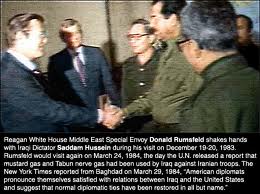
Exclusive: CIA Files Prove America Helped Saddam as He Gassed Iran

The U.S. knew Hussein was launching some of the worst chemical attacks in history — and still gave him a hand.

The U.S. government may be considering military action in response to chemical strikes near Damascus. But a generation ago, America's military and intelligence communities knew about and did nothing to stop a series of nerve gas attacks far more devastating than anything Syria has seen, Foreign Policy has learned.

Source: https://www.indybay.org/newsitems/2003/03/11/15814941.php

In 1988, during the waning days of Iraq's war with Iran, the United States learned through satellite imagery that Iran was about to gain a major strategic advantage by exploiting a hole in Iraqi defenses. U.S. intelligence officials conveyed the location of the Iranian troops to Iraq, fully aware that Hussein's military would attack with chemical weapons, including sarin, a lethal nerve agent.

The intelligence included imagery and maps about Iranian troop movements, as well as the locations of Iranian logistics facilities and details about Iranian air defenses. The Iraqis used mustard gas and sarin prior to four major offensives in early 1988 that relied on U.S. satellite imagery, maps, and other intelligence. These attacks helped to tilt the war in Iraq's favor and bring Iran to the negotiating table, and they ensured that the Reagan administration's long-standing policy of securing an Iraqi victory would succeed. But they were also the last in a series of chemical strikes stretching back several years that the Reagan administration knew about and didn't disclose.

U.S. officials have long denied acquiescing to Iraqi chemical attacks, insisting that Hussein's government never announced he was going to use the weapons. But retired Air Force Col. Rick Francona, who was a military attaché in Baghdad during the 1988 strikes, paints a different picture.

“The Iraqis never told us that they intended to use nerve gas. They didn't have to. We already knew,” he told Foreign Policy.

Read full article (four screens, more links).

Berto Jongman: US False Flag CW for Syria, to Trigger International Intervention

04 Inter-State Conflict, 05 Civil War, 07 Other Atrocities, Civil Society, Government, Military, Peace Intelligence
Berto Jongman
Berto Jongman

The theater of the macabre continues.

Multimedia presentation

Phi Beta Iota:  All our sources call into question all claims that CW has been used by anyone.  The highest probability is that the rebels are faking it hoping to lure the USA into Syria the way the USA lured Russia into Afghanistan. We tend not to believe that the USA is behind the effort, or it would have come off much more credibly (witness the Boston false flag endeavor).  Truth is a casualty across all fronts on the matter of Syria.

See Also:

Marcus Aurelius: Appraisal of Syrian Intervention Options and Costs + Syria Anti-War Meta-RECAP

Shiela Casey: Photographic Essay on False flag theater — Boston bombing involves clearly staged carnage + Boston False Flag Meta-RECAP

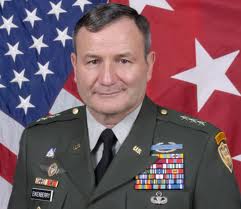
General and Ambassador Karl Eikenberry on the Persistent Failure of US Understanding in Afghanistan

02 Diplomacy, 03 Economy, 08 Wild Cards, 09 Justice, 10 Security, 11 Society, Corruption, Director of National Intelligence et al (IC), DoD, Government, Idiocy, Ineptitude, IO Deeds of War, Lessons, Military, Officers Call, Peace Intelligence
Karl W. Eikenberry
Karl W. Eikenberry

使用谷歌翻译在下一列的顶部。

गूगल अगले स्तंभ के शीर्ष पर अनुवाद का प्रयोग करें.

Google sonraki sütunun üstünde Çevir kullanın.

Используйте Google Translate на вершине соседней колонке.

گوگل اگلے کالم میں سب سے اوپر ترجمہ کا استعمال کریں.

Emphasis below added by Milt Bearden, former CIA chief in Pakistan also responsible for the field aspects of the CIA's covert support against Soviet forces in Afghanistan.

Foreign Affairs, September/October 2013

ESSAY

The Limits of Counterinsurgency Doctrine in Afghanistan
The Other Side of the COIN

Karl W. Eikenberry

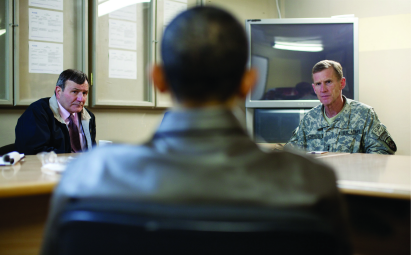
Eikenberry, Obama, and General Stanley McChrystal in Afghanistan, March 2010. (Pete Souza / White House)

KARL W. EIKENBERRY is William J. Perry Fellow in International Security at the Center for International Security and Cooperation at the Freeman Spogli Institute for International Studies at Stanford University. He served as Commanding General of the Combined Forces Command–Afghanistan from 2005 to 2007 and as U.S. Ambassador to Afghanistan from 2009 to 2011.

Since 9/11, two consecutive U.S. administrations have labored mightily to help Afghanistan create a state inhospitable to terrorist organizations with transnational aspirations and capabilities. The goal has been clear enough, but its attainment has proved vexing. Officials have struggled to define the necessary attributes of a stable post-Taliban Afghan state and to agree on the best means for achieving them. This is not surprising. The U.S. intervention required improvisation in a distant, mountainous land with de jure, but not de facto, sovereignty; a traumatized and divided population; and staggering political, economic, and social problems. Achieving even minimal strategic objectives in such a context was never going to be quick, easy, or cheap.

Of the various strategies that the United States has employed in Afghanistan over the past dozen years, the 2009 troop surge was by far the most ambitious and expensive. Counterinsurgency (COIN) doctrine was at the heart of the Afghan surge. Rediscovered by the U.S. military during the wars in Afghanistan and Iraq, counterinsurgency was updated and codified in 2006 in Field Manual 3-24, jointly published by the U.S. Army and the Marines. The revised
doctrine placed high confidence in the infallibility of military leadership at all levels of engagement (from privates to generals) with the indigenous population throughout the conflict zone. Military doctrine provides guidelines that inform how armed forces contribute to campaigns, operations, and battles. Contingent on context, military doctrine is
meant to be suggestive, not prescriptive.

Broadly stated, modern COIN doctrine stresses the need to protect civilian populations, eliminate insurgent leaders and infrastructure, and help establish a legitimate and accountable host-nation government able to deliver essential human services. Field Manual 3-24 also makes clear the extensive length and expense of COIN campaigns:  “Insurgencies are protracted by nature. Thus, COIN operations always demand considerable expenditures of time and resources.

Continue reading “General and Ambassador Karl Eikenberry on the Persistent Failure of US Understanding in Afghanistan”

David Swanson: Lying About Syria, and the Lying Liars Who Lie About the Lying

Peace Intelligence
David Swanson
David Swanson

Lying About Syria, and the Lying Liars Who Lie About the Lying

“U.S. prepares for possible retaliatory strike against Syria,” announces a Los Angeles Times headline, even though Syria has not attacked the United States or any of its occupied territories or imperial forces and has no intention to do so.

Quoth the article:

“the president made no decisions, but the high-level talks came as the Pentagon acknowledged it was moving U.S. forces into position in the region.”

Forgive me, but who the SNAFU made that decision?  Does the commander in chief have any say in this?  Does he get to make speeches explaining how wrong it would be to attack Syria, meet with top military officials who leave the meeting to prepare for attacks on Syria, and go down in history as having been uninvolved in, if not opposed to, his own policies?

Threatening to attack Syria, and moving ships into position to do it, are significant, and illegal, and immoral actions.  The president can claim not to have decided to push the button, but he can't pretend that all the preparations to do so just happen like the weather.  Or he couldn't if newspapers reported news.

(Yes, illegal.  Read the U.N. Charter:

Continue reading “David Swanson: Lying About Syria, and the Lying Liars Who Lie About the Lying”

David Swanson: 10 Problems with the Latest Excuse for War [Against Syria]

Peace Intelligence
David Swanson
David Swanson

10 Problems with the Latest Excuse for War

If you own a television or read a newspaper you've probably heard that we need another war because the Syrian government used chemical weapons.

If you own a computer and know where to look you've probably heard that there isn't actually any evidence for that claim.

Below are 10 reasons why this latest excuse for war is no good EVEN IF TRUE.

1. War is not made legal by such an excuse.  It can't be found in the Kellogg-Briand Pact, the United Nations Charter, or the U.S. Constitution.  It can, however, be found in U.S. war propaganda of the 2002 vintage.  (Who says our government doesn't promote recycling?)

2. The United States itself possesses and uses internationally condemned weapons, including white phosphorus, napalm, cluster bombs, and depleted uranium.  Whether you praise these actions, avoid thinking about them, or join me in condemning them, they are not a legal or moral justification for any foreign nation to bomb us, or to bomb some other nation where the U.S. military is operating.  Killing people to prevent their being killed with the wrong kind of weapons is a policy that must come out of some sort of sickness.  Call it Pre-Traumatic Stress Disorder.

3. An expanded war in Syria could become regional or global with uncontrollable consequences.  Syria, Lebanon, Iran, Russia, China, the United States, the Gulf states, the NATO states . . . does this sound like the sort of conflict we want?  Does it sound like a conflict anyone will survive?  Why in the world risk such a thing?

4. Just creating a “no fly zone” would involve bombing urban areas and unavoidably killing large numbers of people.  This happened in Libya and we looked away.  But it would happen on a much larger scale in Syria, given the locations of the sites to be bombed.  Creating a “no fly zone” is not a matter of making an announcement, but of dropping bombs.

5. Both sides in Syria have used horrible weapons and committed horrible atrocities.  Surely even those who imagine people should be killed to prevent their being killed with different weapons can see the insanity of arming both sides to protect each other side.  Why is it not, then, just as insane to arm one side in a conflict that involves similar abuses by both?

Continue reading “David Swanson: 10 Problems with the Latest Excuse for War [Against Syria]”

SchwartzReport: US Census Findings on Languages in the USA

Cultural Intelligence

schwartzreport new14 Language Facts from the U.S. Census Bureau

ARIKA OKRENT – Mental Floss Language is both intimately yours, and part of what links you to a group. The U.S. has always been a melting pot but, I think, we don't fully realize the true dimensions of this reality. This report will help give you a sense of our diversity.

Since 1890, the U.S. Census has asked various questions about the languages people speak. Until 1980, the questions were sometimes confusing and they were directed only to those who didn’t speak any English or were born in a foreign country. With the 1980 census, a three-part question was adopted that applied to everyone, giving a more complete picture of language in the U.S. The first part of the question asks if a person speaks a language other than English at home. If the answer to the first part is yes, the second part asks what the other language is. The third part asks how well the person speaks English: ‘very well,” ‘well,” ‘not well,” or ‘not at all.”

The language questions are now asked every year on the American Community Survey. This month, the Census Bureau released its report on the 2011 survey. Here are 14 interesting facts about language in the U.S.

1. Over 300 languages are spoken in the U.S. For purposes of analysis they are categorized into 39 groups (e.g., Slavic languages besides Russian, Polish, and Serbo-Croatian are under ‘Other Slavic Languages.” Indian languages besides Hindi, Gujarati, and Urdu are under ‘Other Indic Languages.”)

Continue reading “SchwartzReport: US Census Findings on Languages in the USA”

noble gold