Warfare seems endemic to mankind. Nations around the world are driven by conflict. But is the impetus to war decreasing? Håvard Hegre finds statistical grounds for hope.
In my view, perhaps the most evident shortcoming is that our predictions ignore the importance of political systems – the institutions that regulate how leaders are recruited and how they make decisions. We leave this out since we have no credible forecasts for changes to political systems over the next 40 years, but it is evident that many internal armed conflicts are fought over the nature of the political system, in particular in non-democratic middle-income countries.
Paul van Tongeren (2013): Potential cornerstone of infrastructures for peace? How local peace committees can make a difference, Peacebuilding, 1:1, 39-60
Co-founder, International Civil Society Network on Infrastructures for Peace, Amsterdam, The Netherlands
(Received 9 October 2012; final version received 28 November 2012)
In many conflict-affected countries local peace committees (LPCs) have an impact on local communities by keeping the violence down, solving community problems and empowering local actors to become peacebuilders. Of course, committees like these are confronted with many challenges; the biggest challenge is that they are very dependent on the broader, political or conflict environment. If that environment becomes very polarised or violent, they will be gravely affected. LPCs are committees or structures formed at the level of a town or village with the aim to encourage and facilitate joint, inclusive peacemaking and peacebuilding processes within their own context. The article describes 10 examples of LPCs in countries such as the Democratic Republic of Congo, Colombia and Afghanistan. It is remarkable to see that in those countries hundreds of LPCs exist, with in most cases limited impact. The article describes as well a broader framework of infrastructures for peace, as it is implemented in several countries, such as Ghana and Kenya. This is a promising approach. The article concludes with some conclusions and proposals to enhance LPCs and infrastructures for peace nationally and internationally.
Keywords: local peace committees; local peace communities; infrastructures for peace; local peace building
The civil war in Syria is destabilising Iraq as it changes the balance of power between the country’s communities. The Sunni minority in Iraq, which two years ago appeared defeated, has long been embittered and angry at discrimination against it by a hostile state. Today, it is emboldened by the uprising of the Syrian Sunni, as well as a growing sense that the political tide in the Middle East is turning against the Shia and in favour of the Sunni.
Could a variant of the Syrian revolt spread to the western Anbar Province and Sunni areas of Iraq north of Baghdad? The answer, crucial to the future of Iraq, depends on how the Prime Minister, Nouri al-Maliki, responds to the seven-week-long protests in Anbar and the Sunni heartlands. His problem is similar to that which, two years ago faced rulers in Tunisia, Egypt, Libya, Yemen and Syria. They had to choose between ceding some power and relying on repression.
Most Arab rulers chose wrongly, treating protests as if they were a plot or not so broadly based that they could not be crushed by traditional methods of repression. The situation in Iraq is not quite the same, since Maliki owes his position to victory in real elections, though this success was not total and depended overwhelmingly on Shia votes. He has nevertheless ruled as if he had the mandate to monopolise power.
Last Monday, the Community of Latin American and Caribbean Countries (CELAC) met for its second summit in Santiago, Chile, one year after its founding meeting in Caracas, Venezuela in 2011. The Summit is the culmination of roughly a decade of efforts to create a viable mechanism for greater integration in the Americas, and particularly a year of planning by a “troika” of representatives from, believe it or not, Chile, Venezuela and Cuba. They were able to pull it off successfully, despite their obvious differences, and all 33 presidents or heads of state from the region attended, with the exception of Hugo Chavez from Venezuela, who sent a letter with his Vice-President Nicolás Maduro.
CELAC explicitly excludes the US and Canada, a historic first for a hemispheric organization with huge symbolic importance, because it answers a long-standing dream for unity of the subcontinent that harks back to Simón Bolívar and the struggles for independence from the European colonial powers. Beyond the symbolism, however, it is strategically crucial: It means that there is now a subcontinent bloc of developing nations that can speak with one voice,, and also serve as a counterweight to US political and economic hegemony.
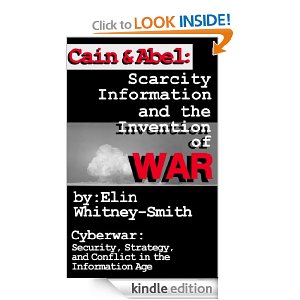
We have not always been warriors. War was invented along with political hierarchy, writing, and the invention of kingship.
This chapter tells the history of war starting with the end of the last ice age, 10,000 years ago, (before war was invented) up till the present when we may be seeing war becoming obsolete.
It examines various information revolutions and how they impacted the way war has been waged.
One thing which is constantly overlooked is that to have a successful war it is necessary that both parties have the same definition of what constitutes winning. The chapter shows how, from the very beginning of war, there were two different definitions of group violence – that of the agricultural peoples and that of the herding peoples. This difference in definition has been relevant throughout history and continues to this day.
Phi Beta Iota: $1.99 for Kindle. 33 pages. Elin Whitney-Smith is one of the original thinkers that the US Government has chosen to ignore for the past 20 years, because her ideas are affordable, practical, and would eradicate corruption while creating a prosperous world at peace.
The Rev. Jeremiah Wright, the president's former Chicago pastor whose sermons touched off a firestorm in the 2008 political campaign, urged today that Barack Obama heed the words of the late Rev. Martin Luther King Jr. and transform the country into the world's “No. 1 purveyor of peace.”
Wright, in the capital today but skipping the inauguration, recalled a speech by King during the Vietnam war, when the civil rights leader denounced the U.S. as “the greatest purveyor of violence in the world.”