
Pakistan: Pakistan is coping with three major internal political crises and one foreign crisis. Any one of these could prevent the first ever transfer of power in March 2013 between successive constitutional, civilian, elected governments in the history of Pakistan.
Chuck Spinney: Arab Spring Act II — Near Enemies Falling First?
Cultural Intelligence, Peace Intelligence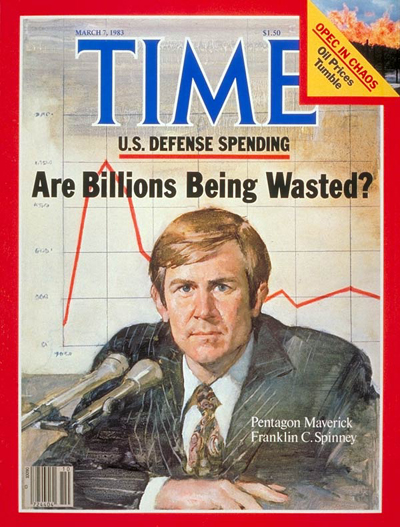
Arab spring, act two
As the chaotic transition towards democracy continues in North Africa and Yemen, the fighting in Syria is intensifying. And, less noticed, opposition to the Arab monarchies is growing.
by Hicham Ben Abdallah El Alaoui
Le Monde Diplomatique, January 2012
The Arab Spring is not an outcome, it is a process. For those countries at the forefront of regional transformation, the fundamental question is can democracy become institutionalised? Though progress has been uneven and the outcomes of many state-society struggles have yet to be resolved, the answer is a cautious yes. In at least a few countries, we are witnessing the onset of democratic institutionalisation: whether the process of reform and transformation spreads to other parts of the Middle East depends on many factors — religious tensions, political mobilisation, regime adaptations, geopolitics. Meanwhile North Africa provides the most promising preview of the future.
Democratic institutionalisation means the healthy convergence of politics around three arenas of competition: elections, parliaments and constitutions. When these institutions are robust and durable, then the democratic governments they engender are relatively safe from radical groups, reactionary forces and authoritarian backsliding (due to alternation: democracies that uphold the rule of law and hold regular elections require that power alternates between competing parties).
Continue reading “Chuck Spinney: Arab Spring Act II — Near Enemies Falling First?”
Chuck Spinney: Afghan Fraud, Permanent War, VERY Expensive – Robert Steele: $2 Trillion a Year for DoD is Criminally Insane
Commerce, Corruption, Government, Military, Peace IntelligenceObama may want out of Afghanistan, but he is under to pressure to stay, and the Military – Industrial – Congressional Complex (MICC) still has a budgetary interest in maintaining perpetual war, be it cold or hot ( for reasons I explained here).
The bloom is off the Karzai rose (as Amy Davidson explained in her 11 Jan New Yorker blog), but when one combines
- (1) the not-so-zero option explained by Kate Clark in the very important report attached below, with
- (2) the no-so-different high-cost plan for waging the American style of high-tech war described by General Barno in Ms. Clark's report (note: contrary to Barno's claim, his is hardly a new idea; in fact, the Pentagon has been flogging this this idea since McNamara's Electronic Line failed so disastrously in Vietnam), and
- (3) the possibilities of a new cold war implied by Obama's (really the MICC's) “pivot” to China,
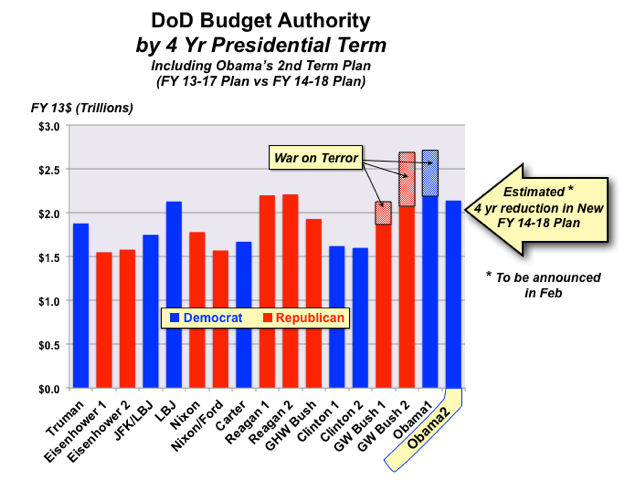
The sum 1+2+3 makes it easy to understand why Obama's new (albeit still unauditable*) budget plan, if executed perfectly, will result in the biggest eight year boom to the defense industry (including foreign military sales) since since the golden years of Ronald Reagan.
And … as indicated this chart (which I explained in latter part of this essay), this measure of the MICC's golden cornucopia would be true out to 2017,* even if a real zero option for the Afghan war and the war on terror, took place tomorrow!
Zero or Zero Plus? US-Afghan negotiations over the war
Presidents Obama and Karzai are due to start the wrangling over their countries’ post-2014 military relationship during the Afghan president’s current visit to Washington. US soldiers, bases, training, equipment, money, immunity all need to be hammered out, although no-one is expecting results just yet. Figures floated in recent days by US government and military officials speak of plans for anything from 20,000 to zero US troops to be left behind after 2014. Talk of the ‘zero option’ on troops might just be a bargaining ploy to put pressure on President Karzai, although as AAN senior analyst, Kate Clark, reports, it needs taking seriously, as does the possibility of a ‘zero plus’ option, ie a full withdrawal of troops which would still leave intelligence agents and military contractors fighting the Taleban.
Kate Clark, Afghan Analysts Network, 11/01/13
Mini-Me: Kerry-Hagel as Obama Attempt to Change Direction Away from War and Toward Domestic Reconstruction
02 Diplomacy, 03 Economy, 04 Inter-State Conflict, 07 Other Atrocities, 10 Security, 11 Society, Corruption, Cultural Intelligence, DoD, Government, Military, Peace Intelligence
Huh?
A view of what's really behind Hagel nomination fight
From CNN's “Early Start”
January 8, 2013
EXTRACT:
CNN: Peter wrote what I think is (one of the) most … interesting and compelling articles about the Hagel nomination, explaining it perhaps better than anyone I've seen, including the president.
The first paragraph of the piece, you write, it may prove the most consequential foreign policy appointment of his presidency because the struggle over Hagel is a struggle over whether Obama can change the terms of the foreign policy debate. Explain that for me.
Peter Beinart: I think so far, the debate about military action in Iran has been conducted by and large in Washington, as if Iraq and Afghanistan didn't happen.
As if we haven't learned anything from the disaster (of) these two wars over the last 10 years. I think the real struggle between Hagel and his foes is he wants to bring some of the lessons in to the Iran debate that we learned about (Iraq) and Afghanistan.
He talks very compellingly about the fact wars once launched can't be fully controlled. He is very cognizant of the enormous financial cost that these wars have imposed on the United States, and I think the heart of the hostility is the fear that his recognition about what happened in Afghanistan and Iraq will make taking us to war in Iran harder.
Hagel vows to fight ‘distortions'
[Note: An Open Source Agency (OSA) controlled by Kerry-Hagel would go a very long way toward fighting the information pathologies that abound in Washington.]
CNN: You suggest there are no consequences for the Iraq War in terms of those who supported or imposed it.
Winslow Wheeler: Will Chuck Hagel Stand Up to Drone Lobby?
Corruption, Cultural Intelligence, Ethics, Government, IO Deeds of War, Military, Peace Intelligence
Everyone has an opinion and the speculation is almost entirely based on what former Senator Hagel has said, rather than his actions–or lack of them–which speak a lot louder. Take an acutely political career that seems to have valued words above everything and match it with Pentagon myths about defense systems, and you get a somewhat different picture of what to expect from Secretary of Defense Chuck Hagel. It is not at all encouraging. This commentary about the all embracing mythology of drones and Chuck Hagel was published at Foreign Policy last evening.
Foreign Policy
Or will he be yet another victim of Pentagon operators?
WINSLOW WHEELER | JANUARY 7, 2013
U.S. Central Command has released some interesting numbers on the performance of modern air systems in Afghanistan; the data do not auger well for our defenses in the next decade, nor for the suitability of the man who appears likely to be the next secretary of defense, former Senator Chuck Hagel — his admirable iconoclasm toward some national security dogmas notwithstanding.
Continue reading “Winslow Wheeler: Will Chuck Hagel Stand Up to Drone Lobby?”
John Steiner: THE GLOBAL MARCH TOWARD PEACE by Gareth Evans*
BTS (Base Transciever Station), Culture, Peace Intelligence, Resilience
A starting point for the new Secretaries of State and Defense.
by Gareth Evans
Gareth Evans, Australia’s foreign minister for eight years and President Emeritus of the International Crisis Group, is currently Chancellor of the Australian National University and co-chair of the Global Center for the Responsibility to Protect. As Foreign Minister, he was at the forefront of recasting Australia’s relationship with China, India, and Indonesia, while deepening its alliance with the US, and helped found the APEC and ASEAN security forums. He also played a leading role in bringing peace to Cambodia and negotiating the International Convention on Chemical Weapons, and is the principal framer of the United Nations’ “responsibility to protect” doctrine.
Project Syndicate, 27 December 2012
CANBERRA – If we were hoping for peace in our time, 2012 did not deliver it. Conflict grew ever bloodier in Syria, continued to grind on in Afghanistan, and flared up periodically in West, Central, and East Africa. There were multiple episodes of ethnic, sectarian, and politically motivated violence in Myanmar (Burma), South Asia, and around the Middle East. Tensions between China and its neighbors have escalated in the South China Sea, and between China and Japan in the East China Sea. Concerns about North Korea’s and Iran’s nuclear programs remain unresolved.
Continue reading “John Steiner: THE GLOBAL MARCH TOWARD PEACE by Gareth Evans*”
Reflections on Healing the Americas — Open Source Agency & Hourglass Strategy
#OSE Open Source Everything, Advanced Cyber/IO, All Reflections & Story Boards, Communities of Practice, Cultural Intelligence, Earth Intelligence, Ethics, Peace Intelligence
Click on Image for Personal Page
The Hourglass Strategy: Healing the Americas with Intelligence & Integrity
Robert David STEELE Vivas, CEO, Earth Intelligence Network
Mr. Steele grew up in Latin America, returning as a clandestine case officer, and then going on to teach governments across the region how to leverage Open Source Intelligence (OSINT). He is the #1 Amazon reviewer for non-fiction, reading in 98 categories, and has been described in the media as a serial pioneer and an unsung hero helping create the future. If implemented, ethical evidence-based decision-support becomes the foundation for a completely new innovative and positive OAS in the Americas.
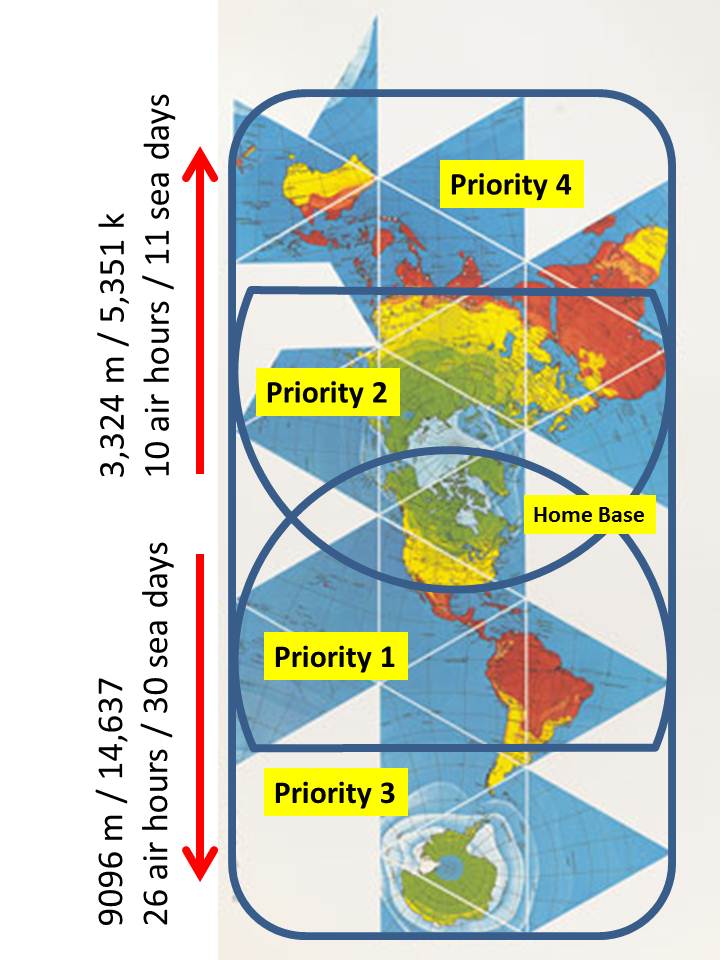
The USA and the OAS have lost their way. The formation of CELAC (Community of Latin American and Caribbean States) was ignored, just as President Barack Obama ignored the value of the book Open Veins of Latin America when it was given to him by President Hugo Chavez. The seven sins of American foreign policy, beginning with ignorance and ending with arrogance, persist. Meanwhile, in Asia – and reinforcing the future of CELAC – President Obama was politely sent home with a sound rejection of his proposed and obviously predatory Trans-Pacific Partnership; instead, a Regional Comprehensive Economic Partnership (RCEP) is being established. The Western Hemisphere including the Arctic should be but is not Priority One for the USA and OAS. The fact is that the USA and OAS lack a strategy, lack coherent policies, and lack harmonized spending strategies for embracing, nurturing, and devising mutually beneficial diplomatic, informational, military, and economic (DIME) programs. This is a global short-coming best addressed first in relation to the Americas.
Continue reading “Reflections on Healing the Americas — Open Source Agency & Hourglass Strategy”
