WARNING NOTICE. The latest printer update for HP OfficeJeg J4680 All-In-One immediately decommissions perfectly good, full, and genuine HP print cartgriges as being “incompatible” with your printer. It FORCES you to go buy a new one and start fresh.
Recommendation if this happens to you: pull the cartridge that has been incorrectly blocked, go buy an exact replacement, and work with the store to do an instant switch out. Staples etc loses nothing, and they can return it to HP for full credit. We need to FLOOD HP with the fruits of their ineptitude.
There really ought to be a quality control center outside of HP, they have lacked integrity on printer cartridges for over a decade. Generally when HP says your cartridge is low, you still have a third of the ink left.
There is now a petition for a Wall Street Sales Tax online at: http://wh.gov/ARGi
The petition was initiated by the United Front Against Austerity. It has started off strong, and we want to keep the momentum building, so the more it's shared, the better. Thank you!
We've got until April 10 to get 100,000 signatures. Twitter people, can you put this in front of people like Robert Reich, Dean Baker and others to ask them to mobilize their networks?
Getting an official White House response would be huge, but this is also a way to push the concept in front of more people.
CHARGE!!!!!!
Phi Beta Iota: Wall Street transactions (both stock and currency) are among the most numerous in the economy, and they are tax free. The Tobin Tax and the Automated Payment Transaction Tax both call for the widening of the economic revenue “pie” beyond income taxes — indeed, an honest Congress and an honest Executive could eliminate all income taxes by applying either of these taxes (a fraction of a penny) across the economy starting with the financial transactions — including the shadow banks (hedge funds) — that are now completely outside the revenue stream. The FACT that the US Government has been BORROWING $1 trillion a year since 1980 in order to fund BOTH a grossly over-extended entitlements program and a grossly under-performing national security corporate welfare program, should be — but is not — a major public grievance.
According to the Bureau of Labor Statistics, the US economy created 236,000 new jobs in February. If you believe that, I have a bridge in Brooklyn that I’ll let you have at a good price.
Then there are 23,700 new jobs in retail trade, which is hard to believe considering the absence of consumer income growth and the empty parking lots at shopping malls.
By offshoring manufacturing and professional service jobs, US corporations destroyed the growth of consumer income, the basis of the US economy, leaving the bulk of the population mired in debt. Deregulation was used to concentrate income and wealth in fewer hands and financial firms in corporations “too big to fail,” removing financial corporations from market discipline and forcing taxpayers in the US and Europe to cover bankster losses. Click for Amazon Page.
The real puzzle is 20,800 jobs in motion picture and sound recording industries. This is the first time in the years that I have been following the jobs reports that there has been enough employment for me to even notice this category.
The BLS lists 10,900 jobs in accounting and bookkeeping, which, as it is approaching income tax time, is probably correct; 21,000 jobs in temporary help and business support services; 39,000 jobs in health care and social assistance; and 18,800 jobs in the old standby–waitresses and bartenders.
That leaves about 50,000 jobs sprinkled around the various categories, but not in numbers large enough to notice.
The presstitute media attributed the drop in the headline unemployment rate (U3) to 7.7% from 7.9% to the happy jobs report. But Rex Nutting at Market Watch says that the unemployment rate fell because 130,000 unemployed people who have been unable to find a job and became discouraged were dropped out of the U3 measure of unemployment. The official U6 measure which counts some discouraged workers shows an unemployment rate of 14.3%. Statistician John Williams’ measure, which counts all discourage workers (people who have ceased looking for a job), is 23%.
In other words, the real rate of unemployment is 2 to 3 times the reported rate.
Nutting believes that the U3 unemployment rate has become too politicized to have any meaning. He suggests using instead the work force participation rate. This rate is falling substantially, reflecting the discouragement that occurs from inability to find jobs.
John Williams (shadowstats.com) says that distortions in seasonal factor adjustments overstate monthly payroll employment by about 100,000 jobs. The jobs data that is not seasonally adjusted shows about 1.5 million fewer jobs in the economy.
In a recent communication, statistician John Williams (shadowstats.com) reports that the rigged official annual rate of consumer inflation (CPI) of 1.6% is in fact, as measured by the official US government methodology of 1990, 9.2%. In other words, the rate of inflation is 5.75 times greater than the reported rate. If Williams is correct, the interest rate on bonds is extremely negative.
The C-130 Hercules, or Herk for short, isn't a sexy plane. It hasn't inspired hit Hollywood films, though it has prompted a few photo books, a beer, and a “Robby the C-130” trilogy for children whose military parents are deployed. It has a fat sausage fuselage, that snub nose, overhead wings with two propellers each, and a big back gate that comes down to load and unload up to 21 tons of cargo.
The Herk can land on short runways, even ones made of dirt or grass; it can airdrop parachutists or cargo; it can carry four drones under its wings; it can refuel aircraft; it can fight forest fires; it can morph into a frightening gunship. It's big and strong and can do at least 12 types of labor — hence, Hercules.
Too Much of a Good Thing
Here's where the story starts to get interesting. After 25 years, the Pentagon decided that it was well stocked with C-130s, so President Jimmy Carter’s administration stopped asking Congress for more of them.
Click on Image to Enlarge
Lockheed was in trouble. A few years earlier, the Air Force had started looking into replacing the Hercules with a new medium-sized transport plane that could handle really short runways, and Lockheed wasn't selected as one of the finalists. Facing bankruptcy due to cost overruns and cancellations of programs, the company squeezed Uncle Sam for a bailout of around $1 billion in loan guarantees and other relief (which was unusual back then, as William Hartung points out his magisterial Prophets of War: Lockheed Martin and the Making of the Military-Industrial Complex).
Then a scandal exploded when it was revealed that Lockheed had proceeded to spend some $22 million of those funds in bribes to foreign officials to persuade them to buy its aircraft. This helped prompt Congress to pass the Foreign Corrupt Practices Act.
So what did Lockheed do about the fate of the C-130? It bypassed the Pentagon and went straight to Congress. Using a procedure known as a congressional “add-on” — that is, an earmark — Lockheed was able to sell the military another fleet of C-130s that it didn’t want.
To be fair, the Air Force did request some C-130s. Thanks to Senator John McCain, the Government Accountability Office (GAO) did a study of how many more C-130s the Air Force requested between 1978 and 1998. The answer: Five.
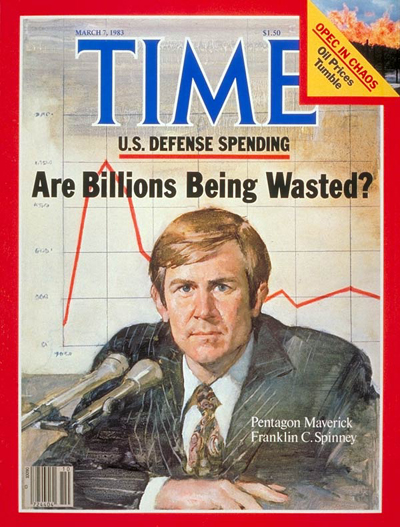
Below is more insight into the disgraceful state of affairs of the F-35 Joint Strike Fighter, the largest program in DoD's history. This commentary by Winslow Wheeler, Director of the Strauss Military Reform Project, is based on the information in yet another official Pentagon DOT&E report. Read it and weep … I especially uge that doubters, deniers, and non-believers take the time to peruse the entire official DOT&E report at this link, also referenced in Winslow's the first paragraph.
It is important to understand F-35's deplorable state of affairs is a typical albeit extreme example of where concurrency leads — higher costs, decreased performance, stretched-out and/or truncated production runs, culminating in aging, shrinking inventories and rising costs of maintaining even low rates of readiness of combat forces. And the concurrency horrors of the F-35 are by no means unique, think F-111, C-5, V-22, F-22, and F-18E/F. To be sure, concurrency is not the sole cause of these aforementioned trends, but it is a major contributor.
But in the case of the F-35, even some parts of the Pentagon are starting to gag on the monster they have unleashed. In February 2012, no less an authority than Frank Kendall, the Pentagon's acting acquisition chief charactered the F-35's grossly excessive concurrency as “acquisition malpractice.” (Congressional Research Report (RL30563), F-35 Joint Strike Fighter (JSF) Program, see page 7).
Of course, Kendall's statement smacked of the pot calling the kettle black. Where was the concern by him or his predecessors when they could have done something about what is now a $1.4 trillion* problem? It is not as if the general nature, if not the specifics, of the inevitable F-35 mess was hard for acquisition managers to foresee — if you doubt that, read my essay, JSF: One More Card in the House, published over 12 years ago in the August 2000 issue of the Proceedings of the Naval Institute.
_______
* Estimated (as of 2011) life cycle cost for developing, buying, and operating 2443 F-35s for 30 years, assuming total production run, assuming no more unexpected problems, schedule slippages, and a full production run [source].
Warfare seems endemic to mankind. Nations around the world are driven by conflict. But is the impetus to war decreasing? Håvard Hegre finds statistical grounds for hope.
In my view, perhaps the most evident shortcoming is that our predictions ignore the importance of political systems – the institutions that regulate how leaders are recruited and how they make decisions. We leave this out since we have no credible forecasts for changes to political systems over the next 40 years, but it is evident that many internal armed conflicts are fought over the nature of the political system, in particular in non-democratic middle-income countries.

 WARNING NOTICE. The latest printer update for HP OfficeJeg J4680 All-In-One immediately decommissions perfectly good, full, and genuine HP print cartgriges as being “incompatible” with your printer. It FORCES you to go buy a new one and start fresh.