
Smart Planet: Google Data Center Interior

Commerce

An inside look at Google’s data centers

By Kirsten Korosec | October 17, 2012

Google has long kept details about its data centers–everything from the number of servers and design of the building to its energy use and –from the prying eyes of the public. Very few people, with the exception of its critical data center employees, have actually stepped foot into one of these facilities.

For the first time, Google has lifted the veil on its data centers to give folks a peek inside its facilities via a “virtual visit.” Google’s new site Where the Internet Lives provides an inside view of its data centers, including dozens of amazingly cool photos from Connie Zhou (pictured here) as well as information about the technology in these facilities and how the company protects your data.
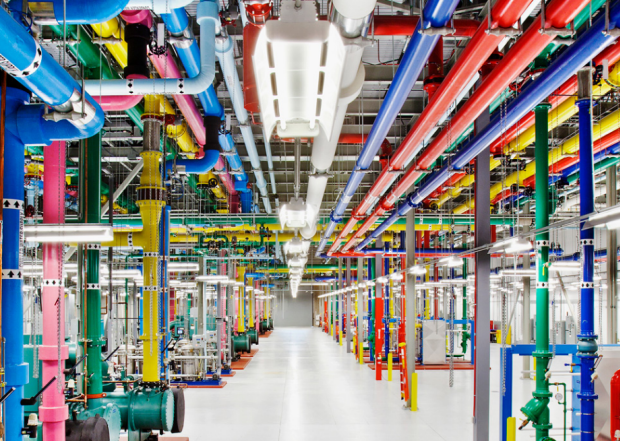
Click on Image to Enlarge

Google began sharing some information about its data centers in the past year, including its best practices and some energy consumption information. This latest sharing session goes far beyond its previous efforts with its photos, interviews, a video tour and even its Google street view feature, which allows user to explore the company’s Lenoir, North Carolina data center.

Google went one step further and let Steven Levy, a reporter from Wired behind the curtain.

All of this transparency matters as data centers, racing to keep up with our emails, video and Internet searches, gobble up an increasing amount of energy and store more of our private information. Security and energy efficiency are its two big challenges. Google has combated the latter with a host of solutions, such as creating a seawater-cooled data center in Finland and more simple innovations like turning up the thermostat in its data centers.

Photos: Google/Connie Zhou

Mini-Me: Eustace Mullins Books & Videos — a Deep Look Into the Origins of Western Financial Crime & Terror with Politicians as the Best of the Servant Class

Collective Intelligence, Commerce, Commercial Intelligence, Corruption, Cultural Intelligence
Who? Mini-Me?

Huh?

First read Wikipedia / Eustace Mullins

EXTRACT:

A central theme of Mullins' book is that the Federal Reserve allows bankers to monetize debt, creating it out of nothing by book entry, and thus they have enormous leverage over everyone else. Near the end of the book, he said of the Federal Reserve:

The Federal Reserve System is not Federal; it has no reserves; and it is not a system, but rather, a criminal syndicate. It is the product of criminal syndicalist activity of an international consortium of dynastic families comprising what the author terms “The World Order”. The Federal Reserve system is a central bank operating in the United States. Although the student will find no such definition of a central bank in the textbooks of any university, the author has defined a central bank as follows: It is the dominant financial power of the country which harbors it. It is entirely private-owned, although it seeks to give the appearance of a governmental institution. It has the right to print and issue money, the traditional prerogative of monarchs. It is set up to provide financing for wars. It functions as a money monopoly having total power over all the money and credit of the people.

Then watch this YouTube (58:19) Eustace Mullins – The New World Order (Full Length)

Eustace Mullins (1923-2010), America's foremost bank examiner, appears for the first time in a full studio production interview with “The Mouth of the South,” Bobby Lee. Mullins, a renowned author, lecturer and scholar reveals over 50 years of intensive research in an incredible true story and documentation of the conspiracy against the patriotic, hard working families of middle America.

Eustace Mullins can rightly be called not only America's premier populist historian, but he is a titanic figure on the landscape of American and world history, as a consequence of his monumental contributions to the arena of political, economic and philosophical discussion. Debt, Taxation, Inflation, Deflation, Bankruptcy; in the New World Order, there's nothing new under the sun.

More Links (Books, Videos, Online)

Continue reading “Mini-Me: Eustace Mullins Books & Videos — a Deep Look Into the Origins of Western Financial Crime & Terror with Politicians as the Best of the Servant Class”

Paul Craig Robert: America (RIP) – The True Cost of Government Corruption and Banking Greed – Moral Bankruptcy Assures the Death of a Nation

Commerce, Corruption, Government
Matt Taibbi

Review: Griftopia–Bubble Machines, Vampire Squids, and the Long Con That Is Breaking America

QUOTE (32): What has taken place over the last generation is a highly complicated merger of crime and policy, of stealing and government. Far from taking care of the rest of us, the financial leaders of America and their political servants have seemingly reached the cynical conclusion that our society is not work saving and have taken on a new mission that involved not creating wealth for us all, but simply absconding with whatever wealth remains in our hollowed out economy. They don’t feed us, we feed them.

Paul Craig Roberts

America R.I.P.

Paul Craig Roberts

Institute for Political Economy, October 16, 2012

Paul Craig Roberts was Assistant Secretary of the Treasury for Economic Policy and associate editor of the Wall Street Journal. He was columnist for Business Week, Scripps Howard News Service, and Creators Syndicate. He has had many university appointments. His internet columns have attracted a worldwide following.

EXTRACT:

In the early years of the 21st century, the Federal Reserve substituted a rise in consumer debt to drive the economy in place of the missing rise in consumer incomes. Low interest rates drove up housing prices, and people refinanced their mortgages and spent the equity. The Federal Reserve kept the economy alive by loading up consumers with debt that housing prices and consumer incomes would soon be unable to support.

Continue reading “Paul Craig Robert: America (RIP) – The True Cost of Government Corruption and Banking Greed – Moral Bankruptcy Assures the Death of a Nation”

SmartPlanet: Corrupt Government Allows Corporate Socialism – Privatized Profits and Externalized Losses

Commerce, Corruption, Government, Media

How corporations are crippling U.S. prosperity

By | October 15, 2012

David Cay Johnston
Click for Biography

A dearth of competition in major U.S. industries and a government that’s policy making has been severely corrupted by moneyed interests has led to depressed wages and stifled innovation, a Pulitzer Prize winning journalist says in a new book.

In essence, you’re being ripped off, and those responsible are taking everyone’s money while assuming very little risk.

David Cay Johnston was awarded the Pulitzer Prize for reporting the inequalities and loopholes that exist in the U.S. tax code and exposing corporate tax evasion. His latest work, The Fine Print: How Big companies Use “Plain English” to Rob You Blind, examines his findings about how the U.S. economy has strayed away from capitalism and into “corporate socialism,” where the free market, its engine of prosperity, has stalled.

Some argue that globalization has caused a smoothing of salaries as developing economies grow. We asked Johnston to make his case about how the alleged subversion of competitive markets could actually be what’s responsible. Here’s our interview with David Cay Johnston:

SmartPlanet: Are our markets competitive or is the game fixed?

David Cay Johnston: A growing number of industries are monopolies, duopolies and oligopolies even as they claim to be in highly competitive markets. Cable, Internet and telephone provide a good example of this. In most places you have one phone company and one cable company offering similarly slow, by world standards, Internet speeds and very similar prices. Computers make it possible for companies to match prices quickly, as airlines do in just a few minutes for millions of fares when one airline changes its pricing structure.

SP: Are we paying too much for goods and services?

DCJ: We pay four times what the French do for a triple play package of cable, Internet and telephone — and they get worldwide TV, not just domestic; their Internet is ten times faster and instead of two country calling, they get long-distance to 70 countries at no extra charge. All that for $38 compared to the U.S. average of $160 including taxes. By one measure we pay 38 times as much as the Japanese per bit of information on the Internet. In states where the electric utilities were broken up so power generation could be a competitive business prices did not fall. Instead since 1999 they rose 48% more than inflation, compared to just 8 percent in states that retained traditional regulation. Everywhere there is a lack of competition, or only the appearance of competition, we pay way too much.

Continue reading “SmartPlanet: Corrupt Government Allows Corporate Socialism – Privatized Profits and Externalized Losses”

Mini-Me: Web Hosting Firm ServerBeach Cannot Be Trusted…

Access, Commerce, Corruption, Idiocy, IO Impotency
Who? Mini-Me?

Huh?

How a single DMCA notice took down 1.45 million education blogs

Web hosting firm ServerBeach recently received a Digital Millennium Copyright Act (DMCA) violation notice from Pearson, the well-known educational publishing company. The notice pertained to Edublogs, which hosts 1.45 million education-related blogs with ServerBeach, and it focused on a single Edublogs page from 2007 that contained a questionnaire copyrighted by Pearson. ServerBeach informed Edublogs about the alleged violation, and Edublogs says it quickly took down the allegedly infringing content.

Instead of calling the matter settled, though, ServerBeach took Edublogs' servers offline last Wednesday, temporarily shutting off all 1.45 million blogs, according to Edublogs. ServerBeach confirms taking all of the Edublogs offline, telling Ars that the outage lasted for “roughly 60 minutes before we brought them back online and confirmed their compliance with the DMCA takedown request.”

As you might expect, ServerBeach and Edublogs have slightly different accounts of how it all happened.

Read full article.

Phi Beta Iota:  The criminal insanity of how ServerBeach handled this matter should be broadcast widely.  We certainly would not trust any company so cavalier, so utterly oblivious to the unwarranted cost of their unbirdled actions.  This specific instance should be the poster child for why an Autonomous Internet is needed with multiple backups such that no one unprincipled moron can wreak such havoc.  ServerBeach – posterchild for how not to do business.

DefDog: Reuters – Western Defense Cuts May Be Unstoppable – The Era of Rising Spending on Weapons and Wars is Over

Commerce, Economics/True Cost, Government, Military
DefDog

Western defense budget cuts may be unstoppable

Companies, governments already preparing for reduced military spending

Peter Apps,, updated 10/13/2012

WASHINGTON — Whether or not America's politicians can find a way to sidestep the brutal automatic military cuts of sequestration, the era of rising Western spending on weapons and wars is over.

That reality increasingly is challenging major arms manufacturers, spurring them to look for new markets, cost cuts and mergers. It is also confronting policymakers with difficult political and strategic choices as new rivals, particularly China, spend more on their armed forces.

U.S. military spending still dwarfs that of other countries – the equivalent of the next 13 nations' spending by some estimates – but the global military balance is clearly shifting. With European states already cutting, the London-based International Institute for Strategic Studies this year reported that Asian military spending outstripped Europe's for the first time in several centuries.

Read full article.

Yoda: US Intelligence Turns to Crowd-Sourcing (Only in English, Only Online)

Advanced Cyber/IO, Collective Intelligence, Commerce, Government
Got Crowd? BE the Force!

Intelligence agencies turn to crowdsourcing

Sharon Weinberger

BBC 10 October 2012

EXTRACTS:

Research firm Applied Research Associates, has just launched a website that invites the public—meaning anyone, anywhere—to sign up and try their hand at intelligence forecasting. The website is part of an effort, sponsored by the Intelligence Advanced Research Projects Activity (Iarpa), to understand the potential benefits of so-called crowdsourcing for predicting future events. Crowdsourcing aims to use the “wisdom of crowds” and was popularised by projects like Wikipedia.

. . . . . . . .

There’s good reason for Iarpa’s interest in finding new ways to collect useful information: the intelligence community has often been blasted for its failure to forecast critical world events, from the fall of the Soviet Union to the Arab Spring that swept across North Africa and the Middle East.  It was also heavily criticized for its National Intelligence Estimate in 2002, which supported claims that Iraq had weapons of mass destruction.

Those failures raised larger questions about how the intelligence agencies come up with forecasts, which is usually a deliberative process involving a large number of analysts.  The Iarpa project, known officially as Aggregative Contingent Estimation, is looking at whether crowdsourcing can result in more accurate forecasts about future events than those traditional forms of intelligence estimation.

Continue reading “Yoda: US Intelligence Turns to Crowd-Sourcing (Only in English, Only Online)”

noble gold