PewOur now infamous one percent own more than 35 percent of the nation’s wealth. Meanwhile, the bottom 40 percent of the country is in debt. Just this past Tuesday, the 15th of April – Tax Day – the AFL-CIO reported that last year the chief executive officers of 350 top American corporations were paid 331 times more money than the average US worker. Those executives made an average of $11.7 million dollars compared to the average worker who earned $35,239 dollars.
As that analysis circulated on Tax Day, the economic analyst Robert Reich reminded us that in addition to getting the largest percent of total national income in nearly a century, many in the one percent are paying a lower federal tax rate than a lot of people in the middle class. You may remember that an obliging Congress, of both parties, allows high rollers of finance the privilege of ‘carried interest,” a tax rate below that of their secretaries and clerks.
And at state and local levels, while the poorest fifth of Americans pay an average tax rate of over 11 percent, the richest one percent of the country pay – are you ready for this? – half that rate. Now, neither Nature nor Nature’s God drew up our tax codes; that’s the work of legislators – politicians – and it’s one way they have, as Chief Justice John Roberts might put it, of expressing gratitude to their donors: ‘Oh, Mr. Adelson, we so appreciate your generosity that we cut your estate taxes so you can give $8 billion as a tax-free payment to your heirs, even though down the road the public will have to put up $2.8 billion to compensate for the loss in tax revenue.”
Rasmussen is a right leaning survey operation. I mention this because context matters and a Right leaning poll with these results is worthy of close attention. I think this is telling us that the basis of trust upon which our democracy was based is eroding as quickly as the ice sheet covering Greenland.
Thirty-seven percent (37%) of Likely U.S. Voters now fear the federal government, according to a new Rasmussen Reports national telephone survey. Forty-seven percent (47%) do not, but another 17% are not sure.
Perhaps in part that’s because 54% consider the federal government today a threat to individual liberty rather than a protector. Just 22% see the government as a protector of individual rights, and that’s down from 30% last November. Slightly more (24%) are now undecided. (To see survey question wording, click here.)
As recently as December 2012, voters were evenly divided on this question: 45% said the federal government was a protector of individual rights, while 46% described it as a threat to those rights.
Two-out-of-three voters (67%) view the federal government today as a special interest group that looks out primarily for its own interests. Just 17% disagree, while 15% are undecided.
It costs about 10 bucks to buy a weekly issue of The Economist, and about $1 billion a year to fund the secret operations of Australia’s intelligence agencies. Which source gives better value for money?
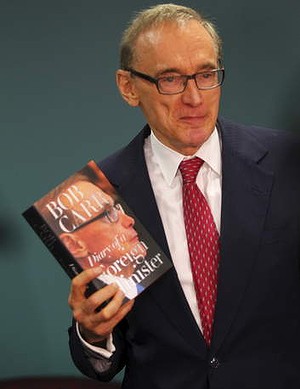
Bob Carr: “One must not be seduced by spies.”
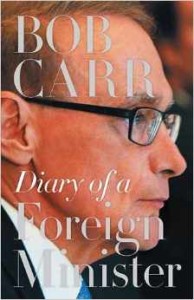
This is the fascinating but as yet largely overlooked question to emerge from Bob Carr’s diary of his time as foreign minister. ‘‘Intelligence figures larger in the job than I would have imagined,’’ Carr writes, and describes the Australian Secret Intelligence Service, tucked in its crypt inside Foreign Affairs headquarters, as ‘‘My own little CIA, my own spies’’.
. . . . . . .
Nothing in the book appears to put any secret sources at risk, even though security types expecting strict control over information will doubtless squirm from the attention.
But for all Carr’s devouring of intelligence reports, he doesn’t seem overly impressed by the shadowy world from whence they emanate. ‘‘One must not be seduced by spies and their agenda,’’ he writes after meeting the CIA chief in Washington. At an earlier meeting, fresh in the job, Carr also spoke with CIA officers on topics ranging across Afghanistan, Pakistan, Iran and China, and came away underwhelmed.
‘‘All this was solid but unexciting. Where were the revelations? Was there anything here one would not pick up from The Economist, let alone [diplomatic] cables? This thought stirred my instinctive scepticism about intelligence. How often do we get to relish the knockout revelation that we can whole-heartedly believe and on which we can base policy, taking our rivals altogether by surprise?’’
Amazon Page
Carr is not the first to doubt the value of intelligence, whose reputation is regularly burnished by Hollywood depictions of the all-seeing, all-knowing spies. He approvingly records a conversation with former US secretary of state Henry Kissinger who similarly reported having never been much surprised by intelligence reports.
Carr has a point. Open source material – the stuff of newspapers, academic journals or a chat with an expert – is often regarded as less worthy when placed alongside a report stamped ‘‘TOP SECRET’’ in big red letters. Yet the best answers are regularly to be found in plain sight.
He goes further, warning that spying for spying’s sake carries grave risk. Presumedly this is the ‘‘agenda’’ he worries over. He left the job before leaks by Edward Snowden exposed Australian bugs on the phones of Susilo Bambang Yudhoyono and his wife, upending ties with Indonesia.
But Carr did see hints of trouble with Jakarta over spy operations emerge during his time. ‘‘The pursuit of intelligence of questionable value has got to be weighed,’’ he writes. ‘‘Weighed against the harm if the intelligence gathering is exposed.’’
This is a debate Australia should be having, rather than beating up on the ABC and other reporters for broadcasting the Snowden leaks. Are we happy to be the kind of nation that covertly listens in on other country’s leaders? Is there a genuine advantage?
Attached herewith is an important report in the Guardian. It places the deregulation of Wall Street during the Clinton Administration into a particularly smarmy perspective by examining documents just released by the Clinton library. Note the connections to players now in the Obama Administration.
This report paints a revealing albeit depressingly familiar portrait of how the iron triangle of individuals and money moving between government executive positions, and private sector, together with friendly legislators in Congress encourages corruption that leads ultimately to taxpayer bailouts. Consider please the following:
1. Note how the memos make it look like President Clinton was being rushed, implying a certain degree of passivity and manipulation by advisors. But before taking this at face value, bear in mind, Clinton was never a passive actor; quite the opposite, he was a highly energetic president. He set the tone, and he picked these advisors; he stayed with them; and he passed many of them on to President Obama.
2. Note that the repeal of Glass Steagall — Clinton’s signature deregulation of the financial markets and perhaps the major contributor to the rise of speculation that culminated in 2008 crash — was not a last minute affair. In fact, the memos show effort to repeal reaches bat to at least in February 1995 and May 1997 and the reference to eating the paper after you read it suggests a degree of malevolent cynicism.
3. Note the tight connection between the repeal Glass-Steagall and the pending Citigroup merger with Travelers Group, and particularly, the central the role played by Secretary of the Treasury Robert Rubin in the promotion of the of that repeal. Rubin was Secretary of the Treasury from 11 January 1995 to 2 July 1999 — the period covered by the memos contained in the Guardian report.
4. Finally, the reader should note that four months after leaving the Treasury Department, in Oct 1999, Rubin joined Citigroup. Here is a contemporary portrait painted by a 27 October 1999 report in the New York Times,
“Mr. Rubin, 61, a former top official of Goldman, Sachs & Company, said yesterday that he had joined Sanford I. Weill and John S. Reed, the chairmen and chief executives Citigroup, in what Mr. Reed described as a ”three-person office of the chairman” that will oversee what has become the first true American financial conglomerate since the Depression.
The appointment came less than a week after the Clinton Administration and Congress agreed on a compromise bill that would overhaul the laws that regulate the financial industry, a measure that removes many of the restrictions preventing banks, securities firms and insurance companies from buying one another or engaging in one another's businesses. Both Mr. Rubin and Citigroup strongly supported the bill, which would greatly benefit the company. Mr. Rubin said he played a role in arranging the final compromise that will probably lead to the repeal of the so-called Glass-Steagall legislation. But he said that had nothing to do with his decision to join the company.”
By 2007 Rubin was Chairman of Citigroup. And in 2008, nine years after the repeal of Glass Steagall, the worst financial crisis since the Great Depression hit Wall Street to trigger the worst and longest recession since the Great Depression. That crisis, among other things, collapsed the stock markets, destroyed retirement nest eggs, wrecked the housing markets, and put millions of people out of work — and our nation has still not recovered. Then the “best government money can buy” added insult to injury by bailing out of the banks that created the mess, while ducking the issue of re-regulating their behaviour with anything close to proven power of defunct Glass-Steagall Act. Some observers are now warning the government’s failure to reign in speculative behaviour is setting the stage for yet another crash (e.g., here and here)
And what about Rubin’s role? According to information in Wikipedia, on 3 December 2008, shortly after the financial collapse, the Wall Street Journal characterized Rubin’s mix of oversight and management responsibilities at Citigroup “murky.” In an interview with the Journal, Rubin defended himself, saying: “I think I've been a very constructive part of the Citigroup environment.”But, the Journal reported that Citigroup shareholders suffered losses of more than 70 percent since Rubin joined the firm and that he encouraged changes that led the firm to the brink of collapse.[23] Investors filed a lawsuit in December contending that Citigroup executives, including Rubin, sold shares at inflated prices while concealing the firm’s risks. A Citigroup spokesman said the lawsuit was without merit.[24].
But what happened to Rubin personally? According to a 20 September 2012 report in Bloomberg, Rubin received a total compensation of $126,000,000 from Citigroup between 1999 and 2009.Among other things, the former eagle scout is now co-chairman of the prestigious Council on Foreign Relations.
(NaturalNews) Everything you and I are doing right now to try to save humanity and the planet probably won't matter in a hundred years. That's not my own conclusion; it's the conclusion of computer scientist Steve Omohundro, author of a new paper published in the Journal of Experimental & Theoretical Artificial Intelligence.
His paper, entitled Autonomous technology and the greater human good, opens with this ominous warning (1)
Military and economic pressures are driving the rapid development of autonomous systems. We show that these systems are likely to behave in anti-social and harmful ways unless they are very carefully designed. Designers will be motivated to create systems that act approximately rationally and rational systems exhibit universal drives towards self-protection, resource acquisition, replication and efficiency. The current computing infrastructure would be vulnerable to unconstrained systems with these drives.
Privacy: Sweden, like most European countries, has a number of governmentally-run state lotteries that are an efficient extra tax on the people who can’t math properly. Because of the jackpot sizes (nine-figure euro or dollar amounts), they are still hugely popular. From June 1, the Swedish state lottery requires people who want to buy a simple lottery ticket to identify and register.
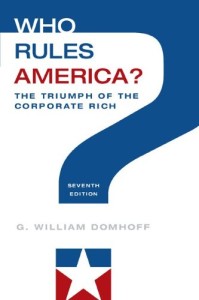
NOTE: WhoRulesAmerica.net is largely based on my book, Who Rules America?, first published in 1967 and now in its 7th edition. This on-line document is presented as a summary of some of the main ideas in that book.
Who has predominant power in the United States? The short answer, from 1776 to the present, is: Those who have the money — or more specifically, who own income-producing land and businesses — have the power. George Washington was one of the biggest landowners of his day; presidents in the late 19th century were close to the railroad interests; for the Bush family, it was oil and other natural resources, agribusiness, and finance. In this day and age, this means that banks, corporations, agribusinesses, and big real estate developers, working separately on most policy issues, but in combination on important general issues — such as taxes, opposition to labor unions, and trade agreements with other countries — set the rules within which policy battles are waged.