After Yemeni Offensive Against al Qaeda in South, Militants Keep Low Profile, Say Officials
EXTRACT
Some officials in San'a, however, worry that President Hadi's credibility has been undercut by reports issued by government spokesmen earlier in the day that the country's security forces had uncovered and foiled a variety of terrorist plots—including, the spokesmen said, planned attacks against a major Yemeni oil facility, military installations and Western embassies.
U.S. officials cast doubt on the veracity of the claims, saying that the U.S. hadn't changed its assessment of a broad al Qaeda threat. Later Wednesday, Yemen's SABA state news agency cited security sources denying there had been a threat against the oil terminal.
Rami G. Khouri is Editor-at-large of The Daily Star, and Director of the Issam Fares Institute for Public Policy and International Affairs at the American University of Beirut, in Beirut, Lebanon. You can follow him @ramikhouri.
BEIRUT — I would love to know who the jerk is who wrote the White House’s press statement on the occasion of the inauguration earlier this week of the new Iranian President, Hassan Rouhani. I say this is the work of a jerk, or a band of war-addicted zealots in Washington, D.C., because it seems designed to totally bury the opportunity that Rouhani represents to improve the wellbeing of Iranians and resolve Western-Iranian and Arab-Iranian tensions on a variety of important issues.
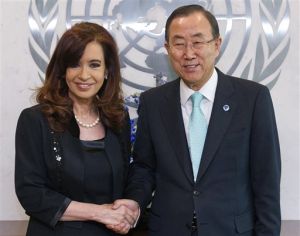
Argentina's President Cristina Fernandez used the opportunity of presiding over the U.N. Security Council for the first time Tuesday to take aim at the veto power of its five permanent members _ the United States, Russia, China, Britain and France.
Fernandez also criticized member states that don't implement U.N. resolutions, citing unheeded demands for a Palestinian state and Britain's refusal to engage in talks about the disputed Falkland Islands, which Argentina calls the Malvinas.
. . . . . . .
Argentine President at UN
She said the veto was a safeguard during the Cold War to prevent “nuclear holocaust” _ but today the United States and Russia sit at the same table “and we can't deal with the problems in this new world with old instruments and old methods.”
Fernandez pointed to two Latin American organizations _ the Community of Latin American and Caribbean States and the Union of South American Nations _ which take decisions on the basis of unanimity when there is a conflict. By contrast, she criticized the use of vetoes by the permanent members of the Security Council.
Russia and China have vetoed three Western-backed resolutions to pressure Syrian President Bashar Assad to end the 2 1/2 year conflict that has killed more than 100,000 people, and the United States, Israel's closest ally, has vetoed numerous resolutions over the years on the Palestinian conflict with Israel.
Fernandez strongly supported the Arab League's U.N. observer Ahmed Fathalla who said all 193 U.N. member states must implement U.N. resolutions
When I first began to travel professionally, when I started working for National Geographic, we used to be warned about not drinking the local water from the tap. Today I would be more concerned about the tap water in parts of American than I would be in much of the rest of the world. Here's why. My suggestion to all of you is to have your water tested by a! n independent lab. It only costs a few dollars, and it may give you a surprise.
Right now there is another blown-out rig in the Gulf of Mexico, and FOUR major tar sands pipeline leaks in Alberta, Canada. We are experiencing a major continent wide slow motion environmental disaster going on within the carbon energy infrastructure and, as far as I can see, the only person in corporate media who is even talking about it is Rachel Maddow on MSNBC. And today! , the Republicans in the House gutted support for non-carbon energy.
I write to ask you to join 11 Nobel Laureates in Economics, other leading economists, and former government officials in endorsing the INFORM ACT (Intergenerational Financial Obligations Reform Act) at www.theinformact.org.
All endorsements will be included in a letter to Congress, which is posted on the website, that will appear early this fall in a full-page ad in the New York Times.
The INFORM ACT, which I drafted in large part with the assistance of Alan Auerbach, requires the Congressional Budget Office (CBO), the Government Accountability Office (GAO), and the Office of Management and Budget (OMB) to do fiscal gap and generational accounting on an annual basis and, upon request by Congress, to use these accounting methods to evaluate major pieces of proposed legislation.
“Very leery” of going to a developing country like India or Thailand, which both draw so-called medical tourists, he ultimately chose to have his hip replaced in 2007 at a private hospital outside Brussels for $13,660. That price included not only a hip joint, made by Warsaw-based Zimmer Holdings, but also all doctors’ fees, operating room charges, crutches, medicine, a hospital room for five days, a week in rehab and a round-trip ticket from America.
The more one shares, the more one undermines a future patent application and a system that encourages privatization [profit for the few, suffering for the many]
Charles Davis
Al Jazeera, 3 August 2013
EXTRACT:
Signed into law by President Bill Clinton, the Economic Espionage Act of 1995 makes it a federal offence punishable by up to 15 years in prison for someone to “knowingly” deliver a “trade secret” into the hands of a foreign government or institution. As written, that means even if someone had the most honest of intentions – hey, maybe people outside of America get cancer too – they would still be considered a spy for letting a scientific secret cross a body of water. If that secret is ever disclosed, it will be disclosed on corporate America's terms. And it will make someone a lot of money.
Consider the case of Hua Jun Zhao. A researcher at Wisconsin Medical College, Zhao was recently accused of stealing several vials of a potentially cancer-fighting compound he was working on with the intent of passing it on to a university in China, allegedly as his own work. If true, Zhao certainly committed a crime – theft – and perhaps intended to commit academic fraud. But when the FBI came knocking, the $8,000 in missing goods was treated as espionage. Zhao, according to the bureau, was a spy.
In a press release, the FBI alleged that the Chinese native used his position to “illegally acquire patented cancer research material and to have taken steps to provide that material to Zhejiang University in China”. Among the goals served by his arrest, the bureau stated, was protecting America's “competitiveness in an age of globalisation”. By law, the espionage case had to first be approved by a top official at the Justice Department.