Simon Johnson, former chief economist of the IMF, lays out the political case for “Trust Busting” in the 21st Century — it is a political argument that Andrew Jackson and Teddy Roosevelt would have understood and probably approved of.
At this stage in the electoral cycle, Democrats should be running hard against big banks and their consequences. Some roots of our current economic difficulties lie in the Clinton 1990s, but the real origins can be traced to the financial deregulation at the heart of the Reagan Revolution – and all the underlying problems became much worse in eight years of George W. Bush’s unique brand of excess and neglect.
The theme for the November midterms should be: Which part of the 8 million jobs lost [since December 2007] do you not understand? The big banks must be reined in and forced to break themselves up, or we’ll head directly for another such crisis.
Instead, the Democrats have fallen into a legislative and electoral trap that – amazingly – they built for themselves.
Welcome to the Tea Party Express III: Just Vote Them Out!
All throughout the recent Tea Party Express national bus tour we kept receiving calls from people around the nation who lived far away from the route our buses took across America. We vowed at the time to keep the Tea Party Express effort alive – and that’s exactly what we are doing.
Join us from March 27th to April 15th, 2010
as we tell Congress and the White House: “Enough!”
Let’s stand up and stop the bailouts, cap and trade, out-of-control spending, government-run healthcare, and higher taxes! We’re back and determined to take our country back!
Phi Beta Iota: We do not believe that a Civil War is coming for the simple reason that there are not enough organized guns to put down the public if the public is united. The Tea Party Express is more authentic in many ways than the Committee for a Unified Independent Party (CUIP), which is much more like organized politics as operated by the two parties that have corrupted the electoral system and block out the other 63 parties from actual participation.
On 16 January 2010, Herbert Meyer, who served during the Reagan Administration as Special Assistant to the Director of Central Intelligence and Vice Chairman of the CIA's National Intelligence Council, wrote the following:
“No one among us is perfect, or even close to perfect. In the real world, intelligence failures will happen from time to time no matter how honorable, hardworking, or talented the men and women are on whom we rely to keep us safe. But after so many intelligence
Full Meyer Op-Ed
failures in such a short time, we have got to stop making the same mistake over and over again. This week's Washington cliché is that our system failed. No. Systems don't fail; people fail. Put the right people in charge, and the “system” will fail much, much less frequently.”
I couldn't agree more with Mr. Meyer.
The final chapter of my book, Cash on Delivery: CIA Special Operations During the Secret War in Laos, is titled “Speaking Truth to Power – Lessons Learned”. In it I wrote, “It probably is wonderful that so many politicians, wide variety of pundits and family members of victims of terrorist attacks have taken such an interest in the organization of the CIA and other intelligence community agencies. I see no reason why they should not criticize what they see and understand about what the CIA has or has not done. However, they do not know the full story and they ought to know they do not know it. Yet, they proceed to suggest just how the CIA should be re-organized, without any experience in the collection, analysis and dissemination of intelligence and without all the details of how any particular intelligence, and certainly not how all of it, was collected, analyzed and disseminated. Most often, the solution they suggest boils down to rearranging the lines and boxes on organization charts. People populate the boxes on organization charts. How can it be that the perceived failures they are correcting were merely the result of the boxes not being connected properly among the lines? If the failures were the fault of the people, why don’t they ask that all those people be fired or demoted? Would that do any good? You cannot just go out and hire experienced intelligence professionals from a vast pool that just happens not to be working for the CIA at the time. Intelligence professionals must be grown from seed; they cannot be transplanted from mature plants. Yet, reorganizations are always proposed as changes of the alignment of lines and boxes or the creation of more lines and boxes added to the top of the whole structure, e.g. the National Counterterrorism Center or the Director of National Intelligence. Just how does adding more people to boxes and placing them on top of a bureaucratic structure make it better? Where do the people come from? If they are experienced intelligence professionals, how did anyone figure out how to identify the ones who were not part of the problem? If they are not experienced intelligence professionals why does anyone believe they will have what it takes to lead such a complex undertaking that has no valid lateral experience other than to mature within the intelligence structure?”
Reorganizations look good on paper and play well in the media, but they don't solve the true problem of a lack of first class leadership. When there is a failure to “connect the dots” you need to determine why the people you have did not or could not make the connections. Then you must take remedial actions to lead those people to better performance and to inspire them to, in the words of the U.S. Army, be all they can be.
Intelligence organizations like the CIA will still fail to connect all the dots and will still lose officers killed in action, no system can be perfect and the fight against terrorism will not be without casualties, but when we have failures or casualties we must be able to figure out whether there was nothing we could have done, or whether the leaders we have failed in their duties. Then we replace those leaders and do our best to give them the remedial training they need to become better, if and when they lead again. If we have the best leaders we can get, they will determine how the lines and boxes should be connected and we should expect they will be correct.
UPDATE: A colleague from within asked us to highlight this quote with the observation that neither the US IC nor DoD have any clue how to execute. We agree. Both lack leadership with vision and multinational panache; they simply do not know what they do not know because they have both wasted the last 21 years refusing to listen or learn.
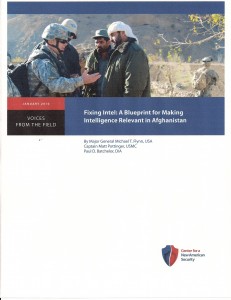
P.23. They must embrace open-source, population-centric information as the lifeblood of their analytical work. They must open their doors to anyone who is willing to exchange information, including Afghans and NGOs as well as the U.S. military and its allies. As General Martin E. Dempsey, commander of the U.S. Army Training and Doctrine Command, recently stated, “…[T]he best information, the most important intelligence, and the context that provides the best understanding come from the bottom up, not from the top down.”
The Cold War notion that open-source information is “second class” is a dangerous, outmoded cliché. Lieutenant General Samuel V. Wilson, former director of the Defense Intelligence Agency, captured it perfectly: “Ninety percent of intelligence comes from open sources. The other 10 percent, the clandestine work, is just the more dramatic.
Good News: Some good people in the field have finally re-invented half the wheel–the company-level bottom-up half. Unfortunately they have absolutely no idea what can be gotten from the rest of the world (non US citizens without clearances); they are jammed into a legacy system that demands at least a SECRET clearance; there is no Multinational Engagement Network that is totally open albeit commercially encrypted, and therefore this is going nowhere. We could fix this on leftover loose-change, but ONLY if DoD intel leadership will accept the iconoclastic multinational solutions that have been in gestation for 21 years.
Bad News: CIA and DIA are still broken and not likely to get fixed anytime soon. The Human Terrain Teams (HTT) are an utter disgrace. DoD commanders still have not figured out Open Source Intelligence (OSINT) and OSINT does not appear in this report, nor does Reach-Back, 24/7 tribally-nuanced on demand web-cam translator services, and on and on and on. Army G-2 is non-existent–Army is simply not trained, equipped, nor organized to do tactical intelligence in small wars. Neither is the Marine Corps, but they adapt better. What is so very tragic is that this is a problem that can be fixed FAST with Multinational Engagement and a proper use of distributed linguistic and cultural assets. All it needs is an internationalist mind-set, which no one now serving in DIA or CIA actually can muster. All of the pathologies we have been writing about since 1988 are to be found in Afghanistan, and none of the solutions that many, many authors have written about for the last 21 years are even on the table.
President Obama has a rapidly vanishing opportunity to achieve historical greatness as a trust buster by breaking up the banks. Trust busting is an almost risk free path to lasting respect — Teddy Roosevelt's honored place in American history is more a result of his trust busting than his gross imperialism.
In the attached article, my good friend Marshall Auerback explains why Obama's faux populism attacks the symptom rather than the disease now infecting our financial system.
My guess is that Obama's “reform” policies — i.e., change we can believe in — will not even be smart politics in the long run, because at the end of the day, suckering the Tea Baggers (not to mention the so-called progressives) with phony populist appeals, while supporting cosmetic banking reforms, will alienate just about everyone except the oligarchical elites benefitting from his protectionist policies. In this sense, Mr. Obama is rapidly becoming just another Bill Clinton, a highly intelligent, self-made man of the people who squandered his opportunity for greatness on the altar of short-sighted service to the rich and powerful.
The mounting crisis in the country only attracted notice when a Nigerian student is revealed to have been “trained” in Yemen by al-Qa’ida to detonate explosives in his underpants on plane heading for Detroit. But this botched attack has led to the US and Britain starting to become entangled in one of the more violent countries in the world. The problems of Yemen are social, economic and political, and stretch back to the civil war in Yemen in the 1960s, but Gordon Brown believes solutions can be found by holding a one day summit on Yemen to “tackle extremism.”
Al-Qa’ida in Yemen is small, its active members numbering only 200-300 lightly armed militants in a country of 22 million people who are estimated to own no less than 60 million weapons. Al-Qa’ida has room to operate because central government authority barely extends outside the cities and because it can ally itself with the many opponents of President Ali Abdullah Saleh, who has been in office since the 1970s.
CNN Editor's note: Charles S. Faddis is a retired CIA operations officer and the former head of the CIA's unit focused on fighting terrorism involving weapons of mass destruction. The author of a recently published book about the CIA, “Beyond Repair,” Faddis is also president of Orion Strategic Services, a Maryland-based consulting firm.
Phi Beta Iota: We know and admire Charles Faddis. Below the fold are other references on the implosion of CIA, which is no longer fit for duty. Panetta means well, but he does not know what he does not know, and the stuffed shirts surrounding him are not about to tell him what he really does need to know, in part because they don't know, they've made a career out of pushing paper, inflating success, and avoiding accountability. The difference between the earlier set of anti-CIA retirees and our set are two: 1) we're not breaking rules and cannot credibly be labeled as traitors; and 2) we know vastly more about the real world of all-source intelligence than the incompetent insiders and we cannot be silenced. Eventually an honest political leadership will hear us.
Full Story Online
STORY HIGHLIGHTS
We owe it to 7 fallen CIA agents (sic) to examine the state of the CIA, says Charles Faddis [PBI: US citizens are officers, the recruited foreigners are agents]
A retired CIA officer, Faddis says the agency is hobbled by bureaucracy
He says the CIA's leaders lack the experience to run counter-terror operations
CIA needs stronger training, better leadership and higher standards, he says