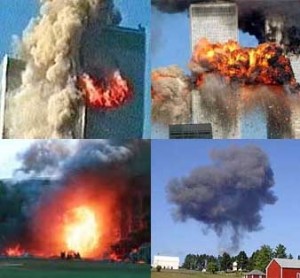
Phi Beta Iota: a 59 page memorandum is rocketing around the Internet, entitled Collateral Damage: U.S. Covert Operations and the Terrorist Attacks on September 11, 2001. Read the report, which includes very specific details and charts with head and shoulder photos. This material is substantiated not just by the sources cited in the endnotes, but by many other sources such as those reviewed at 9-11 Truth Books & DVDs (23) and (indirectly) at Empire, Sorrows, Hubris, Blowback (145).
In 1975, physicist Andrei Sakharov and a group of fellow Soviet academicians warned the Kremlin leadership that unless the nation’s ruinous defense spending was slashed and funds refocused on modernizing the nation’s decrepit, obsolete industrial base and its wretched state agriculture, the Soviet Union would collapse by 1990.
Their grim warning was prescient. Twenty years ago this week – 9 November, 1989 – boisterous German crowds forced open the hated Berlin Wall, Communist East Germany collapsed in black farce, and the once mighty Soviet Empire began to crumble.
This was one of modern history’s most dramatic and dangerous moments. No one knew if the dying Soviet Union would expire peacefully, or ignite World War III.
In November, 1989, the vast empire built by Stalin that stretched from East Berlin to Vladivostok was on its last legs. The USSR had 50,000 battle tanks and 30,000 nuclear warheads, but could not feed its people. Military spending consumed 20% of the economy. As I saw for myself while traveling around the Soviet Union in the late 1980’s, conditions were often primitive, even third world outside the big cities.
Who would have thought a year ago that most of the issues of conflict in America’s foreign relations would be made worse during the first year following Barack Obama’s election as U.S. president?
Even those disputes or differences that were appeased or quiet a year ago are now worse. On Iraq, the new president has faithfully followed the policy of George W. Bush, and now Iraq threatens breakdown. . . . . . . .
Put aside, for a moment, the military disaster that is now in the course of manufacture in the “Af-Pak” theater of unwinnable wars.
Look at the president’s other policy problems. The Korean affair continues, as we have just seen. There are tensions foreseeable in his visit to a new Japanese government at the end of this week. The old security conventions and connivances of past Japanese Liberal Democrat governments will be questioned.
Japan’s new government’s geopolitical view of East Asian security is not the passive and compliant one displayed for nearly 60 years by Liberal Democrat politicians who did as Washington suggested. In question today is the legal status under which 47,000 U.S. troops and a series of bases have quasi-permanently occupied the archipelago since 1945. Japanese naval forces were limited in number and mission, despite China’s rising military power.
China is developing a blue-water navy to support territorial claims in the region, while experiencing serious trade tensions with the U.S. On Nov. 5, the U.S. imposed 99 percent anti-dumping taxes on certain Chinese steel exports. Then there is the question of the American trade deficit with China, which suits the U.S. but not China, and the troublesome shadowing of the dollar by the Chinese renminbi.
In Latin America, the Obama people have already made trouble, demanding and getting a sizable new air base agreement in Colombia, whose significance, as the U.S. Air Force itself says, will be strategic. (Presumably to counter the “menace” of Russian ships off Venezuela.) Washington’s ambiguous conduct with respect to the Honduras military coup did not contribute to good pan-American relations.
Success in Afghanistan is measured in Washington by the ability to create an indigenous army that will battle the Taliban, provide security and stability for Afghan civilians and remain loyal to the puppet government of Hamid Karzai. A similar task eluded the Red Army, although the Soviets spent a decade attempting to pacify the country. It eluded the British a century earlier. And the United States, too, will fail.
American military advisers who work with the Afghan National Army, or ANA, speak of poorly trained and unmotivated Afghan soldiers who have little stomach for military discipline and even less for fighting. They describe many ANA units as being filled with brigands who terrorize local populations, exacting payments and engaging in intimidation, rape and theft. They contend that the ANA is riddled with Taliban sympathizers. And when there are combined American and Afghan operations against the Taliban insurgents, ANA soldiers are fickle and unreliable combatants, the U.S. advisers say.
Unraveling the mysteries of Vietnam may prevent us from repeating its mistakes
By Evan Thomas and John Barry
Stanley Karnow is the author of Vietnam: A History, generally regarded as the standard popular account of the Vietnam War. This past summer, Karnow, 84, picked up the phone to hear the voice of an old friend, Ambassador Richard Holbrooke. The two men had first met when Holbrooke was a young Foreign Service officer in Vietnam in the mid-1960s and Karnow was a reporter covering the war. Holbrooke, who is now the U.S. special representative for Afghanistan and Pakistan, was calling from Kabul. The two friends chatted for a while, then Holbrooke said, “Let me pass you to General McChrystal.” Gen. Stanley McChrystal, the commander of U.S. and allied forces in Afghanistan, came on the line. His question was simple but pregnant: “Is there anything we learned in Vietnam that we can apply to Afghanistan?” Karnow's reply was just as simple: “The main thing I learned is that we never should have been there in the first place.” [Emphasis added]
Obama's policies are making Democrats the party of Bloated Plutocracy.
November 8, 2009 OP-ED COLUMNIST
The Night They Drove the Tea Partiers Down
Frank Rich
The Obama administration does not seem to understand that this rage, left unaddressed, could consume it.
The system is going back to the way it was with a vengeance, against a backdrop of despair. As the unemployment rate crossed the 10 percent threshold at week’s end, we learned that bankers were helping themselves not just to bonuses as large as those at the bubble’s peak but to early allotments of H1N1 vaccine. No wonder 62 percent of those polled by Hart Associates in late September felt that “large banks” had been helped “a lot” or “a fair amount” by “government economic policies,” but only 13 percent felt the “average working person” had been. Unemployment ranked ahead of the deficit and health care as the No. 1 pocketbook issue in the survey, with 81 percent saying the Obama administration must take more action.
As someone who has lived in Turkey for most of the last two years, I have watched the development of her foreign policy with great interest, not to mention a good deal of confusion
It is hard to make sense out this rapidly-emerging, vibrant country of 70 million, increasingly well-educated, industrious people. While its remote interior is still very traditional, Turkey's coastal regions are already beginning to blossom into an outward looking, modern multinational consumer society, and the effects of rising incomes and education are very visible. In the coastal regions, I would say that living standards are now higher than those of Portugal, about the same as those of Greece, and somewhat lower than those of Spain. To be sure, the interior is poorer, especially as one travels east, but even in the east, there is growing modernity. Everywhere, markets are chock a block with high-quality healthy food and vast quantities middle income consumer goods, and there is fresh water galore, especially in the coastal regions.
The attached op-ed by Patrick Seale is a good summary that brings clarity to much of what is going on with Turkey's foreign policy and is well worth reading.
But there is more. Not mentioned are Turkey's bilateral overtures to Russia, Georgia, the Ukraine, and the various Turkic countries in great swath of Central Asia (including the Uighurs in NW China), as well as a bewildering variety of multilateral environmental and economic initiatives in the Black Sea region (involving Bulgaria, Romania, Ukraine, Russia, Georgia, Greece, and Turkey).