The National Security Agency's $2 billion mega spy center is going up in flames.
Technical glitches have sparked fiery explosions within the NSA's newest and largest data storage facility in Utah, destroying hundreds of thousands of dollars worth of equipment, and delaying the facility's opening by one year.
And no one seems to know how to fix it.
For a country that prides itself on being a technology leader, not knowing the electrical capacity requirements for a system as large as this is inexcusable.
Within the last 13 months, at least 10 electric surges have each cost about $100,000 in damages, according to documents obtained by the Wall Street Journal. Experts agree that the system, which requires about 64 megawatts of electricity—that's about a $1 million a month energy bill–isn't able to run all of its computers and servers while keeping them cool, which is likely triggering the meltdowns.
The contractor that designed the flawed system—Pennsylvania-based Klingstubbins–said in a statement that it has “uncovered the issue” and is working on “implementing a permanent fix.”
But that's not the case, according to the Army Corps of Engineers (ACE), which is in charge of overseeing the data center's construction. ACE disagreed with the contractor and said the meltdowns are “not yet sufficiently understood.”
A report by ACE in the Wall Street Journal said the government has incomplete information about the design of the electrical system that could pose new problems if settings need to change on circuit breakers. The report also said regular quality controls in design and construction were bypassed in an effort to “fast track” the project.
This is probably an even mix among traitors trying to start a war with Iran (USN), patriots refusing to obey illegal orders (Benghazi), and plain incompetents (nuclear) or industrial era jerks (sexual misadventure). Given the number of incompetent flag officers still serving — over 800 of them, one can be skeptical about these particular firings. The nine generals that have been fired are:
UNITED STATES AIR FORCE
Major General Michael Carry, from Commander 20th Air Force
UNITED STATED ARMY
General Carter Hamm, from CG Africa Command
Lietenant General David Holmes Huntoon Jr. from 58th Sperintendent of West Point
Major General Ralph Baker, from Task Force Horn (Djibouti, Africa)
Brigadier General Bryan Roberts, from Fort Jackson
The comment on this article, the last sentence which is in red print, is the most telling. This whole article is a good example that proves two things:
1. There is “stuff” really is going on behind the scenes which is being kept secret.
2. It is difficult, if not impossible, to know who the white hats are and who the black hats are. In this case the general(s) who was “fired” might have been fired by the positive military because he was negative military, following cabal orders. Or he might have been fired by the cabal because he wouldn't follow cabal orders. We don't know without further information.
Since 9/11, two consecutive U.S. administrations have labored mightily to help Afghanistan create a state inhospitable to terrorist organizations with transnational aspirations and capabilities. The goal has been clear enough, but its attainment has proved vexing. Officials have struggled to define the necessary attributes of a stable post-Taliban Afghan state and to agree on the best means for achieving them. This is not surprising. The U.S. intervention required improvisation in a distant, mountainous land with de jure, but not de facto, sovereignty; a traumatized and divided population; and staggering political, economic, and social problems. Achieving even minimal strategic objectives in such a context was never going to be quick, easy, or cheap.
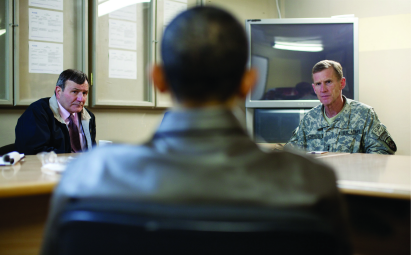
Eikenberry, Obama, and General Stanley McChrystal in Afghanistan, March 2010. (Pete Souza / White House)
Of the various strategies that the United States has employed in Afghanistan over the past dozen years, the 2009 troop surge was by far the most ambitious and expensive. Counterinsurgency (COIN) doctrine was at the heart of the Afghan surge. Rediscovered by the U.S. military during the wars in Afghanistan and Iraq, counterinsurgency was updated and codified in 2006 in Field Manual 3-24, jointly published by the U.S. Army and the Marines. The revised doctrine placed high confidence in the infallibility of military leadership at all levels of engagement (from privates to generals) with the indigenous population throughout the conflict zone. Military doctrine provides guidelines that inform how armed forces contribute to campaigns, operations, and battles. Contingent on context, military doctrine is meant to be suggestive, not prescriptive.
Broadly stated, modern COIN doctrine stresses the need to protect civilian populations, eliminate insurgent leaders and infrastructure, and help establish a legitimate and accountable host-nation government able to deliver essential human services. Field Manual 3-24 also makes clear the extensive length and expense of COIN campaigns: “Insurgencies are protracted by nature. Thus, COIN operations always demand considerable expenditures of time and resources.”
The apparent validation of this doctrine during the 2007 troop surge in Iraq increased its standing. When the Obama administration conducted a comprehensive Afghanistan strategy review in 2009, some military leaders, reinforced by some civilian analysts in influential think tanks, confidently pointed to Field Manual 3-24 as the authoritative playbook for success. When the president ordered the deployment of an additional 30,000 troops into Afghanistan at the end of that year, the military was successful in ensuring that the major tenets of COIN doctrine were also incorporated into the revised operational plan. The stated aim was to secure the Afghan people by employing the method of “clear, hold, and build” — in other words, push the insurgents out, keep them out, and use the resulting space and time to establish a legitimate government, build capable security forces, and improve the Afghan economy. With persistent outside efforts, advocates of the COIN doctrine asserted, the capacity of the Afghan government would steadily grow, the levels of U.S. and international assistance would decline, and the insurgency would eventually be defeated.
Blindly following COIN doctrine led the U.S. military to fixate on defeating the insurgency while giving short shrift to Afghan politics.
If you are willing to lie about this, you cannot be trusted about anything. Counterintelligence starts with demanding the truth from the inside out, and then ruthlessly going after the real insider threat: those who feel they can lie to their own.
Government ‘Big Lie’ Plays Horrific Joke on U.S. Veterans and Their Families
By Bill Dedman, Investigative Reporter, NBCnews.com
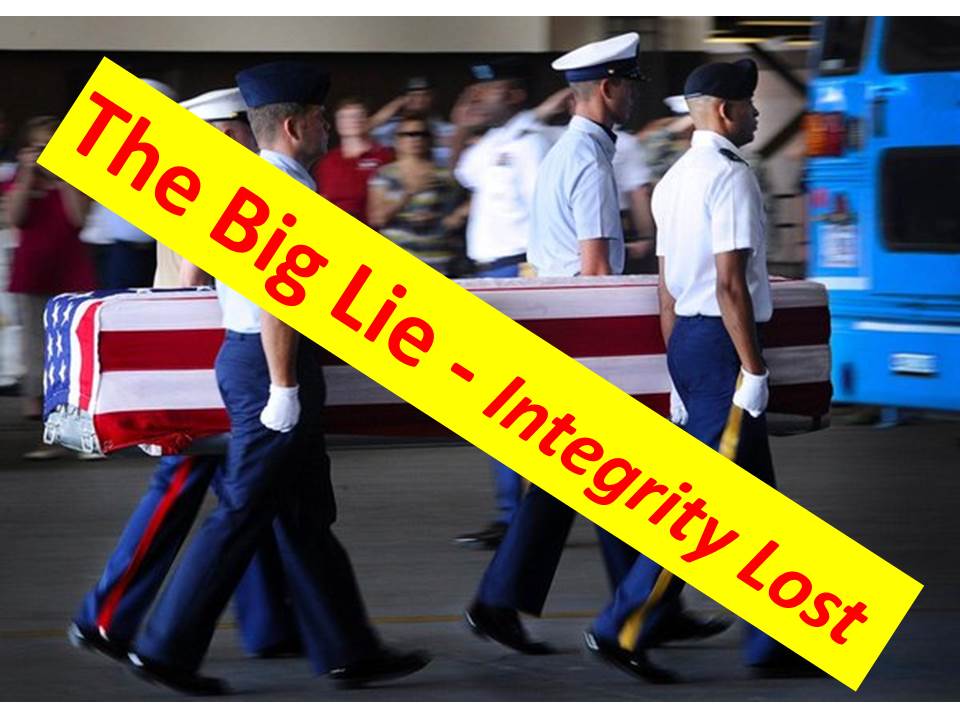
HONOLULU — A unit of the U.S. Department of Defense has been holding so-called “arrival ceremonies” for seven years, with an honor guard carrying flag-draped coffins off of a cargo plane as though they held the remains of missing American service men and women returning that day from old battlefields.
After NBC News raised questions about the arrival ceremonies, the Pentagon acknowledged Wednesday that no honored dead were in fact arriving, and that the planes used in the ceremonies often couldn’t even fly but were towed into position.
Click on Image to Enlarge
The solemn ceremonies at a military base in Hawaii are a sign of the nation’s commitment to returning and identifying its fallen warriors. The ceremonies have been attended by veterans and families of MIAs, led to believe that they were witnessing the return of Americans killed in World War II, Vietnam and Korea.
The ceremonies also have been known, at least among some of the military and civilian staff here, as The Big Lie.
Photos behind the scenes show that the flag-draped boxes had not just arrived on military planes, but ended their day where they begin it: at the same lab where the human remains have been waiting for analysis.
. . . . . . . .
‘Acutely dysfunctional’
After NBC News requested permission to attend an arrival ceremony in July, JPAC canceled the ceremony. It hasn’t held any ceremonies since April, scheduling and canceling them repeatedly.
The Pentagon spokesperson said the commander of JPAC, Army Maj. Gen. Kelly K. McKeague, authorized in April the renaming of the ceremonies “to more accurately reflect the purpose of these events.” However, public affairs staff at JPAC, which organized the events, continued to call them “arrival ceremonies” on into the summer, and until Wednesday they were still identified that way on the agency’s website. (That page of the JPAC website was renamed to “honors ceremonies” on Wednesday.) The Pentagon would not answer when asked when Gen. McKeague and other military officers became aware that the public was being misled.