As many as ten companies including AT&T, Cisco Systems, GE, IBM, and Intel are working with US government representatives to form a consortium to drive the so-called Industrial Internet. Their goal is to define an architectural framework for open industry standards that would serve a broad swath of market sectors from automotive and manufacturing to healthcare and the military.
Terrorist Alert: Special Comment. It is always hazardous to comment on events without having had access to the underlying source material about them. This is especially true of threatening developments. Thus it is not possible to comment on the quality or accuracy of the information on which the current terrorist alert rests.
What makes this threat warning even trickier is that terrorist groups have long known that the US and others eavesdrop on their conversations and chatter. Terrorist knowledge of US eavesdropping practices creates the condition for a perfect set up for deception. It also makes warnings based primarily on that intelligence evidence unpersuasive.
After Yemeni Offensive Against al Qaeda in South, Militants Keep Low Profile, Say Officials
EXTRACT
Some officials in San'a, however, worry that President Hadi's credibility has been undercut by reports issued by government spokesmen earlier in the day that the country's security forces had uncovered and foiled a variety of terrorist plots—including, the spokesmen said, planned attacks against a major Yemeni oil facility, military installations and Western embassies.
U.S. officials cast doubt on the veracity of the claims, saying that the U.S. hadn't changed its assessment of a broad al Qaeda threat. Later Wednesday, Yemen's SABA state news agency cited security sources denying there had been a threat against the oil terminal.
The power of the web is a hot topic for business journals and Internet startups, notably its ability to turn a simple idea into a powerful force by leveraging existing social interactions and letting people share what’s important to them. No longer do we rely on a few experts and advertisers to dole out information according to their own priorities, and passively consume that information. On the contrary, content can be created and curated by literally thousands of ‘average’ people with above average interest and insight, and spread across huge aggregations of likeminded people.
I’ve been watching closely the up-and-coming site “One Hundred Tables,” a restaurant listing site that’s built on a simple idea: one hundred featured restaurants in each of one hundred cities. Founder Tony Akston has created a million-dollar business model by charging just $100 to be listed, a sum a restaurant can recoup by snagging just one new regular. The concept is simple, the site is low in cost to host and maintain, and it offers something every entrepreneur strives for: overwhelming value for the customer. The price point is almost unthinkably reasonable given the opportunity for return – a rare business “no brainer.” The real earning potential is in the exponential multiplication of small transactions – a staple concept for web-based businesses.
Who Are They? What Do They Want? Why Do They Fight?
This paper presents the results of 78 in-depth interviews conducted with self-identified Afghan insurgents. If the interviewees are indeed representative of broader Taliban sentiments, then the future of Afghanistan is grim. It appears that only the return of a ‘pious’ Islamic government will satisfy them.
Rami G. Khouri is Editor-at-large of The Daily Star, and Director of the Issam Fares Institute for Public Policy and International Affairs at the American University of Beirut, in Beirut, Lebanon. You can follow him @ramikhouri.
BEIRUT — I would love to know who the jerk is who wrote the White House’s press statement on the occasion of the inauguration earlier this week of the new Iranian President, Hassan Rouhani. I say this is the work of a jerk, or a band of war-addicted zealots in Washington, D.C., because it seems designed to totally bury the opportunity that Rouhani represents to improve the wellbeing of Iranians and resolve Western-Iranian and Arab-Iranian tensions on a variety of important issues.
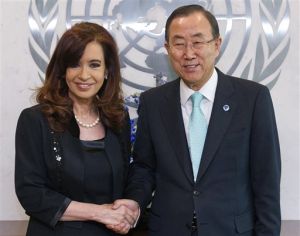
Argentina's President Cristina Fernandez used the opportunity of presiding over the U.N. Security Council for the first time Tuesday to take aim at the veto power of its five permanent members _ the United States, Russia, China, Britain and France.
Fernandez also criticized member states that don't implement U.N. resolutions, citing unheeded demands for a Palestinian state and Britain's refusal to engage in talks about the disputed Falkland Islands, which Argentina calls the Malvinas.
. . . . . . .
Argentine President at UN
She said the veto was a safeguard during the Cold War to prevent “nuclear holocaust” _ but today the United States and Russia sit at the same table “and we can't deal with the problems in this new world with old instruments and old methods.”
Fernandez pointed to two Latin American organizations _ the Community of Latin American and Caribbean States and the Union of South American Nations _ which take decisions on the basis of unanimity when there is a conflict. By contrast, she criticized the use of vetoes by the permanent members of the Security Council.
Russia and China have vetoed three Western-backed resolutions to pressure Syrian President Bashar Assad to end the 2 1/2 year conflict that has killed more than 100,000 people, and the United States, Israel's closest ally, has vetoed numerous resolutions over the years on the Palestinian conflict with Israel.
Fernandez strongly supported the Arab League's U.N. observer Ahmed Fathalla who said all 193 U.N. member states must implement U.N. resolutions