NIGHTWATCH: European Election Updates – Crowds Against Corruption

Civil Society, Collective Intelligence, Corruption, Government

Election Updates:

France: As expected, Francois Hollande is the new president of France. In his victory speech on 6 May, Hollande said “…austerity cannot be the only option.”

Greece: As expected, no party won a majority. The conservative New Democracy Party obtained the most votes, followed by a coalition of leftist parties and then the Socialists. Nevertheless, the New Democracy and Socialist Parties both sustained an enormous reduction in popular support. The magnitude of the anti-austerity vote was described as a volcanic eruption by Greek political analysts.

On 7 May the New Democracy Party failed in its attempt to form a coalition government. The second place party, the Coalition of the Radical Left rejected the New Democracy's offer. The leader of the Coalition, AlexisTsipras, said the parties that make up his coalition are in opposition and demand that the austerity measure be canceled.

The Greek President has asked the Coalition of the Radical Left to form a government. If it fails, the Socialists will be asked. coalition with the conservative New Democracy (ND) party, AP reported May 7. After talks with ND leader Antonis Samaras, Alexis Tsipras said the parties are in opposition and demanded that austerity measures be canceled.

Comment: The popular mood is dark. A neo-Nazi party won 7% of the vote which will entitle it to have representation in parliament for the first time. Expect street disorders.

German reaction also is as expected. Germany will not work to change Europe's compact on budget discipline and rejects growth measures that increase debt levels, government spokesman Steffen Seibert said on 7 May.

New negotiations of the fiscal compact are not possible, Seibert said, adding that growth should come through structural reforms, not through new debt. Greece must implement reforms it agreed to as part of its bailout package. The agreements represent Greece's best path forward and Athens must adhere to them, Seibert said.

Die Welt's editorial wrote,

“Both Hollande and the Greek opposition are serving people's desire for a fundamental change in political and social conditions, which are mainly attributed to the most powerful woman in Europe: Chancellor Angela Merkel.”

“They were voting against a tight rein on states by a central authority in Brussels, against the loss of democracy through ‘expert government'. These elections were a clear rejection of the Angela Merkel's system in Europe.”

Comment: Teutonic sternness is more likely to be incendiary than helpful. Die Welt has the right of it. The eurozone experiment is proving unsustainable against the sentiment for utopian and egalitarian solutions. The economies do not mesh. The regime of the bankers and bureaucrats in Brussels is under threat.
NIGHTWATCH KGS Home

Josh Kilbourn: US Disability & Food Stamp Welfare Skyrocketing

03 Economy, 11 Society, Corruption, Government
Josh Kilbourn

Two Charts Exposing America's Record Shadow Welfare State

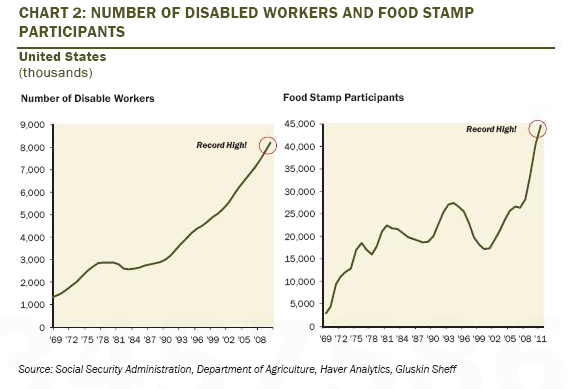
Here was a little mentioned tangent to last Friday's very disappointing NFP print of +115,000 (driven by a surge in temp jobs offsetting a collapse in full time positions): as David Rosenberg notes, the jobs number was about half of another far more important number – that of Americans applying for disability, which in April was +225,000. He continues: “this is the new stealth stimulus program – so far in 2011, nearly one million Americans have applied for disability and year-to-date, 333k have actually enrolled (covering 539k family members). In total, more than five million people have been added to disability coverage since President Obama took over three years ago.”

Click on Image to Enlarge

The punchline will make all those who adore (insolvent) welfare states shake with giddy delight: “So look – either safety standards at work have eroded dramatically or the “99%” have found a creative way to milk the system and turn the economy into a quasi welfare state“…. Yup. What he said. Because remember: the BLS assumes that any amount up to the total 53 million people, is not in the labor force as they have other “wefare” based forms of government handouts and see no need at all to look for a job. Is there any wonder why US unemployment is realistically 20% if not much higher? As for the other chart, food stamps, we know that story all too well.

See Also:

Paul Craig Roberts: December Net Jobs a 12,000 LOSS – Actual Unemployment 2.6 Times Official Rate or 22.4%

Tom Atlee: Wholesome Capitalism

03 Economy, 09 Justice, 11 Society, Blog Wisdom, Civil Society, Commerce, Ethics
Tom Atlee

Wholesome capitalism?

What would wholesome capitalism look like?

“Wholesome” means healthy, in the sense of something that promotes physical and moral well-being. Wholesome capitalism would take into account the wholeness of people and the social and natural world we live in, and it would enhance that wholeness.

Some people think capitalism already does this. They note how good it has been at generating wealth. The word wealth, meaning abundance, derives from roots meaning well-being and wholeness. Many of capitalism's advocates feel it should be freed from constraints so it can generate more wealth.

Others note that capitalism – while generating wealth for some – many or few, depending on its form in a particular time and place – nevertheless generates much suffering and destruction in the process. It reduces everything to money and maximizes financial return even if it has to degrade and destroy human and natural life to do it. Many of capitalism's critics feel it should be undermined or overthrown.

Still others note both the blessings and problems with capitalism. They think we can have the wealth without so much suffering and destruction. Most of these people promote freeing capitalism's creativity and productivity while restraining its rapaciousness in various ways – using everything from laws, regulations and taxes to moral suasion and consumer-shareholder activism.

In this article I advocate all three positions – odd as that may sound – but only after reframing “capital” and “wealth” to better reflect wholeness.

THE PRIMARY DYNAMIC OF CAPITALISM

The special gift of capitalism is its ability to create MORE – more products and services, more self-organized economic activity, more wealth. In systems science, this tendency to create more-ness is called a positive or reinforcing feedback dynamic.

Continue reading “Tom Atlee: Wholesome Capitalism”

Chuck Spinney: Neo-Liberalism Actually Neo-Serfdom

Commerce, Corruption, Government
Chuck Spinney

One of the pillars of the neo-liberal economic policies adopted by Republicans and Democrats alike in the UK and the US is privatization of government services on the theory that free market pressures will generate greater economic efficiencies.  The UK is a case study of how neo-liberal privatization policies promoted by Thatcher, Blair, and Cameron, (and in the US by Reagan, Clinton, Bush II, and maybe Obama) are changing the distribution of economic power.  The attached article by James Meek, which was brought to my attention by my good friend Andrew Cockburn, is a short and not-so-sweet analysis of how the looters in the UK and the US are selling the people into a 21st Century variation of peonage.

Chuck Spinney

Human Revenue Stream 

James Meek, London Review of Books, 20 March 2012

The privatisations are joining up. First it was gas. Then telecoms, oil, electricity, public housing, water, the railways, the airports. There are moves afoot to obliterate the concept of the council house; NHS hospitals are to be privately run, built and managed; now David Cameron wants to get private companies and foreign governments to ‘invest’ in Britain’s roads. What does it all mean? The episodic character of privatisation – one sector being sold, then a pause, then another – has hidden a meta-privatisation that’s passed the halfway point. The essential public good that Margaret Thatcher, Tony Blair and now Cameron sell is not power stations, or trains, or hospitals. It’s the public itself. It’s us.

The commodity that makes water and roads and airports valuable to an investor, foreign or otherwise, is the people who have no choice but to use them. We have no choice but to pay the price the tollkeepers charge. We are a human revenue stream; we are being made tenants in our own land, defined by the string of private fees we pay to exist here. If it’s not obvious that we’re being sold to investors, it’s partly because the idea of privatisation is sold so hard to us, in a way that is hypnotically familiar.

  • First, the denigration of the existing service, as if a universally accepted truth is being voiced: the schools/hospitals/roads are crumbling/failing/ second-class.
  • Then, the rejection of government responsibility: we’ve no money/bureaucrats are incompetent.
  • Finally, the solution: private investment.

And that investment does come, and things get shinier. Surely if the private sector weren’t replacing our old sewers, and won’t replace our old motorways and power stations, we’d need to pay higher taxes instead? The truth is that we already do pay higher taxes. They just aren’t called taxes. Our water supply system is being upgraded because of a huge water tax increase. But it isn’t called that. It’s called ‘the water bill’. As Chris Giles explained yesterday in the FT, water bills have gone up by nearly twice as much as inflation since privatisation. We pay a rail tax: it’s called ‘fare increases’. We pay an energy tax in the form of higher electricity bills, and so on.

By packaging British citizens up and selling them, sector by sector, to investors, the government makes it possible to keep traditional taxes low or even cut them. 

By moving from a system where public services are supported by general taxation to a system where they are supported exclusively by the fees people pay to use them, they move from a system where the rich are obliged to help the poor to a system where the less well-off enable services, like a road network, that the rich get for what is, to them, a trifling sum.

Will there be a revolt?

There was one in the 1990s, on the Isle of Skye. Ostensibly, the private sector was going to build something the people of the island would not have had otherwise: a road bridge to the mainland, replacing the old ferry. The islanders understood what was actually happening. They were being sold as revenue stream. Instead of the bridge being built from a tiny fraction of the government budget, it was built by a private firm, which had been promised that it would be able to gouge the islanders with hefty tolls. Less general tax for British taxpayers: a huge private tax for Skye islanders.

A long campaign of civil disobedience ended in victory for the islanders when in 2004, against the tide of history, the bridge was nationalised. Skye is a small island. Britain is a big one. The plan’s the same. Let’s see what happens.

Phi Beta Iota:  Emphasis added above.

See Also:

We the People Reform Coalition

Howard Rheingold: Online Learning About Google Search

04 Education, Advanced Cyber/IO, Commerce
Howard Rheingold

I'm glad to see Google providing more material about how to use search effectively — Howard

– – – – – – —

GOOGLE SEZ:

Help your students become better searchers

Web search can be a remarkable tool for students, and a bit of instruction in how to search for academic sources will help your students become critical thinkers and independent learners.

With the materials on this site, you can help your students become skilled searchers- whether they're just starting out with search, or ready for more advanced training.

Search Education / Education on Search

Penguin: Pentagon Spending Taxpayer Money to Identify Insider Threats — Never Realizing that Pentagon Misbehavior Inspires Insider Patriots

Corruption, Idiocy, IO Impotency, Military
Who, Me?

After paying for the development of this bullshit we can all plan building this expense into our family budgets.

The Way The Pentagon Is Predicting Your Potential To Become A National Threat Is Frightening

Eloise Lee

Business Insider, May 7, 2012,

Tom Cruise made “pre-crime'” a futuresque and controversial method of law enforcement in the 2002 movie Minority Report.Ten years later, the idea of preemptively identifying a criminal — particularly an inside threat — is taking shape within the U.S. Defense Department, reports Joe Gould at Army Times.Whether it's a low-ranking soldier intent on dumping secret information to WikiLeaks, or a rogue Sergeant going on a shooting rampage, insider threats can seriously plague the military and the government as a whole.

Taking a novel approach, the Pentagon is spearheading research into studying the predictive behavior of personnel in the lead-up to a betrayal.

Continue reading “Penguin: Pentagon Spending Taxpayer Money to Identify Insider Threats — Never Realizing that Pentagon Misbehavior Inspires Insider Patriots”

Marcus Aurelius: The Pentagon’s New Defense Clandestine Service

Intelligence (government), Military
Marcus Aurelius

The Pentagon's New Defense Clandestine Service

American Thinker, 27 April 2012

Earlier this week, the Associated Press reported a new intelligence initiative coming out of the Pentagon. We are constantly reminded that intelligence agencies have difficulty sharing their work, yet the Pentagon has decided to create another intelligence agency — the Defense Clandestine Service. Many professionals believe that this initiative is doomed to fail.

Since the technological revolution, intelligence-collection among human activity has swiftly deteriorated. Technology has superseded human intelligence (HUMINT) collection efforts with tools such as Signals Intelligence, Measures and Signatures Intelligence, and Open Source. Today, HUMINT has become an endangered species. The good news behind the newly formed Defense Clandestine Service demonstrates that America's HUMINT is like the bald eagle — it may be endangered, but it is making a comeback.

America's clandestine activities and HUMINT operations have been crippled by years of internal feuding dating back as far as the Carter administration. Creating additional organizations will not fix the problem; rather, pre-existing organizational resolve is needed. As one operative who spoke on condition of anonymity stated, “[y]ou don't just go out and buy a new car because you need an oil change and some new tires.” When it comes to intelligence, specifically HUMINT, we don't have the money to purchase an entirely new luxury, so we need to fix the one we have.

“HUMINT is assuredly broken. A series of incapable DCI's and self-promoting Deputy Directors for Operations (now called National Clandestine Service) have converted what was once a stellar service into a cadre of messenger boys begging for scraps from foreign liaisons. This problem began long ago with Admiral Stansfield Turner[.]” -Robert David Steele

Continue reading “Marcus Aurelius: The Pentagon's New Defense Clandestine Service”