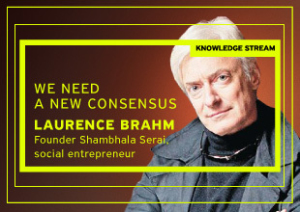
Worth a Look: Fusion Economics by Laurence Brahm

Civil Society, Commerce, Commercial Intelligence, Cultural Intelligence, Ethics, Government, Peace Intelligence
Amazon Page
Amazon Page

AMAZON PAGE: Fusion Economics: How Pragmatism Is Changing the World

Hardcover Pre-Order Now for 21 October 2014 Delivery

Phi Beta Iota: Below is Robert Steele's jacket blurb:

Laurence Brahm is one of those unsung heroes who was changing the world for the better, and influencing various governments in most positive ways, long before ecological economics and social enterprise became fashionable turns of phrase. I regard him as the anti-thesis to the predatory capitalism mantras and methods of our time. His proven focus on community development and evolutionary blends of state planning and market incentives is precisely what we need now that everyone understands that Western governments have been corrupted and Western economies destroyed by financial interests devoted to extracting value instead of creating value. This is a practical book, a spiritual book, and one that should be required reading among those intent on creating collaborative economies and social enterprises.

Robert David Steele
CEO, Earth Intelligence Network

Below is the book description from the publisher:

Continue reading “Worth a Look: Fusion Economics by Laurence Brahm”

Jean Lievens: P2P on Cooperativa Integral Catalana

03 Economy, Civil Society, Collective Intelligence, Commerce, Commercial Intelligence, Ethics, Liberation Technology
Jean Lievens
Jean Lievens

Enric Duran of the Catalan Integrated Cooperative has taken the time to comment on Michel Bauwens’ recent article on Open Coops, contrasting Bauwens’ proposals with the practical realities already under way in the CIC’s own forward thinking cooperativist environment.

Bauwens’ summary of these proposals include four key proposals which Duran addresses below. To give some context, the four proposals are:

  1. That coops need to be statutorily (internally) oriented towards the common good 
  2. That coops need to have governance models including all stakeholders
  3. That coops need to actively co-produce the creation of immaterial and material commons
  4. That coops need to be organized socially and politically on a global basis, even as they produce locally.

Here are Duran’s comments to each proposal.

Read full post.

Yoda: Are Islamic Finance and Ethical Economics the Same?

Civil Society, Commerce, Commercial Intelligence, Ethics
Got Crowd? BE the Force!

Think, we do.

How Islamic finance and a more ethical capitalism go hand-in-hand

In first place, the most-read article on the Guardian Social Enterprise Network for 2013, was Sheeza Ahmad's thoughts on how Islamic finance and a more ethical capitalism go hand-in-hand. As the founder of social enterprise HelpingB, he argued that the Qur'an's teachings of business reflect objectives of the worldwide social enterprise movement.

See Also:

Welby 'embarrassed' by Wonga link

EXTRACT

Linking financing to real assets, as opposed to ‘virtual' money, is what distinguishes Islamic banking from conventional finance. So what would the current financial landscape look like if the attitude towards money lending and interest shifted towards the Islamic model?

Berto Jongman: Melanie Swan on Machine Ethics

Ethics
Berto Jongman
Berto Jongman

Machine Ethics Interfaces

Melanie Swan

Machine ethics is a term used in different ways. The basic use is in the sense of people attempting to instill some sort of human-centric ethics or morality in the machines we build like robots, self-driving vehicles, and artificial intelligence (Wallach 2010) so that machines do not harm humans either maliciously or unintentionally.

Continue reading “Berto Jongman: Melanie Swan on Machine Ethics”

Berto Jongman: New US Leaker of Americans on Secret Terrorist Watchlists

Ethics
Berto Jongman
Berto Jongman

New leaker disclosing U.S. secrets, government concludes

(CNN) — The federal government has concluded there's a new leaker exposing national security documents in the aftermath of surveillance disclosures by former NSA contractor Edward Snowden, U.S. officials tell CNN.

Proof of the newest leak comes from national security documents that formed the basis of a news story published Tuesday by the Intercept, the news site launched by Glenn Greenwald, who also published Snowden's leaks.

. . . . . .

The Intercept report said, citing the documents, that 40% on the “Terrorist Watchlist” aren't affiliated with terror groups.

. . . . . .

The report said that as of August, 2013, 5,000 Americans were on the TSD watchlist. Another 15,800 were on the wider TIDE list.

A smaller subset, 16,000 names, including 1,200 belonging to Americans, are listed as “selectees” who are subject to more intensive screening at airports and border crossings.

Yoda: The Open Source Identity Crisis

Cultural Intelligence, Ethics
Got Crowd? BE the Force!

Tip of the Saber to Charles Yaker.

The Open Source Identity Crisis

As the diversity in tech movement gains traction, open source faces an identity crisis.

EXTRACT

The first story we must look at is: who exactly is an open source contributor? The answer to this seems obvious enough. Open source contributors are hackers. The movement as a whole traces its roots back to Richard Stallman and the hackers at MIT in the late 70s. The hacker identity is a specialisation of the geek identity, which can be seen as a continuation of the scientist and mathematician archetype that stretches back centuries.

But this picture is wrong.

Continue reading “Yoda: The Open Source Identity Crisis”

Robert Steele: Stephen Draper on Intelligence in Complex Environments, with Comment

Advanced Cyber/IO, Ethics, Government, Military
Robert Steele
Robert Steele

Intelligence in Complex Environments

by Stephen Draper

Small Wars Journal, 1 August 2014

Four years into the United States military’s effort to counter the Lord’s Resistance Army in central Africa its leader, Joseph Kony, remains elusive. This certainly isn’t for lack of effort or resources. One hundred Special Forces advisors, a robust command and control structure, contracted airplanes, even the occasional short-term deployment of a CV-22 squadron have all assisted African partner forces to remove a few leaders from the battlefield and enable many more fighters, wives, and children to escape the organization. Yet the mission still faces serious obstacles. The tyranny of distance has oftentimes been crippling to the effort, hindering logistical resupply and time sensitive strikes. In addition to geography, this mission continues to pose many challenges which test the U.S. intelligence community but, if overcome, can serve as a model for U.S. intelligence support in low-intensity conflicts and other crisis areas worldwide. Removing Kony and his LRA from the battlefield is, foremost, an intelligence problem. Without accurate intelligence of Kony and his forces’ location, counter-LRA forces will continue to be reduced to “searching for a needle in twenty haystacks.” Further complicating the situation, in addition to the joint U.S. and combined foreign forces requiring coordination, many other stakeholders are active in the area of operations. Non-government organizations (NGOs), aid organizations, the United Nations, civilian village defense forces, even the Catholic church all contribute to central Africa being a complex environment.

Continue reading “Robert Steele: Stephen Draper on Intelligence in Complex Environments, with Comment”