As everyone should know by now, not quite two weeks ago the latest nugget from Edward Snowden via Glenn Greenwald and co-authors was revealed, and was that the NSA and its UK counterpart the GSHQ “have successfully cracked much of the online encryption relied upon by hundreds of millions of people to protect the privacy of their personal data, online transactions and emails.” The measures used to accomplish this include covertly controlling the setting of encryption standards, more powerful brute force code-cracking, and inserting backdoors into commercial encryption software.
This is very bad, and has led more than one observer to declare that the internet as we know it is dead as a secure medium of communication. That of course leads to the question of what is to be done about it.
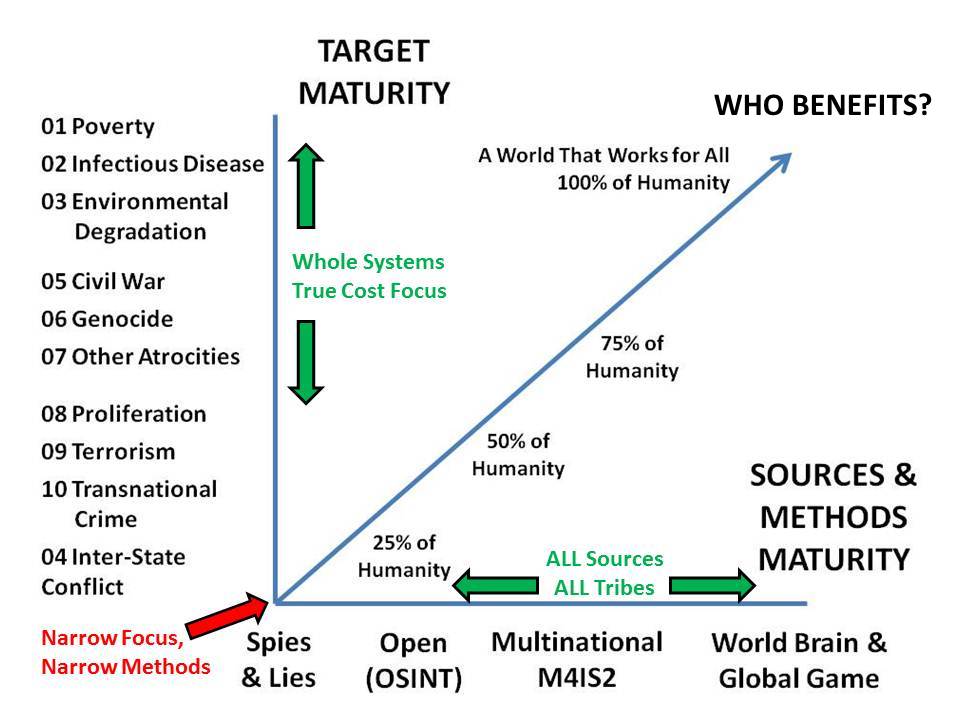
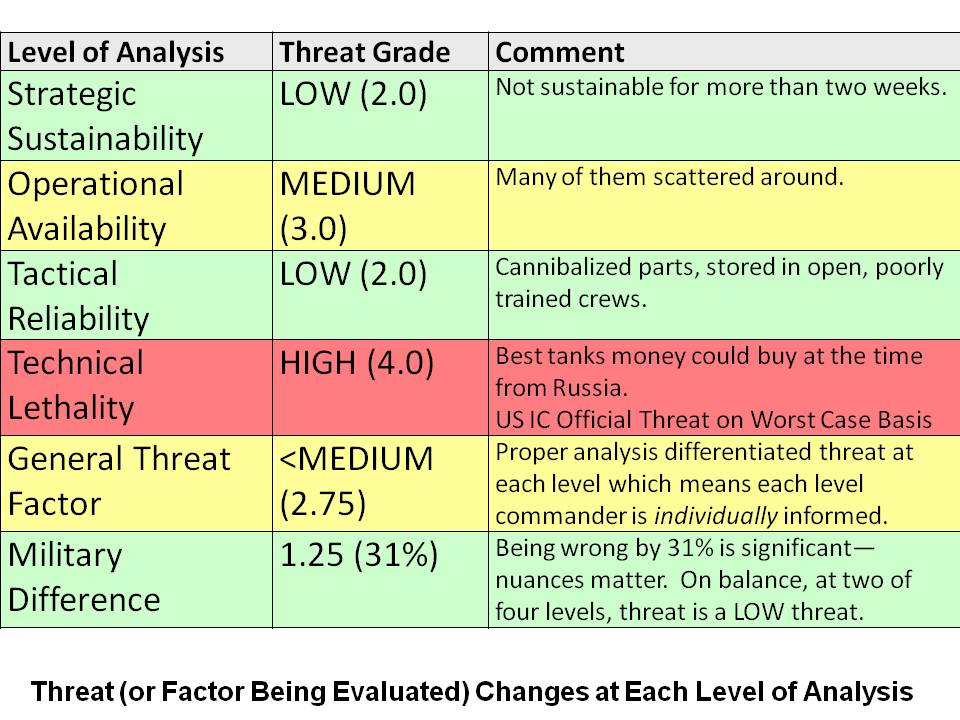
Phi Beta Iota: This simple graphic has enormous implications for the evolving craft of intelligence (decision-support). When considered in relation to absolute scale limits on the depletion of non-renewable resources, and the absolute valuation of diversity of life forms, it recasts how “truth” should be considered in the context of the whole, distinguishing between truth for the whole versus truth for the individual and truth for the nation-centric collective. This is a variation of the discovery made by Robert Steele when he co-founded the Marine Corps Intelligence Center and led the study on planning and programming factors for expeditionary operations in the third world: the threat changes depending on the level of analysis. This degree of sophistication and accomplished holistic reasoning is not yet present in any intelligence community that we know of.
In the world of tech where buzzwords come and go faster than you can say “synergy”, the “Internet of Things” is a bit of an oddity. It is an old concept (first coined in 1999) used to describe a futuristic world where everyday objects—from toasters to dog collars to running shoes—can communicate electronically with other devices. But whereas many buzzwords die off after a few years of overuse, there has been a surge in interest in the Internet of Things of late for the simple fact that the vision is quickly becoming reality.
Patrick MeierThe permanence of social media such as tweets presents an important challenge for data protection and privacy. This is particularly true when social media is used to communicate during crises. Indeed, social media users tend to volunteer personal identifying information during disasters that they otherwise would not share, such as phone numbers and home addresses. They typically share this sensitive information to offer help or seek assistance. What if we could limit the visibility of these messages after their initial use?
Click on Image to Enlarge
Enter TwitterSpirit and Efemr, which enable users to schedule their tweets for automatic deletion after a specified period of time using hashtags like #1m, #2h or #3d. According to Wired, using these services will (in some cases) also delete retweets. That said, tweets with #time hashtags can always be copied manually in any number of ways, so the self-destruction is not total. Nevertheless, their visibility can still be reduced by using TwitterSpirit and Efemr. Lastly, the use of these hashtags also sends a social signal that these tweets are intended to have limited temporal use.
Note: My fellow PopTech and Rockefeller Foundation Fellows and I have been thinking of related solutions, which we plan to blog about shortly. Hence my interest in Spirit & Efemr, which I stumbled upon by chance just now.
At first glance, it appears that the Department of Defense (DoD) and the Intelligence Community (IC) have the same cyber security needs as other large organizations in the commercial world. While this is true to a certain extent, the business rules and requirements are significantly different.
The Federal Government, in general, and the DoD/IC are heavily scrutinized and regulated in terms of acquisition policy. The Federal Acquisition Regulations (FAR) and the applicable DoD regulations (DFAR) are comprehensive, administrative and largely bureaucratic in an attempt to protect the interests of the American taxpayer – Cyber Security Solutions have been affected by this process.
This administrative approach has had an initial negative impact on cyber security effectiveness with state sponsored and agile criminal groups enjoying repeated success. As a result, many DoD/IC agencies are reevaluating their cyber security requirements with a more solutions-oriented strategy.
DoD and IC requirements for an effective cyber system include:
‘Rikke Frank Jorgensen has given us a thoughtful and competent contribution to a debate of increasing global importance. Her theoretical analysis and practical case-study stimulate critical reflection on how we should connect the primary moral domain of our time – human rights – with the primary infrastructure for global communication, the Internet. This book is a must read for all who engage with the search for meaningful and practical normative directions for communications in the 21st century.' – Cees J. Hamelink, University of Amsterdam, The Netherlands ‘Understanding the Internet is key to protecting human rights in the future. In Framing the Net, Rikke Frank Jorgensen, shows how this can be done. Deconstructing four key metaphors – the Internet as infrastructure, public sphere, medium and culture – she shows where the challenges to human rights protection online lie and how to confront them. Importantly, she develops clear policy proposals for national and international Internet policy-makers, all based on human rights. Her book is essential reading for anyone interested in the future of human rights on the Internet: and that should be everyone.' – Wolfgang Benedek, University of Graz, Austria ‘Jorgensen's examination of whether Internet governance can be better aligned with the rights and freedoms enshrined in human rights law and standards of compliance should be read by everyone in the academic, policy and legal practitioner communities. From women's use of ICTs in Uganda to Wikipedia in Germany, information society developments make it imperative that scholars and practitioners understand why it matters how the issues are framed. This book successfully analyses a decade or more of debate in this field in an engaging and very illuminating way.' – Robin Mansell, London School of Economics and Political Science, UK
Confused about social media monitoring? A thread at Quora, “Which Are the Best Social Media Monitoring Tools?” suggests that like search, social media monitoring is pretty tricky. The overall consensus statement makes it clear there is no simple answer: “No overall best tool. Pick the best fit for your needs.” Hmm.
Several respondents share their thoughts. One had compared Radian6 and Sysomos, and found the latter much easier to use. Another liked Engagor for its low price point. Perhaps the most comprehensive (though admittedly promotional) answer comes from Web Liquid account executive Ben Semmar, who shares:
“[. . .] Over the past couple of months, I’ve been involved in the creation of a Social Media Monitoring Buyer’s Guide. We began with a list of over 40 vendors, and based on a variety of criteria, whittled it down to a list five ‘finalists’ that we then conducted hands-on trials with. We found that some tools perform better than other tools in certain areas (but, really, doesn’t everything?) and so we don’t proclaim one tool king of them all; suffice it to say, though, that the five tools we tested are, based on our experience with and objective evaluation of the market, the best out there. You can find the study here: http://www.webliquidgroup.com/social-media-monitoring-tool-buyers-guide.”
Note that the guide he mentions is free, but requires a name and email address to view. Semmar goes on to assert one important caveat: We have not reached the point where algorithms can make reliable judgments about which insights a business should focus on, and how to use them. Though quality monitoring software can be a useful tool, the human mind is still required to wield it. (For now.)