David Isenberg: IARPA Trys to Predict Future

Advanced Cyber/IO, Collective Intelligence
David Isenberg
David Isenberg

How to Get Better At Predicting the Future

Could human and machine forecasters work together to increase the intelligence agencies' foresight?

By Alexis C. Madrigal

Atlantic, 11 December 2012

We would like to know what the future is going to be like, so we can prepare for it. I'm not talking about building a time machine to secure the winning Powerball number ahead of time, but rather creating more accurate forecasts about what is likely to happen. Supposedly, this is what pundits and analysts do. They're supposed to be good at commenting on whether Greece will leave the Eurozone by 2014 or whether North Korea will fire missiles during the year or whether Barack Obama will win reelection.

A body of research, however, conducted and synthesized by the University of Pennsylvania's Philip Tetlock finds that people, not just pundits but definitely pundits, are not very good at predicting future events. The book he wrote on the topic, Expert Political Judgment: How Good Is It? How Can We Know?, is a touchstone for all the work that people like Nate Silver and Princeton's Sam Wang did tracking the last election.

But aside from the electorate, who else might benefit from enhanced foresight? Perhaps the people tasked with gathering information about threats in the world.

You probably have never heard of IARPA, but it's the wild R&D wing of our nation's intelligence services. Much like the Defense Advanced Research Projects Agency, which looks into the future of warfare for the Department of Defense, the Intelligence Advanced Research Projects Activity looks at the future of analyzing information, spying, surveillance, and the like for the CIA, FBI, and NSA.

Continue reading “David Isenberg: IARPA Trys to Predict Future”
Reflections: The Human Factor & The Human Environment: Concepts & Doctrine? Implications for Human & Open Source Intelligence 2.0

Advanced Cyber/IO, All Reflections & Story Boards

Citation:  Robert David STEELE Vivas, “The Human Factor & The Human Environment: Concepts & Doctrine? Implications for Human & Open Source Intelligence,” Phi Beta Iota Public Intelligence Blog (12 December 2012).

For Part II See:  2012 Robert Steele: The Human Factor & The Human Environment: Contextual Trust for Sources & Methods

Click on Image to Enlarge

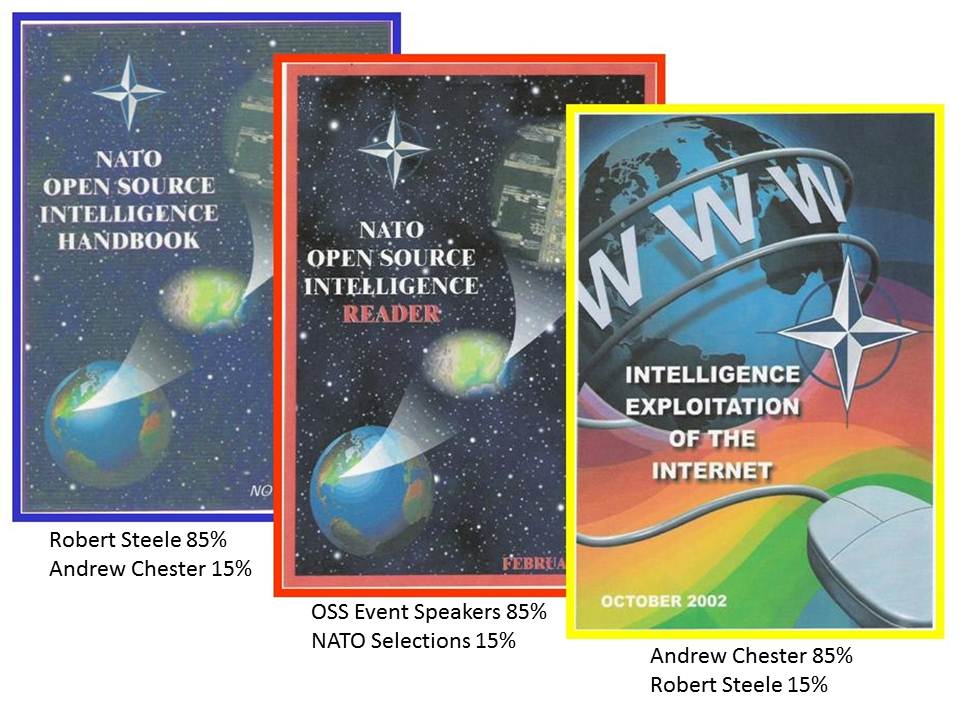
UPDATE 16 Dec 2012:  Added  NATO OSINT Series, pointer to other OSINT Handbooks.  Added Thomas Briggs: Reflections on OSINT in Support of HUMINT

UPDATE 15 Dec 2012:  Robert Steele: How Dutch Intelligence Survived & Prospered Using Open Source Human Intelligence as a Foundation for Ethical Evidence-Based Decisions

UPDATE 14 Dec 2012: 2012 Tom Briggs on The Human Factor & 2012 Ishmael Jones (P) on The Human Factor

Hi Robert,

There is one consideration I would like to discuss with you. While exploring for many years how to address the need for the military to understand all areas and aspects of the human environment, I had the opportunity to listen to many members of the intelligence community speaking about their role in achieving that understanding. I used to have the traditional military idea that it was the role of intel to provide the information and much of the knowledge. Along the way, they got me to doubt this view. Finally, they convinced me that the intel community, as we still know it today, is not a supplier of this understanding, but a customer. Understanding the human environment is a product stemming from Open Sources Information, but not from military intelligence. Intel's role might be, based on the understanding made available by others, to develop the specific products suiting its specific goals : targeting and counter intelligence.

As a general statement, no one nation has put this together — the Mediterranean countries have the skills and mind-set, the Sandanavian countries have the motivation and interest, and the Americans have the money — but the three “sets” are not coming together at this time.

Thank you for all the material you are producing.

Cheers,
REDACTED

Long Answer with Graphics to Four Part Question Below the Line

Continue reading “Reflections: The Human Factor & The Human Environment: Concepts & Doctrine? Implications for Human & Open Source Intelligence 2.0”

Anthony Judge: Encyclopedia of World Problems in WSJ – Seeking a Home

Advanced Cyber/IO
Anthony Judge
Anthony Judge

I regret that the considerable efforts of Jacqueline Nebel and Nadia McLaren are not mentioned — without them the volumes would not have emerged.  Still, this is a wonderful article, I can only hope that it attracts some funding to continue the effort.

WSJ.com – Encyclopedia of World Problems Has a Big One of Its Own

Encyclopedia of World Problems Has a Big One of Its Own

Chronicle of Woes From Alien Abductions to Dandruff Finds Itself Short on Funds

Daniel Michaels

Wall Street Journal, 11 December 2012

Click on Link Above to Read Original.  Safety Copy to Honor Judge Below the Line.

Continue reading “Anthony Judge: Encyclopedia of World Problems in WSJ – Seeking a Home”

Stephen E. Arnold: Screening & Judging Social Media

Advanced Cyber/IO
Stephen E. Arnold
Stephen E. Arnold

Social Media Services Announced

The Honk a Limited Distribution Newsletter

Social media has been on our radar for years. However, in the last three months, a number of clients and people struggling with social media “challenges” have enlisted our help. Our engagements have ranged from analyses of the vulnerabilities of the screening methods in use at Google Plus, LinkedIn, and Quora to message automation methods permitted at Facebook and Twitter. We have worked on a number of “interesting” social media situations. You can find a basic summary of our social media consulting services for professional and commercial organizations on our social subsite.

The problems range from government centric to a single individual disseminating misleading information about an established firm.

You can read more about our social media services at this subsite link. We have set up a separate contact point for our social media services. Write us at arnoldit@yandex.com.

Email thehonk@yandex.com to subscribe to this unindexed newsletter,

See Also:

The Honk at Phi Beta Iota


Steven Aftergood: Senate Slams Door on Defense Clandestine Service — Robert Steele Comments + DoD Clandestine RECAP

Advanced Cyber/IO, Corruption, Government, Ineptitude, Military
Steven Aftergood

Updated 11 Dec 2012 to add Graphic: Intelligence Requirements, Collection, Evaluation, and Capabilities Building

Senate Puts Brakes on Defense Clandestine Service

The Senate moved last week to restrain the rapid growth of the Defense Clandestine Service, the Pentagon’s human intelligence operation.

Under a provision of the FY2013 defense authorization act that was approved on December 4, the Pentagon would be prohibited from hiring any more spies than it had as of last April, and it would have to provide detailed cost estimates and program plans in forthcoming reports to Congress.

“DoD needs to demonstrate that it can improve the management of clandestine HUMINT before undertaking any further expansion,” the Senate Armed Services Committee wrote in a report on the new legislation.

Longstanding problems with defense human intelligence cited by the Committee include:  “inefficient utilization of personnel trained at significant expense to conduct clandestine HUMINT; poor or non-existent career management for trained HUMINT personnel; cover challenges; and unproductive deployment locations.”

The Committee noted further that “President Bush authorized 50 percent growth in the CIA’s case officer workforce, which followed significant growth under President Clinton. Since 9/11, DOD’s case officer ranks have grown substantially as well. The committee is concerned that, despite this expansion and the winding down of two overseas conflicts that required large HUMINT resources, DOD believes that its needs are not being met.”

Instead of an ambitious expansion, a tailored reduction in defense intelligence spending might be more appropriate, the Committee said.

“If DOD is able to utilize existing resources much more effectively, the case could be made that investment in this area could decline, rather than remain steady or grow, to assist the Department in managing its fiscal and personnel challenges,” the Senate Committee wrote.

The Washington Post published a revealing account of Pentagon plans to expand the size and reach of the defense human intelligence program in “DIA sending hundreds more spies overseas” by Greg Miller, December 1.

Along with overhead surveillance, bolstering human intelligence has been the focus of one of two major defense intelligence initiatives, said Under Secretary of Defense (Intelligence) Michael G. Vickers last October.  The Defense Clandestine Service “enable[s] us to be more effective in the collection of national-level clandestine human intelligence across a range of targets of paramount interest to the Department of Defense,” he said.

The latest issues of the U.S. Army’s Military Intelligence Professional Bulletin, released under the Freedom of Information Act, are available here (in some very large pdf files).

“A Short History of Army Intelligence” by Michael E. Bigelow of US Army Intelligence and Security Command, dated July 2012, is available here.

Newly updated doctrine from the Joint Chiefs of Staff includes Information Operations, JP 3-13, 27 November 2012, and Joint Forcible Entry Operations, JP 3-18, 27 November 2012.

Continue reading “Steven Aftergood: Senate Slams Door on Defense Clandestine Service — Robert Steele Comments + DoD Clandestine RECAP”

Yoda: See What NSA Captures ….ACHIFY IS NOT RECOMMENDED

Advanced Cyber/IO
Got Crowd? BE the Force!

UPDATE:  NOT RECOMMENDED.  A pain in the ass every time you open a web page.  Kind of like NSA, but Achify is in your face all the time.

Is, what is, this is.

  • Capture everything

    All your browsing history and social network updates in one place.

  • Find anything

    Easily search your archive to find the websites you’ve already seen and your social network updates.

  • Personal statistics

    Get a personal interactive report featuring weekly insights and usage statistics of your web and social footprints.

Continue reading “Yoda: See What NSA Captures ….ACHIFY IS NOT RECOMMENDED”

Richard Wright: Proposal for an Open Source Agency

Advanced Cyber/IO, Collaboration Zones
Richard Wright

Document (5 Pages): Richard Wright Proposal for an Open Source Agency

Proposal for an Open Source Agency

Executive Summary

This proposal argues that the strategic intelligence needs of U.S. Policy Makers, including the President and National Security Council, can best be met by establishing an independent Open Source Intelligence Agency (OSA) as recommended by the 9/11 Commission (Figure 1) but external to the secret world, under diplomatic auspices as agreed by senior staff in the Office of Management and Budget (OMB).

Such an agency is needed for two reasons:

First, as President Harry Truman has confirmed, the Central Intelligence Agency (CIA) has not evolved to be what he wanted it to be – an all-source analytical service of common concern.

Second, as has been argued for decades (since the late 1960’s) by US intelligence community pioneers, and most recently in a white paper from the Intelligence and National Security Alliance (INSA), the fact is that unless a means is found to acquire and integrate into the secret world’s intelligence process, the 80% or more information that is not secret, not in English, and not now accessed, the secret world will be even less relevant than it is now – to the point of calling into question its extraordinary budget, over $70 billion a year, that produces almost nothing for the President and nothing at all for everyone else.

An Open Source Intelligence Agency would not impact the missions and functions of existing secret intelligence agencies (CIA, DIA, NGA, NSA), but would provide a unique type of intelligence specifically tailored to the needs the senior U.S. policy making establishment.

Continue reading “Richard Wright: Proposal for an Open Source Agency”

noble gold