
Koko: What If Government Were Like an iPod?

Advanced Cyber/IO, Articles & Chapters, Civil Society, Collective Intelligence, Counter-Oppression/Counter-Dictatorship Practices, Ethics, Government, Methods & Process
Koko

What If Government Were More Like an iPod?

Dilbert's Scott Adams on bringing democracy out of the age of wax candles and into the age of touch screens

Scott Adams

Wall Street Journal, 5 November 2011

If Congress had a 9% approval rating while George Washington was still alive, he would have shoved his wooden dentures in his mouth, assembled a militia and marched on the Capitol. The nation's founders weren't big fans of dysfunctional governments. I'll bet we could solve our energy problem by connecting a generator to John Adams's corpse, which I assume is spinning in its grave.
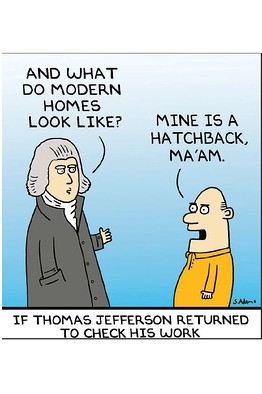
Click on Image to Enlarge

I've heard people say the United States no longer has the caliber of intellectual giants that authored the Declaration of Independence, defeated a superior British military, crafted the Constitution and built a robot butler that would eventually run away and change its name to Mitt Romney. But that's OK, because individuals are not the primary vehicles for genius. When it comes to the larger matters of civilization, group intelligence is more important than individual genius. To put it another way: Do you know who is smarter than the entire senior class at MIT? Answer: no one.

Today, thanks to the Internet, we can summon the collective intelligence of millions.

Read full article.

Tip of the Hat to Damien Morton via IndieGoGo.

Phi Beta Iota:  Mr. Adams provides a very thoughtful overview of the possibilities, while avoiding any mention of the corruption that is pervasive in today's top-down elite control “rule by secrecy” environment.  The Electoral Reform Act of 2012 is intended to eradicate corruption, assure transparency, restore the Republic, and make direct democracy such as Mr. Adams envisions a reality before 2016.  The next President should be of, by, and for We  the People, tested in the fires of the Occupy Wall Street kiln.

Chuck Spinney: Matt Ridley on Why Heresy is Important

Academia, Advanced Cyber/IO, Cultural Intelligence, Earth Intelligence, Ethics, Politics of Science & Science of Politics
Chuck Spinney

The below link goes to Matt Ridley's excellent lecture analyzing the importance of heresy in science; and by extension, the danger to science posed by an Authority that dictates what is acceptable and what is unacceptable. The oppression of authority is a subject Galileo learned to his chagrin, and a central theme of Jacob Bronoski's brilliant Ascent of Man, in my opinion, the finest television series ever produced. (Bronoski's subject was the growth of knowledge and its central role in the cultural evolution of mankind. To appreciate the squandered potential of television and the mass media, one need only to watch Bronoski's series of programs.)

Ridley gave the Angus Millar Lecture of the Royal Society of the Arts in Edinburgh a few days ago 31 October 2011. Ridley is trained in evolutionary biology — he has a PhD in Zoology from Oxford. His libertarian philosophy makes him controversial in some quarters, but he one of the best science writers out there, particularly on the subject of evolution. Like Darwin, he thinks and writes from the point view of the bottom-up empiricist (which is my favorite point of view).

Ridley's specific subject is pseudo-science: its temptations, its fallacies, and its dangers: his case study is the theory of anthropogenic global warming–a theme about which he says: “When a study was published recently saying that 98% of scientists ‘believe’ in global warming, I looked at the questions they had been asked and realized I was in the 98%, too, by that definition, though I never use the word ‘believe’ about myself.”

Chuck Spinney
Alexandria, Virginia

Below the Line: PDF Link and Also Full Text Online

Continue reading “Chuck Spinney: Matt Ridley on Why Heresy is Important”

2011 from 1999: Setting the Stage for Information-Sharing in the 21 st Century (Full Text Online)

Advanced Cyber/IO, Memoranda

Setting the Stage for Information-Sharing in the 21 st Century:
Three Issues of Common Concern to DoD and the Rest of the World

Robert D. Steele

The more I read and talk to people as I work up for this the more I think it comes down to three issues:

Continue reading “2011 from 1999: Setting the Stage for Information-Sharing in the 21 st Century (Full Text Online)”

Stephen E. Arnold: Search Wizards Speak 2008-2011

Advanced Cyber/IO
Stephen E. Arnold

Search Wizards Speak

Conference presentations about search and retrieval, text mining, and content processing are often little more than sales pitches. In the last 30 years, I've met a number of people who have made significant contributions to information retrieval. What I want to do is periodically interview some of the more interesting “search wizards”. Most of these people do not think of themselves as “wizards”. Most work dilligently to fill in the gaps in their knowledge. Search is a complicated discipline, and it is a full-time job to keep up with developments.

Check this page for new interviews or watch for postings on the Beyond Search Web log.

Sort: By Date | By Company

Interview Subject Company Date of Interview
Margie Hlava Access Innovations July 19, 2011
Seth Grimes Alta Plana June 9, 2010
Quentin Gallivan Aster Data September 22, 2010
Ali Riaz Attivio May 26, 2008
Andrew Kanter Autonomy November 18, 2008
Fernando Lucini Autonomy November 15, 2010
Guy Mounier BA-Insight February 2, 2009
Antonio S. Valderrábanos Bitext April 14, 2008
Alan Feuer, Ph.D. Blossom Software February 18, 2008
James Zubok Brainware March 31, 2008
William Bushee BrightPlanet October 6, 2009
Hans-Christian Brockmann Brox IT-Solutions GmbH December 5, 2008
Bjørn Laukli Comperio May 28, 2009
Laurent Simoneau Coveo Solutions Inc. March 11, 2008
Laurent Couillard Dassault Exalead June 28, 2011
François Bourdoncle Dassault Exalead May 3, 2011
Abe Lederman Deep Web Technologies June 10, 2008
Tim Estes Digital Reasoning February 2, 2010
Tim Estes Digital Reasoning (2) December 7, 2010
Ric Upton Digital Reasoning (3) September 20, 2011
Craig Bassin EasyAsk November 16, 2010
Sam Brooks EBSCO Publishing Januaryr 18, 2011
Pete Bell Endeca March 17, 2008
Nicolas Maquaire EntropySoft March 25, 2009
François Bourdoncle Exalead February 25, 2008
Benno Nieswand Exorbyte November 10, 2009
Luca Scagliarini Expert System December 18, 2008
François Schiettecatte FS Consulting June 2, 2009
David Hawking Funnelback July 28, 2008
Emeka Akaezuwa Gaviri Technologies September 8, 2009
Riza C. Berkan Hakia August 12, 2008
Bill Dimm Hot Neuron March 23, 2010
Oleg Shilovitsky Inforbix November 3, 2010
Iqbal & Zubair Talib Intelligenx May 12, 2008
Martin White Intranet Focus November 10, 2008
Ian Davies ISYS Search Software March 5, 2008
Scott Coles ISYS Search Software December 1, 2008
Stefan Andreasen Kapow Software December 14, 2010
David Chaplin Kroll April 28, 2008
Charlie Hull Lemur Consulting July 8, 2008
Marc Krellenstein Lucid Imagination March 17, 2009
Dave Kellogg Mark Logic June 17, 2008
Sergei Ananyan Megaputer June 23, 2008
Daniel Fallmann Mindbreeze September 3, 2009
Miles Kehoe New Idea Engineering July 21, 2008
David Seuss Northern Light June 2, 2008
Per & Susanne Koch Pandia February 1, 2011
Ken Ebert Perfect Search November 25, 2008
Christopher Ahlberg Recorded Future April 5, 2011
Olivier Lefassy PolySpot May 19, 2008
Feivi Arnstein SearchLion August 2, 2011
Kamran Khan Search Technologies March 15, 2011
Richard Padley Semantico January 19, 2009
Otis Gospodnetic Sematext September 15, 2010
Mats Bjore Silobreaker June 12, 2008
Jean Ferré Sinequa April 21, 2008
David Patterson Sophia Search March 1, 2011
Alex Zivkovic Sprylogics August 4, 2008
Søren Pallesen SurfRay September 29, 2009
Michael Weiner Technology Innovations January 6, 2009
John Turnbull Thunderstone April 7, 2008
Raul Valdes-Perez & Jerome Pesenti Vivísimo March 24, 2008
Norbert Weitkämper Weitkämper Technology January 12, 2009
Dinesh Vadhia Xyggy January 25, 2011
Johannes Scholtes ZyLAB May 5, 2008

Howard Rheingold: Mindfulness for Executives

Advanced Cyber/IO, Commerce, Commercial Intelligence, Cultural Intelligence, Government, Movies
Howard Rheingold

Webinar: “Cultivating the Executive Mind: Is Mindfulness the Key to 21st Century Economic Survival?”

Peter Drucker, the founder of the discipline of modern management, asserted that making knowledge workers productive was the key to economic survival for the developed economies. Though knowledge workers use their minds to make a living, are they ever taught to use their minds more effectively? This webinar discusses my decade-old mindfulness program at the Drucker School of Management designed to teach managers to manage themselves.

See Also:

The Knowledge Executive

Venessa Miemis: Occupy Wall Street – Terrain Shifts

Advanced Cyber/IO, Civil Society, Collective Intelligence, Commerce, Commercial Intelligence, Cultural Intelligence, Ethics, Government, Hacking
Venessa Miemis

MindCrush MustRead

Occupy Wall Street – New Maps for Shifting Terrain

EXTRACT:

Occupy Wall Street is an exceptional sociocultural hack. Grabbing eyes & hearts, they’re making it OK to protest again in America. After 911 the normative pressure around dissent & protest shifted, making it very un-American to disagree with and or show criticism of The U S of A. Occupy is quickly becoming view-fodder for the mainstream media. Spin it any way you like but OWS is grabbing the spotlight globally. Expect the election cycle to raise it as a common talking point – a good reason Occupy can safely find heat indoors for the Winter, come back swinging in Spring. This normative shift allows the many many folks who aren’t yet willing or simply can’t come sleep in the streets to be active & connected sympathizers helping spread the word, defend the narrative, and get downtown at 2am on a Thursday to stand against an expected police action. Social media invites participation at all scales.

Read full long post.

Phi Beta Iota:  Utterly brilliant.  As excellent a synopsis as we have seen.

Mini-Me: UK police can blanket-track mobile phones

Advanced Cyber/IO, Law Enforcement
Who? Mini-Me?

Phoney net: UK police can blanket-track mobile phones

Britain’s Metropolitan Police have purchased a system which can identify, track and possibly shut off every cell phone in a 10-square kilometer area. The Orwellian system has raised concerns over potential abuses and violations of privacy.

The system, produced by the company Datong, uses a special transmitter, which emits a signal masquerading that of a regular mobile network, reports The Guardian newspaper. It forces all phones in the target area to release their identification codes for both devices and SIM cards they use. It can also track those mobile phones in real time.

Other equipment the company produces can intercept communications, including text messages, and force the devices to shut off from the network, presumably to prevent the use of mobile phones to trigger bombs.

In addition to the Met Police, Datong lists among its clients organizations like the UK Ministry of Defence, the US Secret Service and Special Operations Command, as well as security and defense forces in the Middle Eastern countries.

Human rights activists believe the system capable of blanket and indiscriminate surveillance violates privacy.

“It raises a number of serious civil liberties concerns and clarification is urgently needed on when and where this technology has been deployed, and what data has been gathered,” Nick Pickles, director of privacy and civil liberties campaign group Big Brother Watch said. “Such invasive surveillance must be tightly regulated, authorized at the highest level and only used in the most serious of investigations. It should be absolutely clear that only data directly relating to targets of investigations is monitored or stored.”

Lawyer Jonathan Lennon, who specializes in cases involving covert intelligence and Regulation of Investigatory Powers Act (RIPA), which mandates how the authorities can intercept private communication, says the system may not comply with the legislation.

“There needs to be clarification on whether interception of multiple people's communications – when you can't even necessarily identify who the people are – is complaint with the act,” he said. “It may be another case of the technology racing ahead of the legislation. Because if this technology now allows multiple tracking and intercept to take place at the same time, I would have thought that was not what parliament had in mind when it drafted RIPA.”

Neither the Metropolitan Police nor Datong commented to the newspaper on how the system classified as “Listed X” is used and whether or not it can be deployed during large protests and demonstrations or riots.

Phi Beta Iota:  Autonomous Internet is clearly needed, but so also must Occupy Wall Street learn how to pre-plan and execute “dead hand” procedures when digital communications are shut down.

noble gold