Howard Rheingold: Brain Pays Attention — AND Manages Exclusion of Distractions

Advanced Cyber/IO
Howard Rheingold
Howard Rheingold

Empirical research on the neural correlates of attention is revealing a multi-functional system by which we balance the center of attention with the periphery, focus and scanning, allowing and suppressing attention to input. For students and those who are beginning to train their online infotention, it begins with strengthening the ability to ignore distractions. However, experts are also good at paying attention to perceptions on the periphery that might be important now or later (think of an expert aviator, scanning the horizon.)

How Attention Works: The Brain’s Anti-Distraction System Discovered

Attention is only partly about what we focus on, but also about what we manage to ignore.

Neuroscientists have pinpointed the neural activity involved in avoiding distraction, a new study reports.

This is the first study showing that our brains rely on an active suppression system to help us focus on the task at hand (Gaspar & McDonald, 2014).

. . . . . . .

The study, published in the Journal of Neuroscience, involved 47 students carrying out a visual search task while their brain signals were monitored.

The finding may have important implications for psychological disorders which involve problems with attention.

The study’s senior author, John McDonald, said:

“…disorders associated with attention deficits, such as ADHD and schizophrenia, may turn out to be due to difficulties in suppressing irrelevant objects rather than difficulty selecting relevant ones.”


Internet Society of New York: Net Governance – Play to Win

Advanced Cyber/IO
Home Page
Home Page

Net governance is a game – play it to win

by David Solomonoff

While we take the Internet for granted as an essential part of everyday life, decisions are being made behind the scenes that affect its future and the lives of everyone who relies on it. Net users are like players in a game where the rules are unknown and can change at any time. Decisions are made by technologists, government regulators and legislators, nonprofits and civil society groups — with a great deal of influence by special interests — far from public view or understanding.

Read full aticle.

Abe Lederman: Deep Web versus Dark Web — Correcting TIME Magazine’s 2013 Errors About the “Secret Web”

Advanced Cyber/IO
Abe Lederman
Abe Lederman

PHI BETA IOTA: As recently as 2013, TIME Magazine has made the mistake — in a cover story no less — of equating the Deep Web to the Dark Web. One is unindexed and legal, the other is anonymous and often invisible as well as criminal. For TIME Magazine to not know the difference — and to ignore a very professional letter from Abe Lederman, founder of Deep Web Technologies seeking to correct the record, is in our view emblematic of the sad ignorance as well as editorial shallowness that characterizes the mainstream media. Below, with profound respect for the ethics, accomplishments, and enormous future potential of Abe Lederman and his company, Deep Web Technologies, we are happy to post pointers to the two TIME Magazine stories that are in error (the authors are Lev Grossman and Jay Newton-Small); and to the blog correction posted by Mr. Lederman that includes a copy of the Letter to the Editor that TIME Magainze in its insousance failed to acknowledge, much less publish. TIME did fine on the Dark Web. They know nothing at all about the much larger, much more important Deep Web . Here is the authentic perspective of Abe Lederman. We are glad to shine a light on his hard-earned knowledge.

TIME: The Secret Web: Where Drugs, Porn and Murder Live Online (11 November 2013)

TIME: Why The Deep Web Has Washington Worried (31 October 2013)

LEDERMAN: The Deep Web isn’t all drugs, porn, and murder

See Also:

2014 Deep Web Technologies

2014 How the Deep Web Works

2010 Interview with Deep Web Technologies’ Abe Lederman

2008 Deep Web Technologies: An Interview with Abe Lederman by Stephen E. Arnold

Berto Jongman: Washington Post Discovers Deep Web — and the World Bank’s Unindexed PDFs — PBI Technical Team Comments

Eagle: Can a $7 USB Stick Provide Billions with Computer Access?

Advanced Cyber/IO
300 Million Talons...
300 Million Talons…

Keepod: Can a $7 stick provide billions computer access?

By Dan Simmons

BBC, 9 May 2014

The USB flash drive is one of the most simple, everyday pieces of technology that many people take for granted. Now it's being eyed as a possible solution to bridging the digital divide, by two colourful entrepreneurs behind the start-up Keepod. Nissan Bahar and Franky Imbesi aim to combat the lack of access to computers by providing what amounts to an operating-system-on-a-stick. In six weeks, their idea managed to raise more than $40,000 (£23,750) on fundraising site Indiegogo, providing the cash to begin a campaign to offer low-cost computing to the two-thirds of the globe's population that currently has little or no access. The test bed for the project is the slums of Nairobi in Kenya.

. . . . . . .

Very few people here use a computer or have access to the net. But Mr Bahar and Mr Imbesi want to change that with their Keepod USB stick. It will allow old, discarded and potentially non-functional PCs to be revived, while allowing each user to have ownership of their own “personal computer” experience – with their chosen desktop layout, programs and data – at a fraction of the cost of providing a unique laptop, tablet or other machine to each person. In addition, the project avoids a problem experienced by some other recycled PC schemes that resulted in machines becoming “clogged up” and running at a snail's pace after multiple users had saved different things to a single hard drive.

Read full article.

Continue reading “Eagle: Can a $7 USB Stick Provide Billions with Computer Access?”

Berto Jongman: Washington Post Discovers Deep Web — and the World Bank’s Unindexed PDFs — PBI Technical Team Comments

Advanced Cyber/IO, Commercial Intelligence, Earth Intelligence, Ethics
Berto Jongman
Berto Jongman

Only fifteen years after Abe Lederman said the same thing at OSS!

The solutions to all our problems may be buried in PDFs that nobody reads

What if someone had already figured out the answers to the world's most pressing policy problems, but those solutions were buried deep in a PDF, somewhere nobody will ever read them?

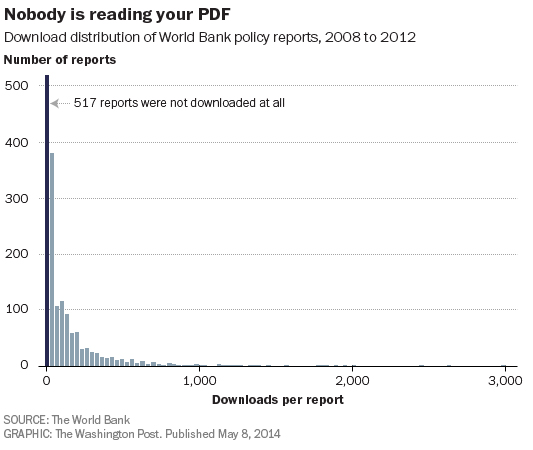
Click on Image to Enlarge

According to a recent report by the World Bank, that scenario is not so far-fetched. The bank is one of those high-minded organizations — Washington is full of them — that release hundreds, maybe thousands, of reports a year on policy issues big and small. Many of these reports are long and highly technical, and just about all of them get released to the world as a PDF report posted to the organization's Web site.

The World Bank recently decided to ask an important question: Is anyone actually reading these things? They dug into their Web site traffic data and came to the following conclusions: Nearly one-third of their PDF reports had never been downloaded, not even once. Another 40 percent of their reports had been downloaded fewer than 100 times. Only 13 percent had seen more than 250 downloads in their lifetimes. Since most World Bank reports have a stated objective of informing public debate or government policy, this seems like a pretty lousy track record.

Read full article.

Continue reading “Berto Jongman: Washington Post Discovers Deep Web — and the World Bank's Unindexed PDFs — PBI Technical Team Comments”

Berto Jongman: NSA Kills People Based on Metadata

Advanced Cyber/IO, Corruption, Government, IO Impotency, Military
Berto Jongman
Berto Jongman

We Kill People Based on Metadata’

David Cole

NY Review of Books, 10 May 2014

EXTRACT

Supporters of the National Security Agency inevitably defend its sweeping collection of phone and Internet records on the ground that it is only collecting so-called “metadata”—who you call, when you call, how long you talk. Since this does not include the actual content of the communications, the threat to privacy is said to be negligible. That argument is profoundly misleading. Of course knowing the content of a call can be crucial to establishing a particular threat. But metadata alone can provide an extremely detailed picture of a person’s most intimate associations and interests, and it’s actually much easier as a technological matter to search huge amounts of metadata than to listen to millions of phone calls. As NSA General Counsel Stewart Baker has said, “metadata absolutely tells you everything about somebody’s life. If you have enough metadata, you don’t really need content.” When I quoted Baker at a recent debate at Johns Hopkins University, my opponent, General Michael Hayden, former director of the NSA and the CIA, called Baker’s comment “absolutely correct,” and raised him one, asserting, “We kill people based on metadata.”

Read full article.

Berto Jongman: New Movement “Reset the Net” Fights NSA’s Mass Surveillance — Google and Twitter NOT Joining the Movement

Advanced Cyber/IO, Civil Society, Commerce, Ethics
Berto Jongman
Berto Jongman

New Movement Aims to ‘Reset the Net’ Against Mass Surveillance

A coalition of nearly two-dozen tech companies and civil liberties groups is launching a new fight against mass internet surveillance, hoping to battle the NSA in much the same way online campaigners pushed back on bad piracy legislation in 2012.

The new coalition, organized by Fight for the Future, is planning a Reset the Net day of action on June 5, the anniversary of the date the first Edward Snowden story broke detailing the government’s PRISM program, based on documents leaked by the former NSA contractor.

“Government spies have a weakness: they can hack anybody, but they can’t hack everybody,” the organizers behind the Reset the Net movement say in their video (above). “Folks like the NSA depend on collecting insecure data from tapped fiber. They depend on our mistakes, mistakes we can fix.”

Continue reading “Berto Jongman: New Movement “Reset the Net” Fights NSA's Mass Surveillance — Google and Twitter NOT Joining the Movement”

noble gold