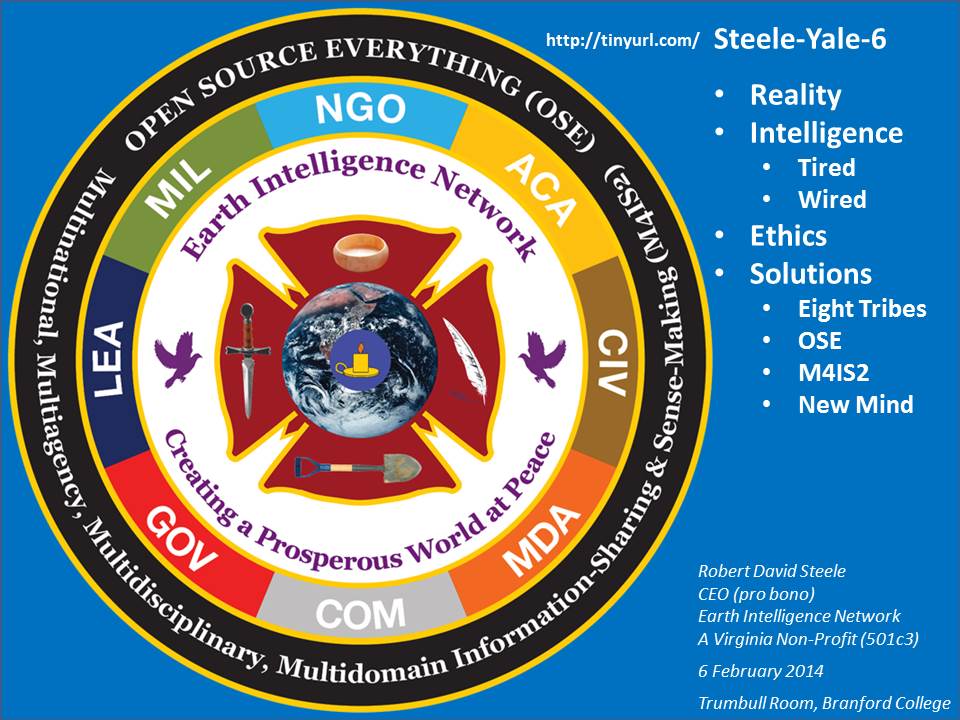
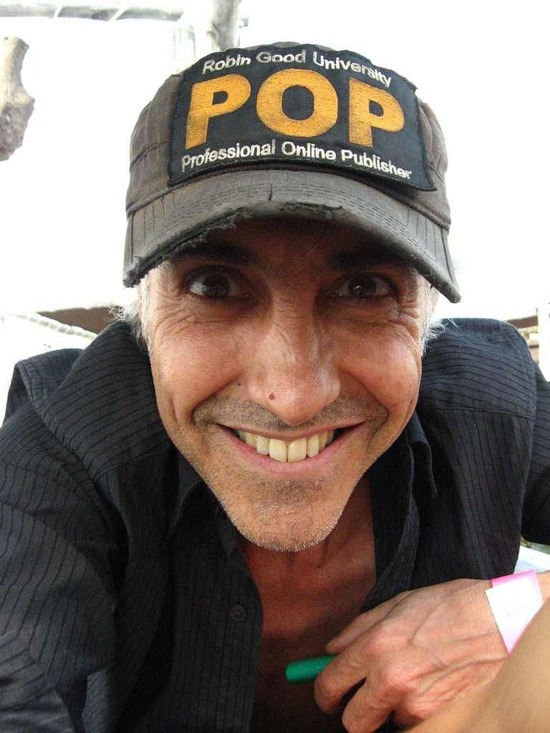
On Thursday 6 February 2014 from 1800-1930, Robert Steele will address a group of undergraduates convened by Yale Politic. The event is free, open to the public without RSVP required, and the media has been invited.
Yale University, Branford College
Trumbull Room
74 High Street
New Haven, CT 06511
AcademicTorrents is a new web service which allows any organization owning large datasets (no size limits) to easily distribute them without needing a dedicated infrastructure. The brainchild of Joseph Cohen and Henry Lo, two PhD students working at the University of Massachusetts in Boston, Academic Torrents facilitates the job of researchers, journalists and information analysts in finding, accessing, curating and downloading large-size datasets. Technically-speaking AcademicTorrents is a bittorrent-type redundant high-speed network and a full distributed system for sharing enormous datasets. As a P2P system it doesn't require intermediate servers, is also fully scalable, secure, fault-tolerant and can act as a reliable repository for data allowing fast downloads. Users can also search the full index, and can create curated datasets collections containing any kind of files and which can be downloaded as a full bundle. This type of system could prove to be an excellent resource for libraries storing digital papers as they would store books, and for simplifying the distribution requirements of any organization needing to publish, curate and share large datasets. “A robust distributed replication design allows libraries to utilize this system as their backbone. Providing fault tolerant hosting of curated data for a university, research lab, or home library. …Also, this system can be used as the foundation of a new open-access publishing system where libraries manage data instead of licenses for external data sources.”
As a graduate student at the Massachusetts Institute of Technology in 1996, Amit Sahai was fascinated by the strange notion of a “zero-knowledge” proof, a type of mathematical protocol for convincing someone that something is true without revealing any details of why it is true. As Sahai mulled over this counterintuitive concept, it led him to consider an even more daring notion: What if it were possible to mask the inner workings not just of a proof, but of a computer program, so that people could use the program without being able to figure out how it worked?'
The idea of “obfuscating” a program had been around for decades, but no one had ever developed a rigorous mathematical framework for the concept, let alone created an unassailable obfuscation scheme. Over the years, commercial software companies have engineered various techniques for garbling a computer program so that it will be harder to understand while still performing the same function. But hackers have defeated every attempt. At best, these commercial obfuscators offer a “speed bump,” said Sahai, now a computer science professor at the University of California, Los Angeles. “An attacker might need a few days to unlock the secrets hidden in your software, instead of a few minutes.”
A recent decision by a US Appeals court ended the regulation of the internet as we know it. The Federal Communications Commission (FCC) was deemed to have created a framework for ensuring the concept of “net neutrality” out-with the remit for the organisation it created itself. Now, a former FCC chairman has called for a “nuclear option” to reclassify Internet Service Providers (ISPs) as common carriers.
Click on Image to Enlarge
Doing so would force ISPs to be treated more like public utilities and subject them to FCC regulations over issues such as rate setting and universal service obligations. There has already been a lot of commentary and speculation about what the ruling means for the average user, and I don't want to add to the hyperbole all ready out there, but I think it is important to clarify a few things.
Net neutrality, or the end of it, has the potential to bring about the end of the internet as we know it. In a practical sense, it opens the doors for companies to manage the traffic across the network as they see most profitable, which means these companies can take measures that not only affect content creators, but end users. The ruling overturns the 20 years of treating the internet as a ‘dumb' network that processed packets of information without prioritising them.
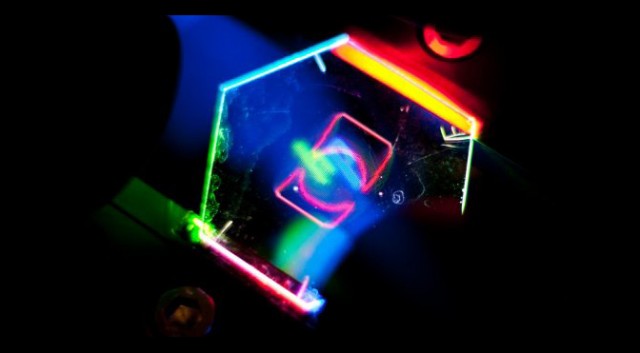
This new hydrogel concept uses a simple hydrogel that has been “impregnated” with silver nanoparticles. A specially developed treatment with a laser, just a single short burst upon manufacturing, aligns these silver particles in a three-dimensional hologram.
Click on Image to Enlarge
When the hydrogel comes into contact with certain trigger substances (like glucose, or insulin) it will physically deform relative to the concentration of the chemical. So, a higher blood glucose level results in a more deformed gel — which naturally adjusts the color of the hologram.
This allows the hologram to have analog output of information. That is, it can display not just a binary yes-no on healthy blood glucose, but can slowly darken to let the user know when they are approaching unsafe levels.
This tech combines quick response time with low cost and ease of use…
Kurzwell invented the first print-to-speech reading machine for the blind, flatbed image scanner, and music synthesizer capable of recreating orchestra instruments. His current projects include the Google Brain and finding a cure for aging. His personal goal is immortality by way of technology. He also predicted the Internet revolution; a computer would beat a human at chess, and the fall of the Soviet Union. One has to give him credit for his accuracy and he has even come up with a timeline for what will happen in the next forty years.
What can we expect? Kurzwell believe we will have self-driving cars, personal assistant search engines, be able to switch off our fat cells, click and print designer clothes at home, full-immersion virtual reality, 100 percent solar energy, and vertical meat and vegetable farms. There are some other ideas listed with Kurzwell’s timeline that supplement his predictions.