Stephen E. Arnold: The Dishonesty of Harvard (on Sugar)

Academia, Corruption
Stephen E. Arnold
Stephen E. Arnold

Above headline by Phi Beta Iota editors. Below is original headline.

Harvard: Does the University Sell What the Customer Wants?

Consider fat and sugar. The answer is my reaction to “Sugar Industry Secretly Paid for Favorable Harvard Research.” For the moment, let’s assume that this article is spot on.

The write up informed me:

As nutrition debates raged in the 1960s, prominent Harvard nutritionists published two reviews in a top medical journal downplaying the role of sugar in coronary heart disease. Newly unearthed documents reveal what they didn’t say: A sugar industry trade group initiated and paid for the studies, examined drafts, and laid out a clear objective to protect sugar’s reputation in the public eye.


Read full post.

Berto Jongman: FBI Pays $1.3M for a $100 Hack

Government, Ineptitude, IO Impotency, Law Enforcement
Berto Jongman
Berto Jongman

The FBI spent $1.3M to crack the iPhone — this hacker spent just $100

A security researcher has demonstrated that the passcode of an iPhone can be cracked using off-the-shelf components which cost just $100 — a tiny fraction of the $1.3 million the FBI paid a third party to do the same thing in the case of an iPhone 5C belonging to the San Bernardino shooter earlier this year. In a video posted on YouTube and an accompanying paper describing the technique, University of Cambridge associate researcher Sergei Skorobogatov showed how a four digit passcode could be revealed in less than two days using a technique known as Nand mirroring.

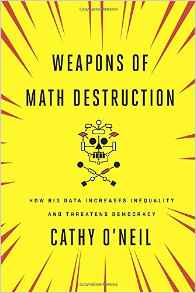
Worth a Look: Weapons of Math Destruction

IO Impotency, Worth A Look
Amazon Page
Amazon Page

In The Case for Algorithmic Equity, inspired by the book, Stephen E. Arnold writes:

Social activist Cathy O’Neil addresses the broad consequences to society in her book, Weapons of Math Destruction. Time covers her views in its article, “This Mathematician Says Big Data is Causing a ‘Silent Financial Crisis’.” O’Neil studied mathematics at Harvard, utilized quantitative trading at a hedge-fund, and introduced a targeted-advertising startup. It is fair to say she knows what she is talking about.

More and more businesses and organizations rely on algorithms to make decisions that have big impacts on people’s lives: choices about employment, financial matters, scholarship awards, and where to deploy police officers, for example. Yet, the processes are shrouded in secrecy, and lawmakers are nowhere close to being on top of the issue. There is currently no way to ensure these decisions are anything approaching fair. In fact, the algorithms can create a sort of feedback loop of disadvantage.

Click Here for Book, Click Here to Read Arnold's Full Post.

Del Spurlock: Many Trayvon’s More? Deja Vu from 2013…

Cultural Intelligence
Delbert J. Spurlock Jr.

Many Trayvon’s More?

Civics is study of how we govern ourselves. Can we agree that we govern ourselves through our Constitution, our laws, customs, popular culture, and habits, and how all of these things interact to create our way of life? Let’s call the analysis of that interaction connecting the dots. You were left with several dots to connect on preparation for discussing the killing of Trayvon. Have you thought about Mr. Looby’s idea of America and had an opportunity to view the “Story of Citizens United” and the “Truthout” article on “Stand your Ground” laws? Can you connect the dots to picture the American people, as opposed to the combined interests and power of major corporations, in control of our Country? Can you connect the dots to fit within the frame of governance cast by the Preamble to our Constitution?

Young Black Americans, especially, must not assign themselves to pessimism. They, among all young Americans must learn to connect the dots. Mr. Younge’s article on Mr. Obama’s response to surveillance of Americans tells the truth about Mr. Obama’s allegiances to the American Corporate Empire.

That allegiance makes him unwilling to look openly at the shame of our “drug wars,” to attack the immorality of our prison system, or to focus on the unconscionable un-employment of black youth. Some black leaders of American pop-culture think that being there is enough.

Read full post.

Phantom Phixer: Wall? What Wall?

Commerce, Government, Law Enforcement

Phantom PhixerHow Drug Cartels Operate Like Silicon Valley Startups

Tunnels, catapults, drones, and manned semi-submersiblesBreast implants, fake carrots, and puppies.

skyrunner-in-flightDrug cannon discovered in Sonora

SkyRunner flying ATV goes on sale

According to its designers, it can go 115 mph on the ground, where it gets 53 mpg, and 55 mph in the air with a range of 200 nautical miles. Its maximum altitude is 15,000 feet, but FAA rules restrict its operation to 10,000 feet. All that’s needed to operate it is a sport pilot’s license, which can be earned with just 12 hours of lessons. As with most paragliders, it doesn't require an airport and can take off and land from just about any open stretch of ground, including the beach.

Steven Aftergood: Sorting Out Snowden…

Cultural Intelligence, Ethics, Government
Steven Aftergood
Steven Aftergood

Sorting Through the Snowden Aftermath

Public discussion of the Edward Snowden case has mostly been a dialog of the deaf, with defenders and critics largely talking past each other at increasing volume. But the disagreements became sharper and more interesting over the past week.   . . . .   In an interesting response to Jack Goldsmith, Marcy Wheeler wrote that it is possible to comprehend — if not to reconcile — the sharply opposing views of the Snowden case if they are understood as a clash between professed American values (such as openness, privacy, and internet freedom) and American interests and actions (such as global surveillance and projection of military power). The former, “cosmopolitan” view presumes, however, that the favored values transcend, and can be sustained apart from, their national and institutional roots.

Continue reading “Steven Aftergood: Sorting Out Snowden…”

noble gold