SchwartzReport: All Dried Up – China Water Crisis

02 China, 12 Water

schwartzreport newAll Dried Up
The Economist (U.K.)

Water is destiny. And here, once again, is evidence of this. China's water and, thus, food problems hold tremendous implications for not just China but the world.

BEIJING — CHINA endures choking smog, mass destruction of habitats and food poisoned with heavy metals. But ask an environmentalist what is the country’s biggest problem, and the answer is always the same. ‘Water is the worst,” says Wang Tao, of the Carnegie-Tsinghua Centre in Beijing, ‘because of its scarcity, and because of its pollution.” ‘Water,” agrees Pan Jiahua, of the Chinese Academy of Social Sciences. ‘People can’t survive in a desert.” Wang Shucheng, a former water minister, once said: ‘To fight for every drop of water or die: that is the challenge facing China.”

He was not exaggerating. A stock image of China is a fisherman and his cormorant on a placid lake. The reality is different. The country uses 600 billion cubic metres (21,200 billion cubic feet) of water a year, or about 400 cubic metres a person-one-quarter of what the average American uses and less than half the international definition of water stress.


Continue reading “SchwartzReport: All Dried Up – China Water Crisis”

NATO ACT CFC: Water Security: Afghanistan Transboundary Water Resources in Regional Context

08 Wild Cards, 12 Water

logo cfcWater Security: Afghanistan Transboundary Water Resources in Regional Context

NATO Allied Command Operations (ACO) Civil-Military Fusion Centre (CFC)

Rainer Gonzalez Palau
Afghanistan Team Leader
Social and Strategic Infrastructure Desk Officer

This document outlines the global trends in water security and the threats to regional stability posed by the transboundary water resources. Moreover, the document presents salient details in the particular case of Afghanistan's transboundary water resources, reviews disputes over the four main international basins Afghanistan shares with its neighbouring countries, and introduces a framework to properly manage water resources. Further information on these issues is available at www.cimicweb.org. Hyperlinks to source material are highlighted in blue and underlined in the text.

Within the next twenty years, the global demand for water will exceed expected supply by forty per cent, according to a report by McKinsey & Company. Since “water security is the gossamer that links together the web of food, energy, climate, economic growth, and human security challenges,” a shortage of water will escalate food prices, disrupt energy availability, limit trade, increase refugee flows and undermine authority, says the World Economic Forum (WEF). If the worsening water security structural problem is unheeded, it will inevitably tear into various parts the global economic system. Illustratively, water was at the heart of the agricultural challenges that caused the unprecedented volatility in food prices between 2007 and 2010. As economies grow and societies develop more water is needed to match the accelerating demand for food and obtain energy to supply the rapidly increasing urban and industrial systems. At the same time rainfall and weather patterns shift and rivers and groundwater sources are becoming more polluted.

This report is divided into four sections: (i) global trends in water security issues and how these can affect global stability in the future; (ii) drivers of transboundary water management conflicts in Central and South Asia; (iii) overview of the four critical international basins that Afghanistan shares with neighbouring countries; and (iv) recommendations by experts for improving water management and avoiding conflict over transboundary water resources.

PDF (15 Pages):  201310_CFC_Afghanistan_Transboundary_Resources_final

Eagle: Are We Approaching Peak Retirement?

03 Economy, 11 Society, Corruption, Government, Idiocy, Ineptitude
300 Million Talons...
300 Million Talons…

Are We Approaching Peak Retirement?   (October 15, 2013)

If stocks, bonds and real estate all decline going forward, where are pension funds going to earn their 7+% annual yields?If we look at the foundations of retirement–Social Security, stocks, bonds and real estate–it seems we may have reached Peak Retirement. Let's start the discussion by noting that the primary Federal retirement programs–Social Security and Medicare–are “pay as you go,” meaning the checks sent out to beneficiaries this year are funded by payroll tax revenues collected this year from workers.

As Mish and I (as well as others) have tirelessly pointed out, the “trust funds” for these programs are phantoms of imagination. When these programs run deficits, the government raises the money to fund the deficit the same way it funds all its deficit spending–by selling Treasury bonds.

Click on Image to Enlarge

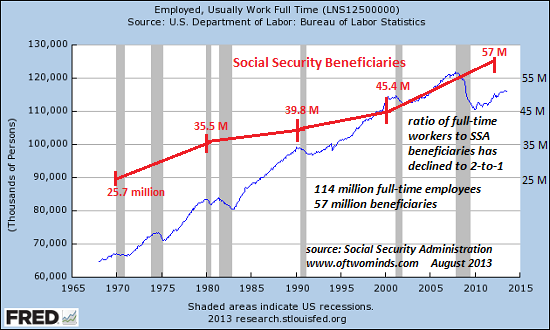
These programs were founded on a demographic illusion, i.e. that the number of retirees (beneficiaries) would magically remain a small percentage of the workforce paying payroll taxes. Alas, the number of beneficiaries is rising fast while the number of full-time workers is stagnating.

Full-time employment and the number of Social Security beneficiaries: the ratio of full-time workers to beneficiaries is already 2-to-1, and set to decline. Below 2-to-1, either payroll taxes will have to icnrease or benefits will have to be trimmed, or some of both.

Read more.

Jon Rappoport: The elite television anchor: mouthpiece for the Matrix

Corruption, Cultural Intelligence, Idiocy, Ineptitude, IO Deeds of War, IO Impotency, Media
Jon Rappoport
Jon Rappoport

The elite television anchor: mouthpiece for the Matrix

Most of America can’t imagine the evening news could look and sound any other way.

That’s how solid the long-term brainwashing is.

The elite anchors, from Douglas Edwards and John Daly, in the early days of television, all the way to Brian Williams and Scott Pelley, have set the style. They define the genre.

The elite anchor is not a person filled with passion or curiosity. Therefore, the audience doesn’t have to be passionate or filled with curiosity, either.

The anchor is not a demanding voice on the air; therefore, the audience doesn’t have to be demanding.

The anchor isn’t hell-bent on uncovering the truth. For this he substitutes a false dignity. Therefore, the audience can surrender its need to wrestle with the truth and replace that with a false dignity of its own.

The anchor takes propriety to an extreme: it’s unmannerly to look below the surface of things. Therefore, the audience adopts those manners.

Continue reading “Jon Rappoport: The elite television anchor: mouthpiece for the Matrix”

SmartPlanet: What a U.S. default means for the world

Commerce, Corruption, Government

smartplanet logoWhat a U.S. default means for the world

By | October 15, 2013

Click on Image to Enlarge

The United States is on the brink of defaulting on its sovereign debt for the first time since the gold standard ended. The “full faith and credit” of the United States hangs in the balance as the Republican tea party caucus is recalcitrant against raising the debt ceiling, which limits how many bonds that the Treasury can issue.

Nothing less than a global economic crisis and the status of the United States as a world power are at risk if T-bills are downgraded from their coveted AAA status. We’ve already written about how catastrophic a default would be for the U.S.; here are some of the consequences of a default for the global business environment courtesy of experts that we spoke with today.

A U.S. economic collapse & fall of the dollar as a reserve currency?

Continue reading “SmartPlanet: What a U.S. default means for the world”

4th Media: What Will Happen to the Global Economy If BRICS Announce Launch of New Currency – BRISCO?

Commerce, Commercial Intelligence, Cultural Intelligence, Government

4th media croppedWhat Will Happen to the Global Economy If BRICS Announce Launch of New Currency – BRISCO?

Peter Koenig, a former World Bank economist and a Voice of Russia regular, outlines one of the scenarios in which America’s plans for a New World Order are broken.

Part I

For several decades, we’ve been told by the mainstream media that the West has a firm grip on the word’s economy and that America decides the future of the world. Peter Koenig, former World Bank economist and Voice of Russia regular, outlines one of the scenarios in which America’s plans for a New World Order are broken. This is the first part of the series about “How to dismate the New World Order”.

Imagine – it is December 31, 2013. The Presidents of the BRICS (Brazil, Russia, India, China and South Africa) plus Iran and Venezuela call an impromptu press conference – in Paris – to present a ‘Sea of Change in Economics,’ as they call it. The announcement was circulated throughout the international media and diplomatic offices and embassies just a day before – an indication of urgency. Despite it being the last day of the year with most people thinking of their year-end festivities, the event calls the attention of many – especially the world of finance – and of course the media. The press meeting is planned for 18:00 at theDolce Chantilly, in Chantilly, just 40 minutes from the center of Paris.

The seven presidents, accompanied by their Ministers of Finance, are seated in a half-moon panel in front of about 500 journalists from all over the world. The Chinese President and General Secretary of the Communist Party, Mr. Xi Jinping, opens the conference without fanfare, introducing the subject as an event that may have worldwide repercussions. He elaborates,

Continue reading “4th Media: What Will Happen to the Global Economy If BRICS Announce Launch of New Currency – BRISCO?”

noble gold