The temperature in Phoenix, Arizona hit 119 degrees (F) on the 29th of June, a new record for the date. The heat was so intense, it led to the cancellation of 18 regional flights at the airport (the aircraft used for those routes were restricted to temperatures no higher than 118 degrees).
The extreme heat is also playing havoc with the electrical grid in the US southwest, much earlier than the late August squeeze that is routine. With everyone in the region running their air conditioners at full clip to avoid cooking (more tex-mex sous-vide in airtight homes than outdoor barbecue), there’s barely enough power available to meet demand. And at peak loads, the electrical grid is much more likely to fail.
These are killer temperatures. And if the grid fails right now, it’s not just an inconvenience.
It quickly becomes a matter of life or death.
If you and your community are relatively unprepared, the only way to meet the challenge of a blackout during extreme heat is to band together as a community. Community action during times like this can dramatically reduce the death toll.
However, community action after a crisis hits isn’t the best approach.
The real resilient solution is to produce more locally.
In this case, the ability to produce energy locally and to use it effectively is the key to long term resilience. It can transform a killer blackout into a relatively minor event.
But, resilience like this requires investments at the household and community level, by people like you and me.
For example, if most of the homes in a community produced solar energy, electricity would be not only be available when needed, the production would be peaking at the very same moment the need for it was the most intense. Further, homes with battery backups and natural gas generators would be able to continue to provide energy around the clock and, if the community was connected by a microgrid, a blackout could be completely avoided.
The only way this type of resilience gets built is if you and I build it, before disaster strikes.
So, let’s get going, before we are all cooked together.
Free information will be our doom, Quartz‘s Jaron Lanier asserts in, “Free Information, as Great as it Sounds, Will Enslave Us All.” From high-frequency trading to online marketing, insists Lanier, big data is being used by those with the resources to collect and manipulate it to enrich themselves. Meanwhile, those of us with just paltry, personal devices are the ones creating the information, creating the value that fuels such systems. It is an argument that has been advanced before, and Lanier pursues the thread:
“Something seems terribly askew about how technology is benefiting the world lately. How could it be that so far the network age seems to be a time of endless austerity, jobless recoveries, loss of social mobility, and intense wealth concentration in markets that are anemic overall? How could it be that ever since the incredible efficiencies of digital networking have finally reached vast numbers of people that we aren’t seeing a broad benefit? . . .
“While people are created equal, computers are not. When people share information freely, those who own the best computers benefit in extreme ways that are denied to everyone else. Those with the best computers can simply calculate wealth and power away from ordinary people.”
See the article for its supporting arguments. Lanier does not leave us hanging for a potential solution. He recalls a suggestion he credits to Ted Nelson, which the IT pioneer made back in 1960: embed a “universal micropayment system” into any digital communication network, so that each individual who contributes any bit of data would get a bit of compensation in return. In that reality, for any tweet each of us sent, search query we made, or even security-camera image of us that was later used by any organization (for whatever purpose), we might become a few cents richer.
Interesting idea; can it gain any traction before the current system is set in stone?
I spotted a blog post called “Could Palantir Technologies Be Raising Additional Funding?” I have no clue who or what is behind this interesting item. The main idea is that Palantir, a high profile company which has been in the news about litigation and other matters, has been funded already. According to Crunchbase, the company has more than $300 million in funding. For the sake of comparison, Attivio and Coveo — both in the content processing space — have been able to drum up about $30 million in funding. Most of the companies in the search and content processing space — Digital Reasoning, for instance — have garnered a fraction of what long time players Attivio and Coveo have been able to gather. At the time of its sale to Oracle, Endeca — another content processing and intelligence vendors — was generating an estimated $150 million in revenues. At the time of its sale to Hewlett Packard, Autonomy was nosing into the $800 million range. But the key figure for Autonomy is that it sold to the prescient managers at HP for more than $10 billion.
Let’s assume that Palantir has received funding in the $300 million range. Let’s assume that the company is not raising any additional funding. Let’s assume that the company, founded in 2004, is going to pay back its investors, operate at a profit, and fund necessary research to keep the content processing system in step with competitors like Cybertap, among others.
So what does the gargantuan funding suggest to me, this fine, humid Sunday morning in rural Kentucky?
I know of three ways to get from today to a prosperous world at peace, a world that works for all — all three merit consideration as a whole.
Click on Image to Enlarge
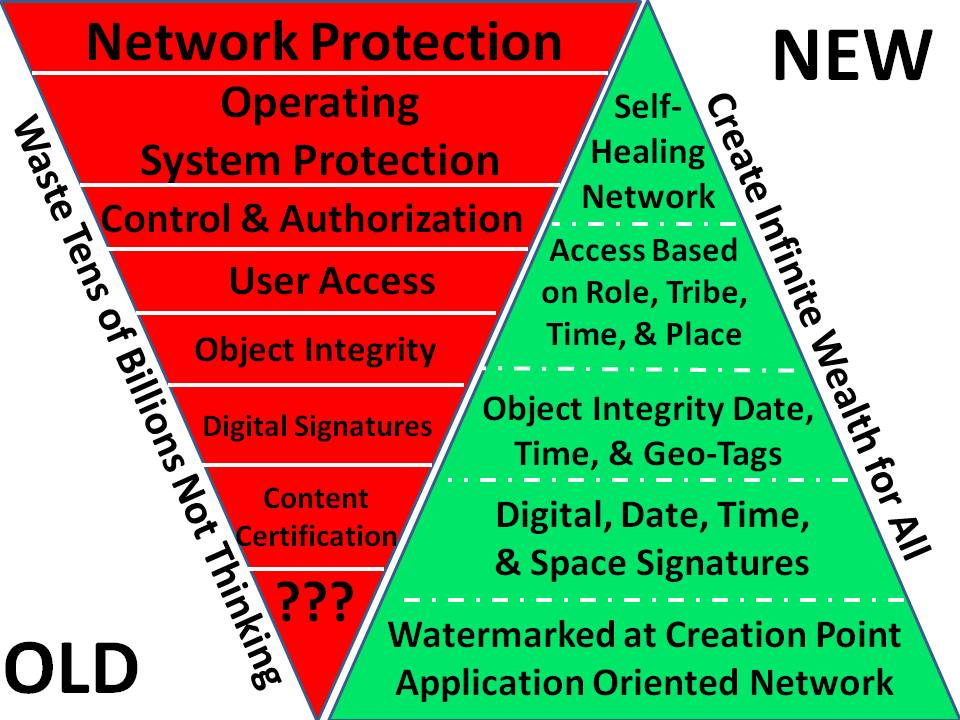
01. Open Source Everything (OSE). This is the technical solution. The US Government is ignorant and arrogant in part because the cult of secrecy and the ineptitude of chief technical officers, combined with the corruption of political figures that have no interest in knowing anything useful (they attend to those that pay to be heard), have resulted in Washington operating on less than 2% of the relevant information [a typical Country Team collects 20% at most and spills 80% of that in how it handles it] and in the case of the secret world, producing “at best” 4% of what the President or a major commander needs. The future of governance is to be found in bottom-up information sharing and sense-making across all boundaries. Only OSE is affordable, inter-operable, and scalable. This is where the BRICS, the EU, and NATO should be focusing as they create 21st Century Alternative C2 (collaboration and consensus have replaced command and control) — one must give up unilateral command and control in order to gain multilateral command and control.
Click on Image to Enlarge
Robert Garigue (RIP) understood what none of the US cyber-chiefs understand: in a decentralized technical environment, human trust is the measure of merit, and security must be embedded such that it is NOT reliant on centralized points that are often asleep, ignorant, arrogant, under-funded, and generally useless. As Col Dr. Max Manwaring and his various contributing authors point out in The Search for Security: A U.S. Grand Strategy for the Twenty-First Century (Praeger, 2003), the primary foundation for both prosperity and peace is LEGITIMACY. A Nobel prize was awarded to the economist that demonstrated that trust lowers the cost of doing business. In brief, proprietary and predatory forms of capitalism have become one. The time has come to create Open Source Ecologies (a fine model is provided by Open Source Ecology, creating a toolkit for civilization), starting with an Autonomous Internet and Liberation Technologies that enable the five billion poor to create infinite wealth. If freedom is our objective, rather than fraud, it demands open source everything. My long-standing vision for an Open Source Agency (OSA) has morphed toward the nurturing of all of the opens as I have discovered that no one open alone will do — they form an unbeatable force for good when combined.
Rachel Naomi Remen offers a story about how wholeness became embedded in the world, waiting for us to call it forth. I explore different dynamics of wholeness and how it relates to being agents of healing and transformation – including the power of disturbance to evoke grace.
Rachel Naomi Remen offers a story about how wholeness became embedded in the world, waiting for us to call it forth. I explore different dynamics of wholeness and how it relates to being agents of healing and transformation – including the power of disturbance to evoke grace.
Healing is about restoring former wholeness. Health is about maintaining existing wholeness. Transformation and evolution are about generating or evoking new forms of wholeness from – as Rachel Naomi Remen puts it in the piece below – “the seed of a greater wholeness, a dream of possibility”.
To a certain extent new forms of wholeness can be created, as in art, innovative technologies, or the unique synergies and dynamic tensions of a groundbreaking work of architecture or engineering. Yet some of the most remarkable forms of wholeness are organic and self-organized, from new ecosystems and babies’ personalities to spontaneous realizations and cultural shifts. Although this kind of wholeness can’t be created in a linear sense and normally simply happens by itself, it can also be catalyzed, evoked, or nurtured by invitation, inspiration, opportunity, and – as Rachel Naomi Remen puts it – by “our listening, our belief, our encouragement and our love.”
“Emergent processes” like Open Space and World Cafe are, in essence, ways to enhance a group’s capacity for generating novel but self-organized wholeness from among its members. I like to think of these processes as thoughtfully designed channels for the Tao, the Way of Nature, whose power is not in what it does but in what it allows, evokes, and facilitates.