From the original article by Justin Reich and Beth Holland on MindShift: “What would a math class look like where students learn to compute, prove, derive, and intuit, as well as to discern and appreciate mathematical beauty?
What about a history class where students maintained a portfolio of beautiful artifacts and ideas from multiple periods?
How might efforts to curate benefit from the portability and ubiquity of mobile devices?
What would a “relevance portfolio” look like, where students catalog their daily encounters with ideas or experiences? What other kinds of portfolios could students create over the course of their academic career?”
If you are curious to get a glimpse at how tablets and their apps can be utilized to leverage curation for your classroom learning objectives, then this is definitely a good read.
You get a good introduction with some interesting historical facts about curation and about what it could be done with it in the real of education, and then you are provided with a good number of examples and tools that you can start to use right away.
I have watched with a mixture of awe and sadness as the Chinese have so successfully kicked our President in the balls over cyber-war, and started an astonishingly active national conversation over whether or not the active measures taken by the US Government against its own citizens are lawful, necessary, or even affordable.
I have taken several oaths over the past 36 years of service — all to defend the Constitution of the United States of America against all enemies, domestic and foreign — and I have to confess that it was not until I spent 20 years wandering in the wilderness — the longest “walk-about” ever taken by any serving intelligence officer in US history that I know of — that I have really appreciated how few in government service reflect on or honor their oath on a day to day basis, and how few of our citizens are intelligently engaged with the non-transferable responsibility of being citizens.
The Constitution is “root.” Anyone that forgets that — or worse yet, demeans it as Henry Kissinger, Michael Bloomberg, Colin Powell, Mike Hayden, Jim Clapper, and Keith Alexander have all been so quick to demean it — is part of the problem. I balance my sense that we need a ruthless counterintelligence service with a recognition that at this juncture, “truth and reconciliation” is the only path that might allow us to move past the old paradigm of money as the controlling authority, never mind that it is illicit money rooted in crimes against the public legalized by a corrupt Congress.
Barack Obama is our President. Get over it, those of you that have so many reasons for questioning everything about his presidency. It is what it is. The question we have to ask ourselves is this: what now? What can we do to save Obama, save the US Government, and save the Republic from three more years of domestic poverty and foreign war?
Mr. President, if I were a professional con artist paid to give you the pros and cons on engaging in a war in Syria, here's what they would be:
As you know, former president Clinton, probably understood by many to also be speaking on behalf of his wife, has called you a wuss. Virtually nobody remembers or cares that you said “I want to end the mindset that got us into war in the first place.” The majority of Americans, exercising that mindset, want you to get us into a new war in the first place if the alternative is having a wuss in the White House. I don't have a poll on that, but trust me.
This is not contradicted by public opposition to U.S. engagement in the war in Syria (as seen in the polls). If U.S. casualties are minimized and if the financial cost can come out of the base DOD budget — at least at first — then the political cost is negligible while the political gain is enormous. Unless you drag this out. The military budget is being increased right now, and in violation of the sequester, and nobody gives a rat's ass. They think it means jobs and non-wussiness. Unless you drag it out.
George thought you might be interested in the op-ed below published today by Guinean President Alpha Condé. President Condé writes about the struggle to reform business practices in Guinea’s mining sector so all the people of Guinea can benefit from the country’s immense mineral wealth. The op-ed comes in the context of Conde’s participation in this year’s G8 meeting, which is focusing on trade, taxes, and transparency. OSF has been in the forefront of promoting transparency particularly in the governance of natural resources. President Condé is emerging as a champion of these values in Africa. His op-ed is an elegant statement of why the issue is so vital to the continent’s development.
We need G8 support for transparency and good global business governance so that our assets can be used to benefit everyone rather than just a few greedy mining companies and politicians.
In December 2010, I was elected president of Guinea in its first truly open and democratic elections. I said then that I had inherited a country, not a state. Our economy was in ruins, our people among the poorest on the planet and our political system weakened by decades of corruption, dictatorship and misrule.
It needn't be so. Guinea has vast mineral wealth, the world's largest reserves of bauxite and some of the highest grade iron ore deposits.
Making these assets work for all our people rather than a few unscrupulous international mining companies and politicians means confronting the deeply ingrained corruption in our politics and business. But uprooting such corruption can be painfully slow, and is often dangerous. After all, vested interests do not welcome challenge.
If your daily routine took you from one homegrown organic garden to another, bypassing vast fields choked with pesticides, you might feel pretty good about the current state of agriculture. If your daily routine takes you from one noncommercial progressive website to another, you might feel pretty good about the current state of the Internet. But while mass media have supplied endless raptures about a digital revolution, corporate power has seized the Internet—and the anti-democratic grip is tightening every day.
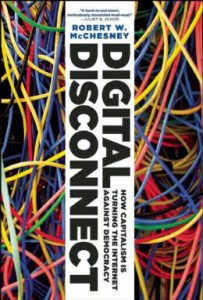
“Most assessments of the Internet fail to ground it in political economy; they fail to understand the importance of capitalism in shaping and, for lack of a better term, domesticating the Internet,” says Robert W. McChesney in his illuminating new book, Digital Disconnect.
Amazon Page
Plenty of commentators loudly celebrate the Internet. Some are vocal skeptics. “Both camps, with a few exceptions, have a single, deep, and often fatal flaw that severely compromises the value of their work,” McChesney writes. “That flaw, simply put, is ignorance about really existing capitalism and an underappreciation of how capitalism dominates social life. . . . Both camps miss the way capitalism defines our times and sets the terms for understanding not only the Internet, but most everything else of a social nature, including politics, in our society.”
And he adds: “The profit motive, commercialism, public relations, marketing, and advertising — all defining features of contemporary corporate capitalism — are foundational to any assessment of how the Internet has developed and is likely to develop.”
Concerns about the online world often fixate on cutting-edge digital tech. But, as McChesney points out, “the criticism of out-of-control technology is in large part a critique of out-of-control commercialism. The loneliness, alienation, and unhappiness sometimes ascribed to the Internet are also associated with a marketplace gone wild.”
Discourse about the Internet often proceeds as if digital technology has some kind of mind or will of its own. It does not.
For the most part, what has gone terribly wrong in digital realms is not about the technology. I often think of what Herbert Marcuse wrote in his 1964 book One-Dimensional Man: “The traditional notion of the ‘neutrality’ of technology can no longer be maintained. Technology as such cannot be isolated from the use to which it is put; the technological society is a system of domination which operates already in the concept and construction of techniques.”
I have been asked by my superiors to give a brief demonstration of the surprising effectiveness of even the simplest techniques of the new-fangled Social Networke Analysis in the pursuit of those who would seek to undermine the liberty enjoyed by His Majesty’s subjects. This is in connection with the discussion of the role of “metadata” in certain recent events and the assurances of various respectable parties that the government was merely “sifting through this so-called metadata” and that the “information acquired does not include the content of any communications”. I will show how we can use this “metadata” to find key persons involved in terrorist groups operating within the Colonies at the present time. I shall also endeavour to show how these methods work in what might be called a relational manner.