UPDATED 1 Mar 2013 to add Comment from Paul Harper at Google+.
The US Government is incredibly stupid about counterintelligence. They learned nothing from the Falcon and the Snowman, and it is clear that the defense team for Bradley Manning will be able to bracket the charges with a) government misconduct as revealed in the cables merited disclosure; b) government ineptitude at failing to protect sensitive communications from easy internal theft; and c) more government misconduct in violation of the Constitution with cruel and unusual punishment.
The Army private charged in the biggest leak of classified material in U.S. history pleaded guilty to 10 charges Thursday and offered an impassioned defense of his actions, arguing that he sought to spark a national debate about what he described as the nation’s obsession with “killing and capturing people.”
The testimony marked Pfc. Bradley Manning’s first detailed account of his disclosure of a trove of U.S. diplomatic cables and military documents in 2010 to WikiLeaks, an anti-secrecy organization he said he approached after he was unable to entice The Washington Post and the New York Times.
Complex Society in Radical Middle (December 2012), Bojan Radej*, Mojca Golobič**, Mirna Macur***. University of Ljubljana, Biotechnical Faculty, Department for Landscape Planning, 240 pp.
EXTRACT
Society is complex because it is composed of irreconcilable constituents. As a consequence, every important social issue is evaluated conflictingly as being both horizontally incommensurable (among interest groups) and vertically incommensurable (micro – macro). Social incommensurability (Munda) as a category concerns incompatible but legitimate social claims. When different principles of social primacy are applied, no objective basis exists for rational choice between alternatives (Wacquant). This raises concern for the possibility of holistic evaluation of complex social matters. Because of an aggregation problem (Scriven; Virtanen Uusikylä) our ability to reach wide social consensus on the content and process of social transformation is critically undermined. Hence it appears that increased complexity leads to the disintegration of contemporary societies.
Click on Image to Enlarge
We are of the opposite opinion! By definition, holistic evaluation of incommensurable social issue is not achievable in a direct way. An indirect approach is needed – such as in a mesoscopic perspective. Its core theoretical background derives from mathematics (Pythagorean Hipassus) and philosophy of science (Kuhn) because of their elaboration of incommensurability concept, complexity theory with the concept of meso (Prigogine, Wallerstein, Leontief, Dopfer, Easterling, Kok, and Rotmans), and theory of social integration (Giddens, Bourdieu and Wallerstein) in sociology.
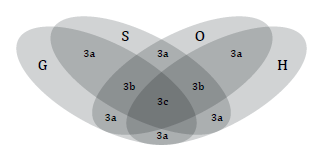
The major characteristic of meso evaluation is its capacity for addressing incommensurable oppositions in intersectional way. “Intersectional” means through overlaps between oppositions which take place only in non-essential instances that are only marginally important to the corresponding agents who pursue incommensurable claims. For example, social-economy is an overlap between conventional economic and social policies as two incommensurable components of sustainable welfare.
. . . . . . . . . .
Complex society in the meso
The five methodological studies have been accomplished with the aim to illustrate difficulties in holistic evaluation of complex social matters. The main findings: it appears that trend of social disintegration is not a result of increasing social complexity but only of oversimplified approaches (micro or macro) to evaluation of socially complex concerns. For eliminating oversimplification, a meso frame is proposed. In meso frame, social totality does not emerge from commensurable elementary parts piled up together but from partial and incommensurable wholes, which remain separated and as such cannot directly coalesce toward ever higher unity. Instead, these partial wholes sometimes compete and sometimes cooperate for more holistic characterization of social good and for more integral strategies for achieving it. Hence, social totality can be emphasised only indirectly, preliminarily, in an open way and educationally.
Bank failures: Towards an « Icelandation » of the banking crisis’ management
In the face of this shock, our team estimates that most countries, including the United States, will approach management of the crisis in an “Icelandic style”, i.e. not to bail out the banks and to let them collapse (16). We have already had a glimpse with the liquidation of the Irish bank IBRC which has given many people ideas: “How Ireland liquidated its banking albatross in one night” headlined La Tribune (17) admiringly. This possibility seems to increasingly be the solution in the event of the banks backsliding, for the following reasons: first, it seems much more effective than the 2008-2009 bailout plans judging by Iceland’s recovery; second, countries don’t really have the means to pay for new bailouts anymore; finally, one can’t deny that it must be a big temptation for leaders to get rid in a popular fashion of part of the debts and “toxic assets” which encumber their economy.
A German by birth, he was imprisoned in Nazi camps during World War II
At the camps he was waterboarded during torture sessions
Time for Outrage became an inspiration for Occupy Wall Street movement
Jill Reilly
MailOnline, 27 February 2013
Stephane Hessel
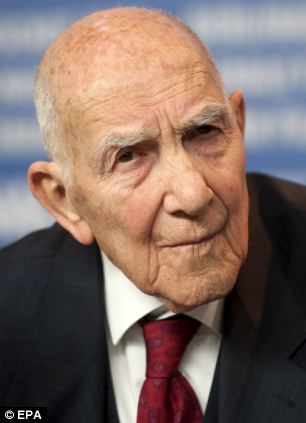
Stephane Hessel, the concentration camp survivor who inspired the Occupy Wall Street movement has died aged 95.
Mr Hessel who was a member of the French resistance passed away overnight in Paris according to his wife.
As a spy for the French Resistance, he survived the Nazi death camp at Buchenwald by assuming the identity of a French prisoner who was already dead.
As a diplomat, he helped write the U.N.'s Universal Declaration of Human Rights.
And at age 93, after a distinguished but relatively anonymous life, he published a slim pamphlet that even he expected would be little more than a vanity project.
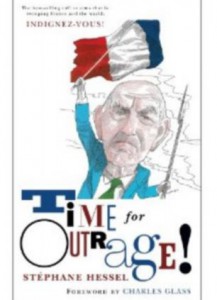
But Mr Hessel's 32-page Time for Outrage sold millions of copies across Europe, tapping into a vein of popular discontent with capitalism and transforming him into an intellectual superstar within weeks.
Translated into English, the pocket-sized book became a source of inspiration for the Occupy Wall Street movement.
In the book, Mr Hessel urges young people to take inspiration from the anti-Nazi resistance to which he once belonged and rally against what he saw as the newest evil: The love of money.
This controversial, impassioned call-to-arms for a return to the ideals that fueled the French Resistance has sold millions of copies worldwide since its publication in France in October 2010. Rejecting the dictatorship of world financial markets and defending the social values of modern democracy, 93-old Stéphane Hessel — Resistance leader, concentration camp survivor, and former UN speechwriter — reminds us that life and liberty must still be fought for, and urges us to reclaim those essential rights we have permitted our governments to erode since the end of World War II.
“This slim but powerful volume answered the public's need for a voice to articulate popular resentment of ruling-class ruthlessness, police brutality, stark income disparities, banking and political corruption, and victimization of the poor and immigrants.” (The Nation )
“INDIGNEZ-VOUS! is creating the sort of stir in France Emile Zola did in 1898, when he published J'Accuse!” (The National Post )
“Like a song you hum or a film you recommend to friends, INDIGNEZ-VOUS! crystallises the spirit of the time. To buy it is a militant act, a gesture towards community and participation in a collective emotion.” (Liberation )
‘The book urges the French, and everyone else, to recapture the wartime spirit of resistance to the Nazis by rejecting the “insolent, selfish” power of money and markets and by defending the social “values of modern democracy”. (The Independent )
Also See:
Indignez Vous!/Time for Outrage! translations (FREE) – Version 1 | Version 2 (pdf)
This is a picture of all of the electricity a family will need for the next twenty years:
Click on Image to Enlarge
Doesn't seem like much, does it?
It gets even better.
If every family in a community had an installation like this, the community would be close to never experiencing a blackout again.
On top of that, the community would be exporting energy. Wealth would be flowing into the community and not out of it.
Amazing, isn't it.
So, why doesn't everyone have an installation like this?
Until recently, even with government subsidies, it didn't make economic or technological sense except in extreme situations.
That's changed. DIY solar energy is now ready for prime time (I'm currently working on a Solar Energy report that blows the lid off of this — stay tuned).
Despite that, many people still don't have the upfront money needed to make it happen.
Here's an innovative way to solve that problem: Community Financing.